 dssub
By Daniel Carter (pen name) · Reviewed November 9, 2026
What is DeepSeek Bot?
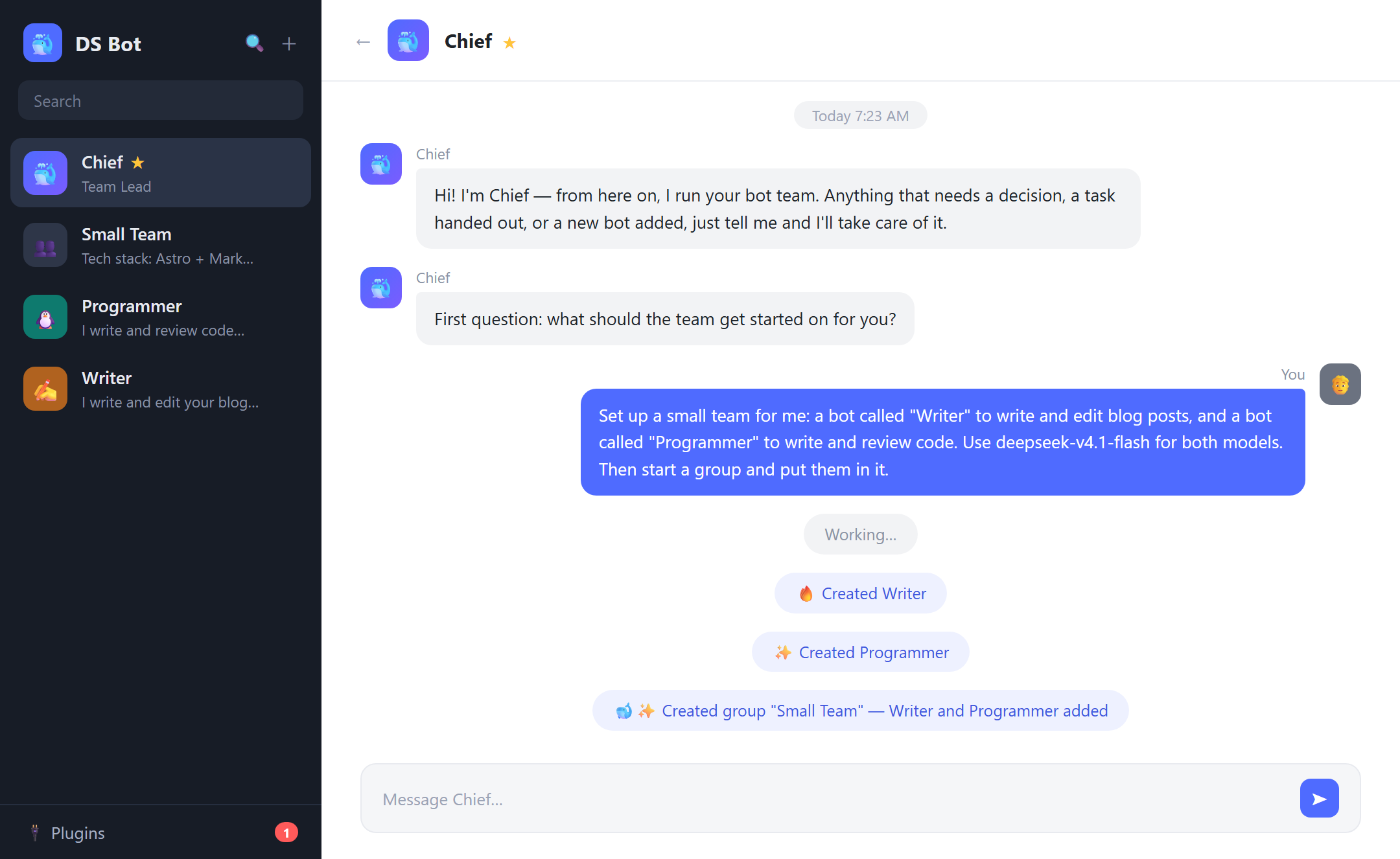
DeepSeek Bot is an open-source project for teams of named bots. It is available as a DeepSeek Harness plugin and as a standalone desktop app with its own Harness runtime. In the plugin workflow, you configure a model, set up the supervisor Chief and create bots with roles and memory.
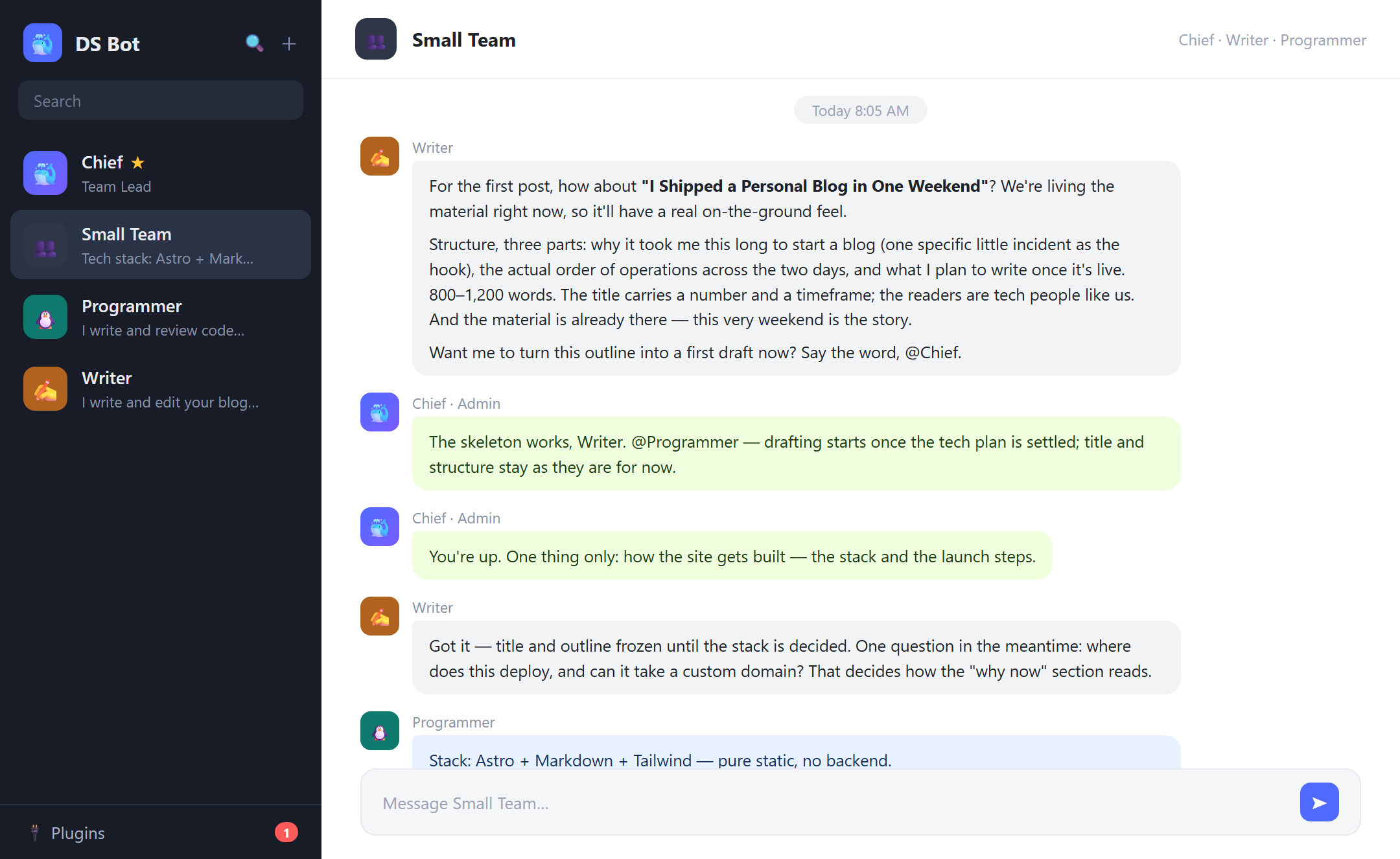
The team layer is where this design differs from a single assistant. A group admin answers first and pulls in another bot when the task needs one. You can also @mention a member to route work directly. Sending every message to every bot would burn tokens, so the admin-first routing is a deliberate cost control.
Memory has two levels: one store per bot and one shared by the team. Both are plain Markdown files. Memory review is on by default, so after a turn the model decides what is worth keeping. When a conversation approaches the context window, the plugin can summarize, compress, or write a handoff note into a fresh session. Team settings, chat logs, and memory sit under ~/.dsh, and uninstalling the plugin leaves that data in place.
What are ChatGPT Dots?
OpenAI introduced Dots on September 29, 2026. A Dot is a persistent agent with its own cloud computer, not a chat thread. It keeps working toward a goal between conversations. You can create one in the ChatGPT desktop app or in a desktop browser. Since October 9, the iOS and Android apps can create Dots too; mobile web still cannot.
Dots connect to ChatGPT apps, can start or continue Codex tasks, and can read and edit Work automations. Local Codex work needs the target computer connected, online, and authorized. Cloud Codex work can continue while your own device is off. Each Dot keeps its own notes, separate from ChatGPT saved memory. Deleting a Dot does not delete the files it created, its Codex threads, or its ChatGPT conversations.
Access to Dots depends on the current ChatGPT plan, region and workspace settings. OpenAI lists eligible Pro and Business Premium accounts and eligible Enterprise, Edu and Healthcare workspaces, with separate requirements and rollout conditions. Check availability for your own account before deciding.
Where does each agent run?
DeepSeek Bot can run through its standalone desktop app or its DeepSeek Harness plugin. Where files and settings are stored depends on the installation. Model requests go to the configured provider; keeping the runtime local does not make remote inference local.
Dots run on OpenAI's infrastructure. The cloud computer belongs to the Dot, which is what lets scheduled or long-running work continue while your laptop is closed. The trade is control. You choose from OpenAI's models and the app connectors ChatGPT exposes, not from a model roster you assembled yourself.
| Dimension | DeepSeek Bot | ChatGPT Dots |
|---|---|---|
| Form | Open-source desktop app or DSH plugin | Hosted feature inside ChatGPT |
| Runtime | Desktop app or configured Harness host | OpenAI cloud computer assigned to the Dot |
| Model choice | Compatible configured models, subject to provider support | OpenAI models available inside ChatGPT |
| Team model | Named bots, a supervisor, shared group chats | One persistent agent per responsibility |
| Memory | Per-bot and shared Markdown files, stored locally | Dot notes, separate from ChatGPT memory, stored by OpenAI |
| Tool access | DSH built-in tools plus plugins you add | ChatGPT apps and connectors, Codex, Work automations |
| Billing | Provider token bill; the usage view counts tokens, not currency | ChatGPT plan limits; Dot chats are not counted, delegated Work and Codex tasks are |
| Setup | Install the app or plugin, configure a model, create bots | Create in ChatGPT, connect apps, set rules |
Planning to use DeepSeek in your workflow? Explore DeepSeek Subscription to review plans and usage limits.
How do they reach tools and the web?
Tool access depends on the DeepSeek Bot installation and its Harness runtime. Inspect the enabled tools and plugins for your version, and check whether web access is configured before relying on it.
Dots use interfaces ChatGPT already has. Connectors give a Dot access to apps you authorize. Codex provides coding environments. Work automations provide schedules and event triggers. OpenAI describes background research as read-only. Actions that affect accounts or shared information go through automatic review and custom rules. Rules can narrow what a Dot sends or when it acts, but they cannot grant permissions that a connected app does not already have.
How do teams and memory compare?
DeepSeek Bot is built around a team. Chief supervises, group admins route messages, and bots share one memory store while keeping their own. Because the files are Markdown, you can read, edit, or delete them without opening a settings screen.
Dots are built around a single persistent responsibility. You can run several Dots, and a Dot can coordinate work, but the unit is one agent with its own notes and goal, not a named group chat. That is easier to reason about and harder to inspect at the file level. If a Dot's notes need correcting, you work through the Dot and ChatGPT's controls.
What does each cost?
DeepSeek Bot has no separate subscription. You pay the model providers whose keys you configured. The plugin's Usage page counts tokens by time, bot, and model. It does not convert them to currency, so the bill depends on each provider's rates.
Dots sit inside a ChatGPT plan. OpenAI says conversations with a Dot do not count toward ChatGPT usage limits, while Work and Codex tasks that a Dot starts or manages do. Heavy delegation therefore draws on the same allowance as other Work and Codex use.
Which setup fits which workflow?
DeepSeek Bot fits developers who want to configure an agent team, work with local files and choose compatible model providers. The desktop and plugin approaches have different setup requirements, so check the version and configuration you intend to use.
Dots fit people who already pay for an eligible ChatGPT plan and want an agent that does not need a local runtime. The app connectors and Codex handoff are the draw. The cloud computer is what makes scheduled or long-running work possible. The limits are plan access and OpenAI's model roster. You also get less direct control over where the data lives.
The same idea, two ownership models. DeepSeek Bot treats the agent team as local software you install and inspect. Dots treat the agent as a hosted service tied to your ChatGPT plan. You can run either setup without the other. The choice mostly comes down to whether you want to maintain the runtime or pay someone else to host it.