 dssub
By Daniel Carter (pen name) · Reviewed November 9, 2026
What does each project control?
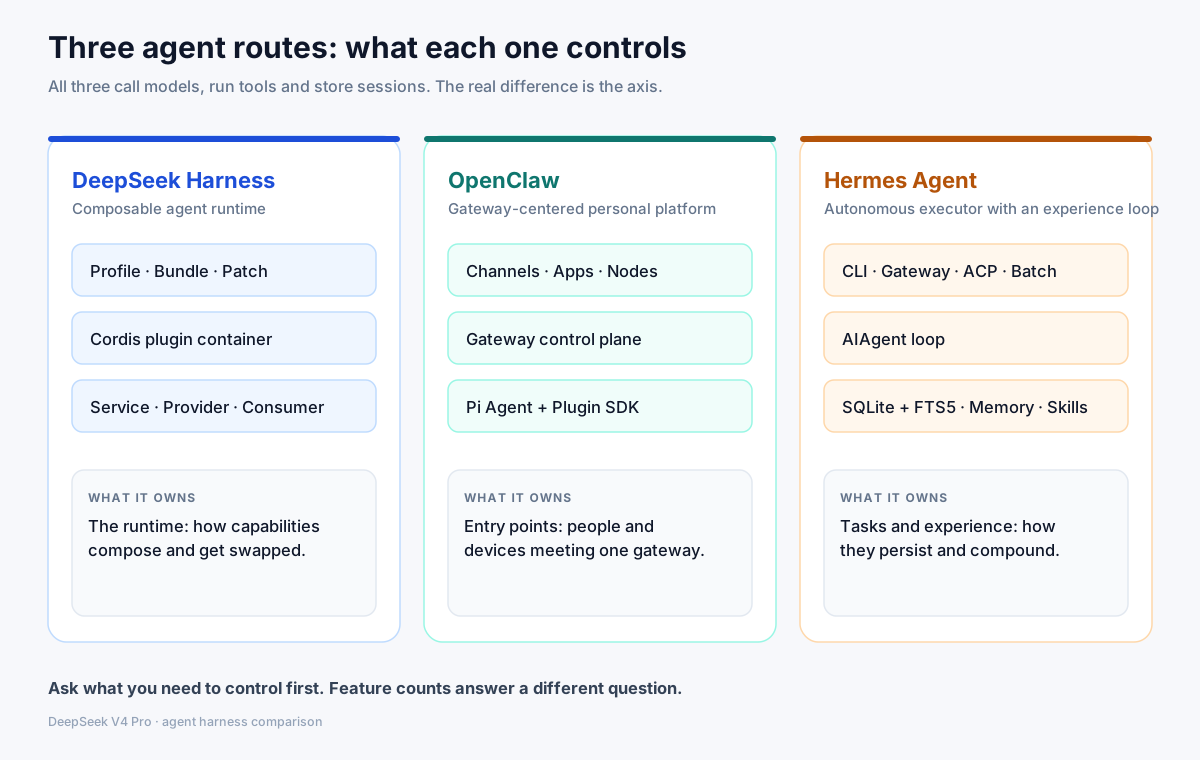
DeepSeek Harness is a plugin-based runtime built on Cordis. Profiles, bundles and patches assemble its capabilities, while models, sessions and tools can be configured. Interfaces and available integrations can change between releases, so check the version you plan to use.
OpenClaw owns the entry points. WhatsApp, Telegram, Slack, Discord, Signal, iMessage, Feishu, WeChat and WebChat, plus desktop and headless nodes, all authenticate, route and keep sessions through one long-running Gateway. Pi Agent runs the model and tool loop. If the Gateway is down, the entry points are down.
Hermes Agent owns the task. One AIAgent loop serves the CLI, messaging gateway, ACP, batch runner and API server. Sessions live in SQLite with FTS5 search, memory is capped in MEMORY.md and USER.md, and skills, cron, subagents and a Kanban board cover work that outlives a conversation.
Where do they actually differ?
| DeepSeek Harness | OpenClaw | Hermes Agent | |
|---|---|---|---|
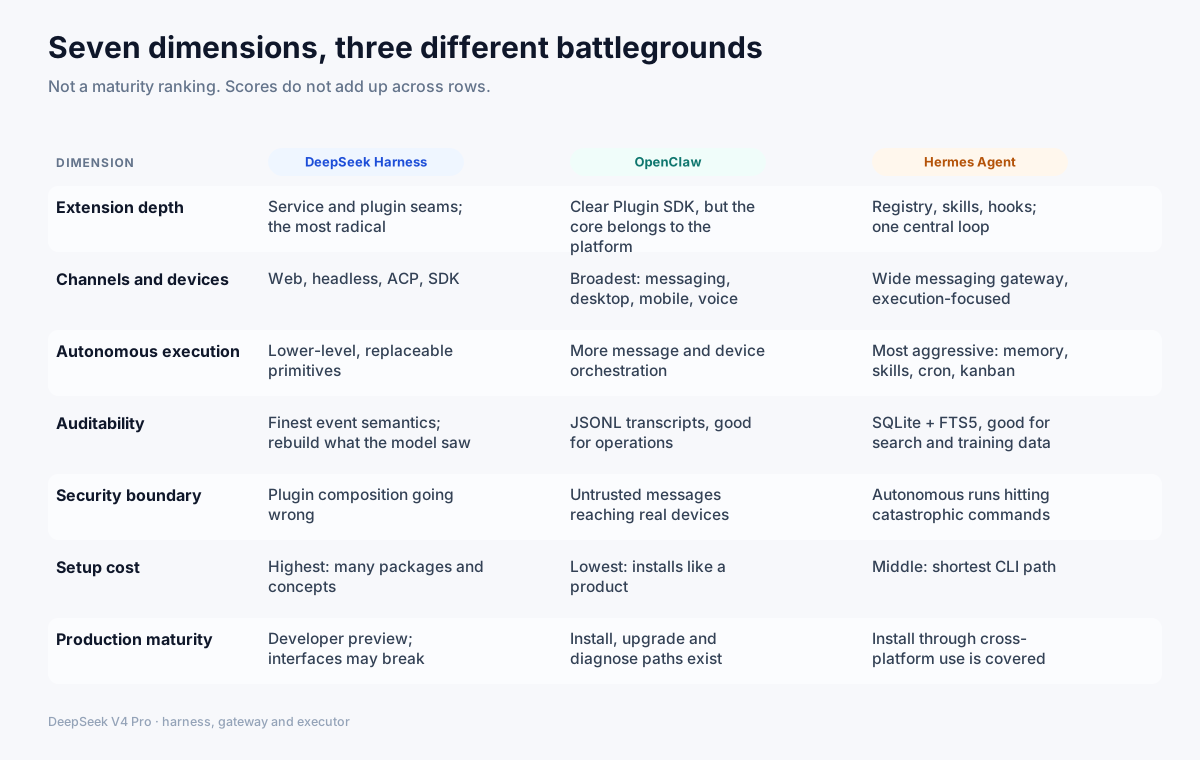
| Architecture | Service and plugin seams | Gateway as control plane | One central agent loop |
| Memory | Replayable event log | Continuity across channels | Bounded memory that changes the next run |
| Security focus | Plugin chain going wrong | Untrusted messages reaching devices | Autonomous runs hitting bad commands |
| Long tasks | Jobs, Workflow, Subagent | Cron, webhooks, routing | Kanban with retries and review |
The projects approach security differently. Review the permissions, isolation and approval settings for the specific version and environment you deploy. None of these tools eliminates the need to review agent actions and protect credentials.
Planning to use DeepSeek in your workflow? Explore DeepSeek Subscription to review plans and usage limits.
Which one should you pick?
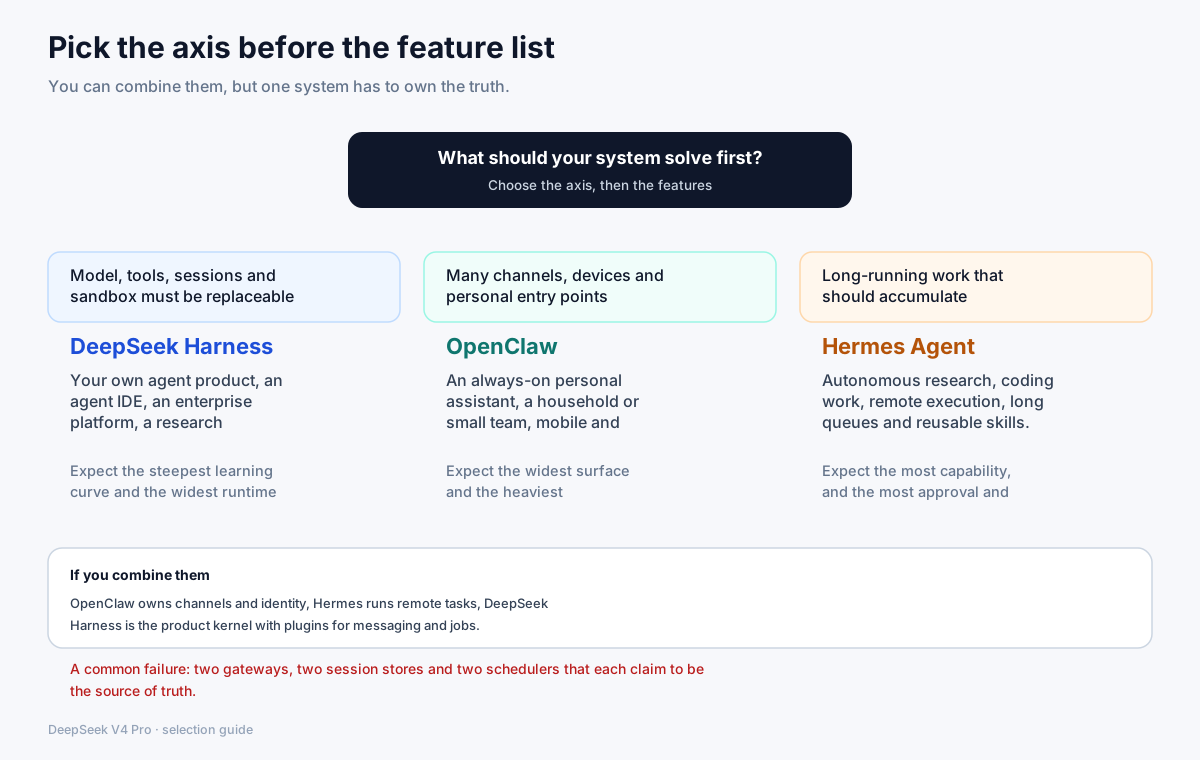
- Building a new agent product where model, session, tools, sandbox and UI must be replaceable: DeepSeek Harness.
- Need one assistant answering from chat apps and phones under one identity: OpenClaw.
- Need work that survives restarts, accumulates skills and runs remotely: Hermes, especially once you need a queue and human review.
Combining them works when one system is the control plane. The failure mode is two gateways, two session stores or two schedulers that each believe they own the state.
Where does DeepSeek V4 fit?
Model choice is separate from harness choice. Check each tool’s current provider documentation and configure a supported API format and model ID. dssub lists deepseek-flash and deepseek-v4-pro; availability and compatibility depend on the chosen client and endpoint.
Quick answers
Is DeepSeek Harness ready for production?
Check the project’s current release and compatibility notes before relying on it in production. Pin a version and test the service and event contracts after upgrades.
Can OpenClaw and Hermes Agent run together?
Yes, if each piece of state has one owner. Let OpenClaw handle channels, identity and routing, and Hermes run long tasks. Two gateways or two schedulers claiming the same truth source will duplicate work.