 dssub
By Cameron Voss · Reviewed November 21, 2026
The bill explains the model before the benchmarks do
Start with the invoice. GLM-5.3 is easier to understand from its bill than from its scores. The endpoint will not let a caller skip the reasoning step, so even a request for a one-line answer produces a hidden chain of thought. The chain and the answer both leave the model as generated text, and both land on the output line.
The trace arrives in delta.reasoning_content before the first visible token. The usage block folds it into completion_tokens, so it counts alongside the answer. When input, cached reads and output carry different prices, the hidden chain is charged at the top rate: output.
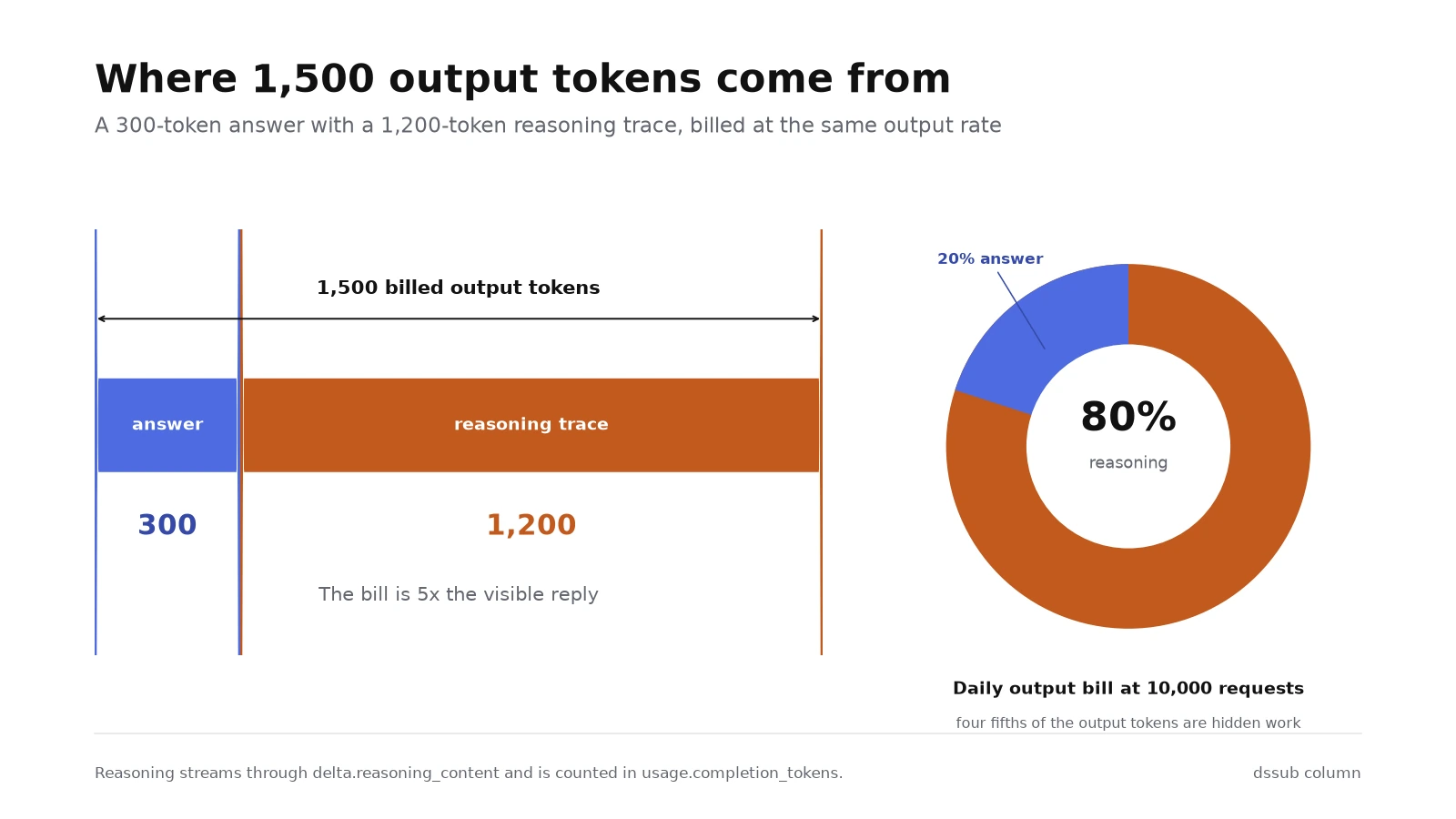
A small request makes the ratio plain. Suppose the answer runs 300 tokens and the reasoning trace runs 1,200. The meter shows 1,500 output tokens. The user sees a 300-token reply, so the bill runs five times the visible text. At 10,000 requests a day, reasoning accounts for 80% of the output bill. The reply never grew. The hidden work did.
Long agent runs change the picture. A deeper chain can make the overall run shorter, and Z.ai’s Code Bench measures the trade directly: accuracy on one axis, mean output tokens for a task on the other. The curve’s shape is why an effort setting exists.
| Effort | Mean output tokens per task | Code Bench score |
|---|---|---|
| GLM-5.3, high | ~50,000 | 31.4% |
| GLM-5.3, max | ~75,000 | 34.5% |
| GLM-5.2, max | ~96,000 | 23.4% |
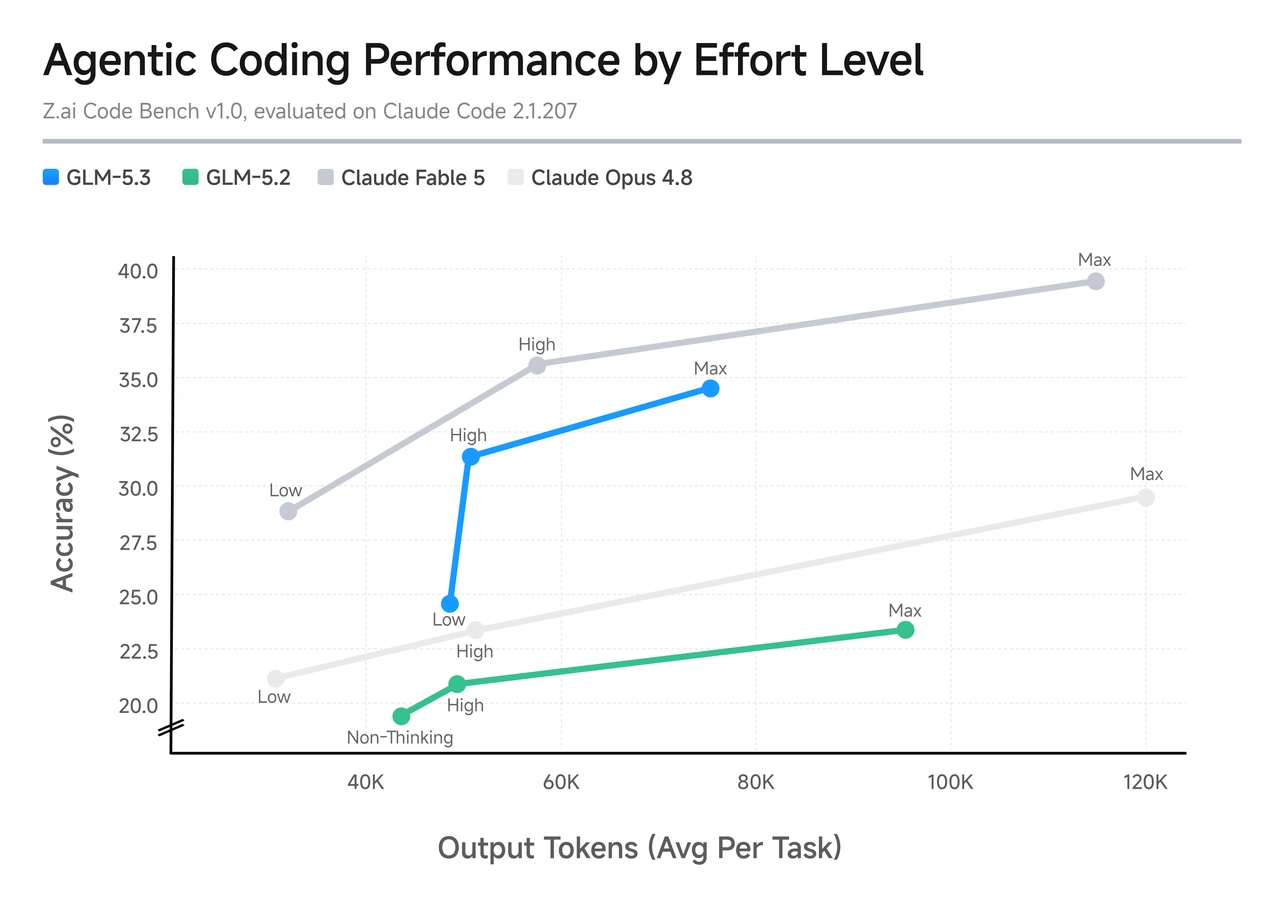
Moving from high to max adds about 50% to the token count and buys about three accuracy points. That is a good trade on a difficult agentic coding job. A chatbot usually cannot justify it.
The off switch is missing, not hidden
Z.ai documents one legal value for thinking.type: enabled. An application that still sends disabled has to change that field before it points the model ID at glm-5.3, otherwise the call is rejected. No fallback exists. You cannot override the choice per turn, and there is no none level that turns the chain off.
That puts GLM-5.3 in a small group. GLM-5.2 and GLM-5.1 inspect each request and decide whether thinking is worth it, so a trivial prompt may return no reasoning tokens at all. GLM-4.7 thinks every time but allows a per-turn toggle. On both GLM-5.3 and GLM-5.3-Flash, the chain runs for each call and each turn, and there is no case where it stays idle.
| Model | Thinking switch | Effort choices |
|---|---|---|
| GLM-5.2 | Available | high and max; low falls back to high |
| GLM-5.1 / GLM-5 | Available | No effort control |
| GLM-4.7 | Turn-level only | No effort control |
| GLM-5.3 / GLM-5.3-Flash | Not available | low, high and max; max is the default |
In place of the switch, the API leaves one dial. At low, the chain is light. The high setting gives it more room, and max runs the deepest version available. Z.ai points to max when the job is coding or another task with several steps. It is also the default, so an unset effort field produces the deepest chain.
Set effort from the work, then fix the plumbing
Use low for classification, field extraction, fixed-format replies, and prompts where much of the answer is already written. That is the shortest chain available and the lowest-cost call this model offers.
The high setting is sensible for mixed traffic. You keep most of the accuracy and spend around two-thirds as many tokens as max. Save max for agents that run for a long time, refactors across several files, and debugging work that depends on tools. Those are the jobs Z.ai names.
Thinking always on changes two operational habits. Give max_tokens extra room, because the hidden chain and the answer share one output budget. A cap that is too tight can come back empty, with finish_reason reporting length. In a multi-turn agent, also choose what to do with old reasoning. With clear_thinking set to false, prior chains stay in the context, and later requests must send them back unchanged. Removing them cuts the context bill, but the model then repeats work it has already done.
What the constant chain buys
The cost is the cheap call for a trivial question. Every request now carries at least some reasoning, so teams sending many short prompts notice it first. The benefit is consistency. The model cannot quietly skip its check because it misread the prompt, and the answer does not vary from turn to turn on whether that check happened.
The score sheet shows the payoff. Terminal Bench 3.0 puts GLM-5.3 at 28.3 and GLM-5.2 at 4.6. DeepSWE goes from 46.2 to 66.9. Agents’ Last Exam moves from 23.8 to 28.5. All of those runs share one always-on chain.
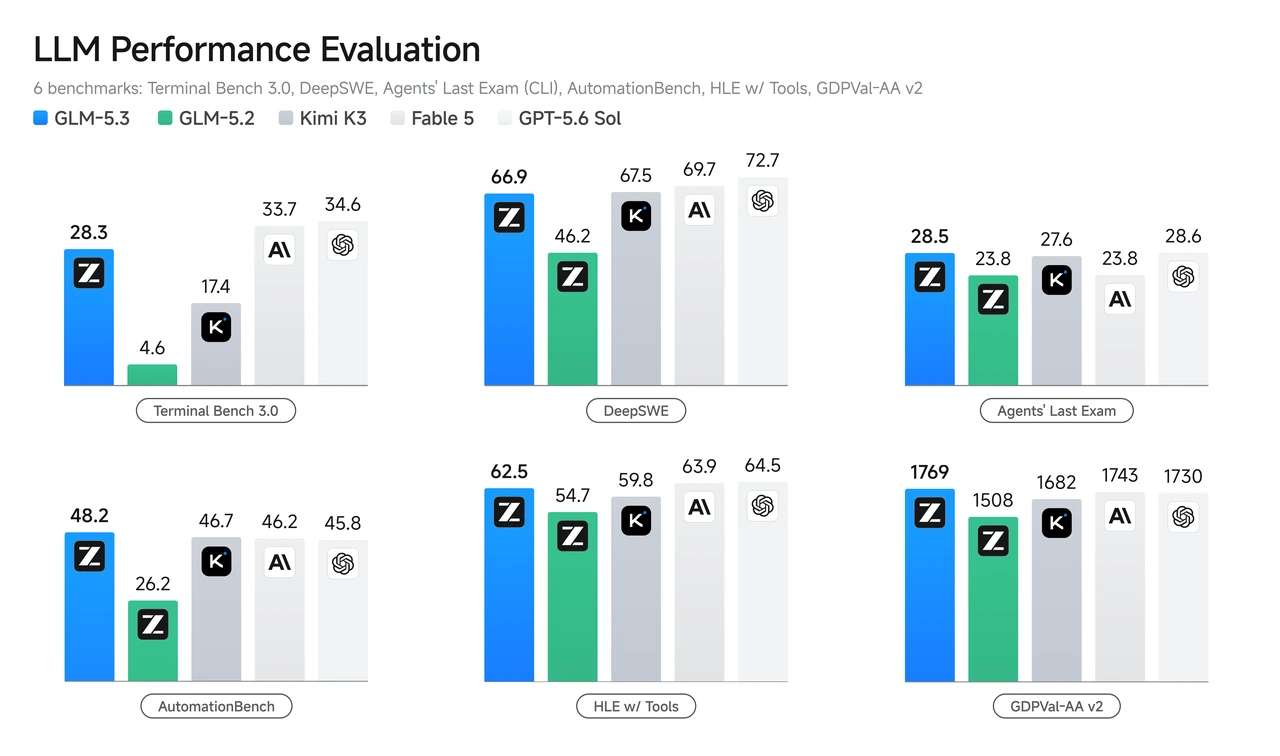
The trade is about pricing and behavior, not quality. A workload dominated by short questions will cost less on GLM-5.2 with thinking switched off, or on GLM-5.3-Flash set to low, for the same answers. A workload built around agents that stay busy for minutes is where max earns its price. The curve above shows the shape of that bargain.
Review GLM on dssub
dssub keeps GLM in its model catalog and tracks GLM coverage on the Multi-Model Plan. The listing marks availability, exact versions and point rates as pending confirmation, so check it before you move a production workload.