 dssub
By Cameron Voss · Reviewed November 19, 2026
Three public tests, same direction
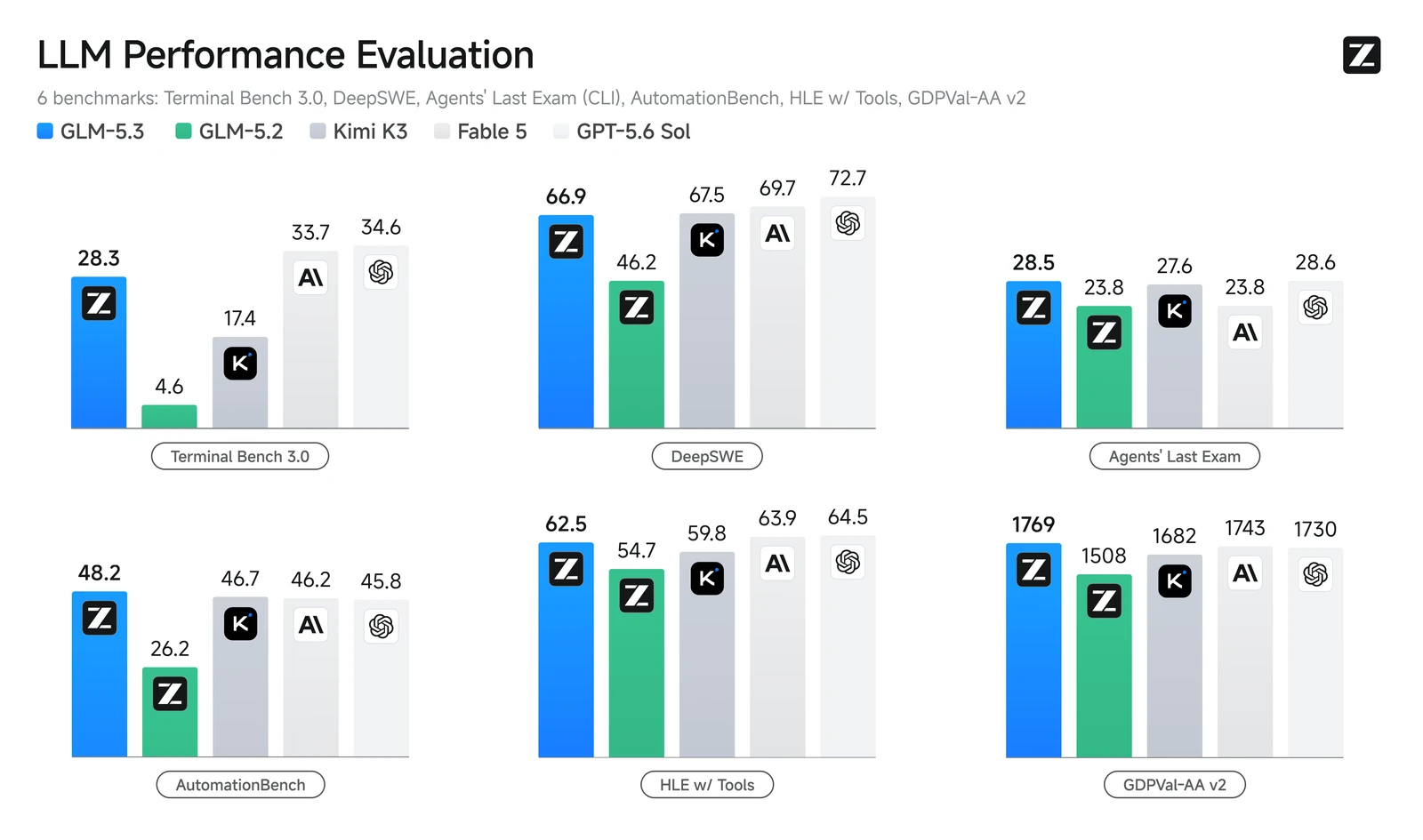
Begin with the scoreboard. The direction is consistent, though the size of each step varies.
| Benchmark | GLM-5.2 | GLM-5.3 | Change |
|---|---|---|---|
| Terminal-Bench 3.0 | 4.6 | 28.3 | +23.7 |
| DeepSWE v1.1 | 46.2 | 66.9 | +20.7 |
| Agents’ Last Exam | 23.8 | 28.5 | +4.7 |
The outlier is Terminal-Bench 3.0. The harness gives an agent a terminal and a real job, then grades whatever artifact remains on disk. A 4.6 suggests the older checkpoint could hardly complete the work. At 28.3, the new one finishes roughly six times more, and the metric counts delivered output instead of a single reply.
Those results come with generous settings. Z.ai evaluated the model through Claude Code with reasoning effort pinned to max, and Agents’ Last Exam used a 1M-token window. Those choices show a ceiling, not what a deployment with a short context will see.
The half of the bill nobody quotes: output tokens
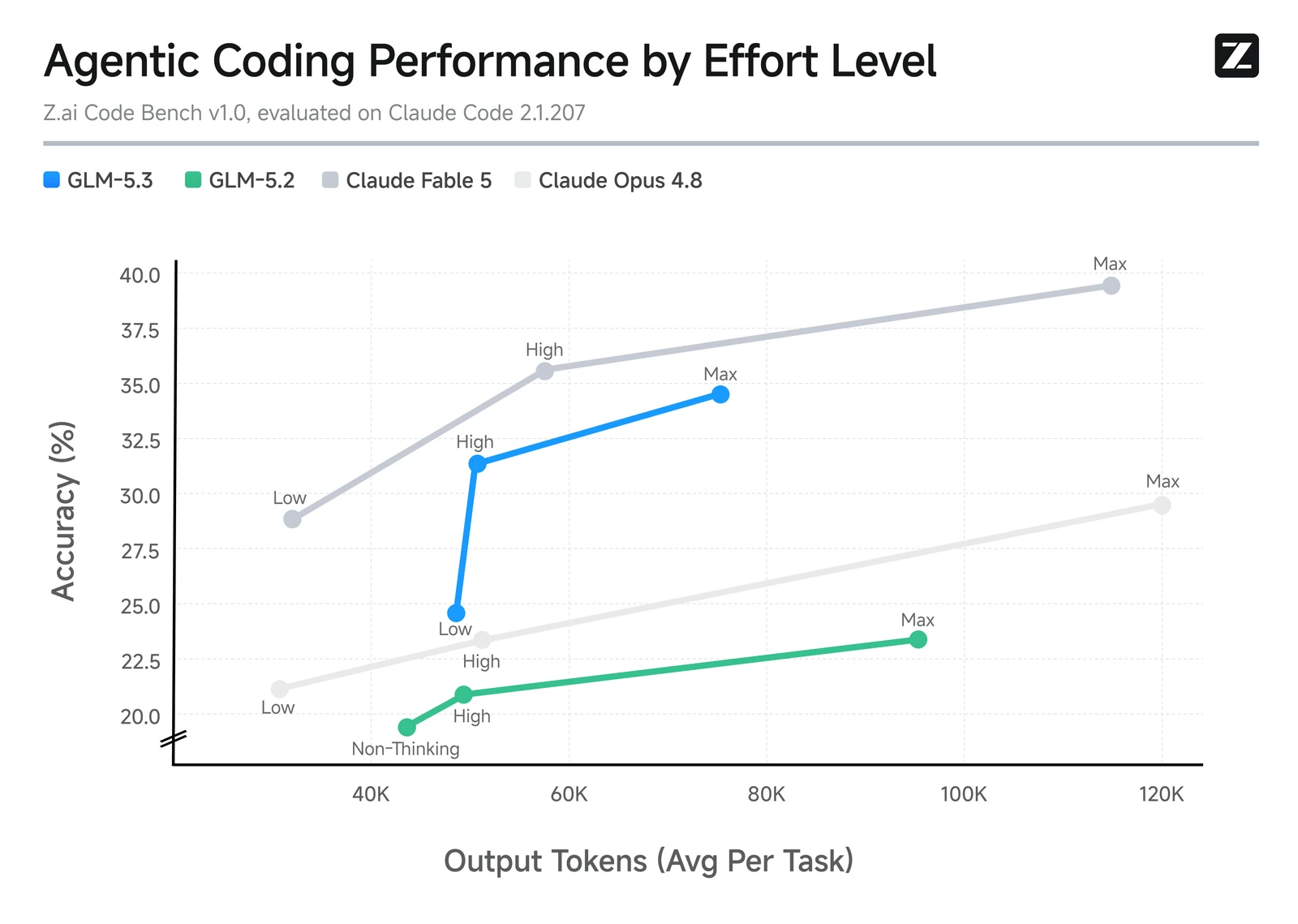
A score tells you whether the work gets done. It says nothing about the invoice. Z.ai’s internal Code Bench plots accuracy against average output tokens for each task, and GLM-5.3 sits above and left of its predecessor.
At max effort it reaches 34.5% while spending about 75K output tokens for a task. GLM-5.2 needed 96K to reach 23.4%. Switch to high effort and GLM-5.3 scores 31.4% on roughly 50K tokens, a little ahead of Claude Opus 4.8, which scores 29.5% at 120K.
The max-effort lead still belongs to Claude Fable 5 at 39.5%. So the defensible claim is narrower than a clean win: GLM-5.3 narrows the distance to the frontier using less output. Most providers bill reasoning as output, which means the savings accumulate over a long agent session.
The Code Bench numbers are internal, which cuts both ways. Public test contamination becomes less likely, but nobody outside Z.ai can audit the tasks. Read the shape of the line as the real signal; treat each percentage as the vendor’s own.
Where the improvement came from
Nothing about the architecture is new, and Z.ai says so plainly. GLM-5.3 continues the GLM-5.2 checkpoint, with every gain produced by post-training.
The team spent the month on task environments: a larger number of them, a wider spread of task types, and greater training compute within each one. Work like this tends to extend endurance on long jobs while leaving the old behavior intact. The failure modes you already know stay in the family.
Z.ai describes the release as its strongest open-weights coding model and puts the gain on its internal Z.ai Code Bench at 50% relative to GLM-5.2. The suite is modeled on real developer work.
Open weights have a schedule attached. The files are absent at launch. Z.ai intends to release them two weeks later, once safety checks and hardening are complete. Until then the API is the only door, and the published model card describes an intention, not a file you can fetch.
Security moved as a side effect
Vulnerability work entered the post-training mix through new data and environments. The team did not expect the rate. Capability continued climbing with training scale, and isolated bug spotting gave way to planning an exploit chain stage by stage.
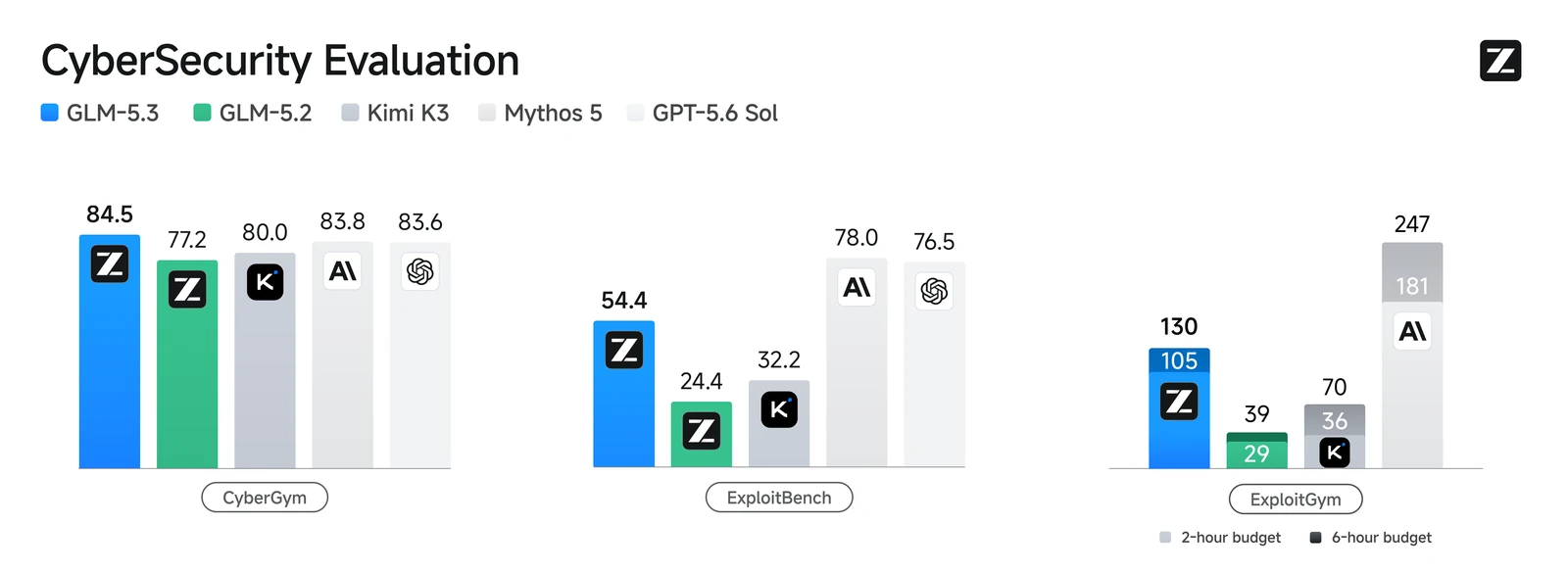
CyberGym hands over a codebase, then requires the model to locate defects and prove each one by triggering it. GLM-5.3 lands at 84.5%; its predecessor scored 77.2%. That puts it just ahead of Mythos 5 (83.8%) and GPT-5.6 Sol (83.6%).
ExploitBench demands deeper reasoning about genuine vulnerabilities. Here the score is 54.4%, more than twice the 24.4% recorded for GLM-5.2. Mythos 5 (78.0%) and GPT-5.6 Sol (76.5%) remain far in front.
ExploitGym counts tasks completed inside a clock. GLM-5.3 finishes 105 in two hours and 130 in six. GLM-5.2 managed 29 and 39. Mythos 5 reaches 181 and 247.
One pattern links all three results. The higher a test sits on the exploitation chain, the larger the improvement over GLM-5.2, and the greater the remaining distance to closed models. Z.ai reads this as capability growing fastest where it had the most ground to cover.
For a practical number, look at the field work. In tests alongside Chinese security teams, and once experts had reviewed and deduplicated the results, the count reached 2,436 vulnerabilities in 269 projects; 1,097 of those were medium-to-high severity. The oldest flaw dated back about four decades. Each finding enters a public disclosure ledger naming the project, assigning severity, recording a CVE if one was issued, and noting how long the defect survived in the code.
A stricter API contract
Thinking is no longer something you can turn off. Every request picks low, high or max effort; max is the default, and thinking.type: "disabled" comes back rejected.
Migrating an existing client takes an order of operations. Flip the type to enabled, lower effort to low, and change the model string last. Skip that sequence and the call fails. Z.ai recommends max for coding.
Other limits fit the long-job pitch. The context window holds 1M tokens and output stops at 128K. The endpoint follows the OpenAI-style chat layout, so most integrations change a URL and a model identifier rather than the code. Input is text only, so screenshot workflows are unsupported.
Watch the output budget. Reasoning and the final answer share that 128K ceiling. Set max_tokens too low and the response can arrive empty, with finish_reason reporting length. Leave room.
Access without buying GPUs
Open weights look inexpensive until the hardware quote arrives. A model of this class wants several GPUs, memory to hold a long context, plus a serving stack that stays online. A solo developer or small team pays that bill before the first request.
Calling the provider’s API directly brings a different set of chores. Developers based outside China handle another account, another bill, and client settings rebuilt for each provider they add. The work is not hard. It simply ships nothing.
DSSUB removes that layer. Model access, API keys and billing live in one account, and GLM has its own page in the catalog. That page carries the model reference and connection details, while availability and supported formats are explicitly marked for confirmation, so check it before planning a migration. For a team that wants to see whether GLM-5.3 fits without renting hardware or wiring another provider account, it is the shorter path.
Model reference, connection details and current availability for GLM in one place.
Review the GLM model page → Availability and supported API formats are unverified on the listing; confirm them before purchase.