 dssub
By Cameron Voss · Reviewed November 20, 2026
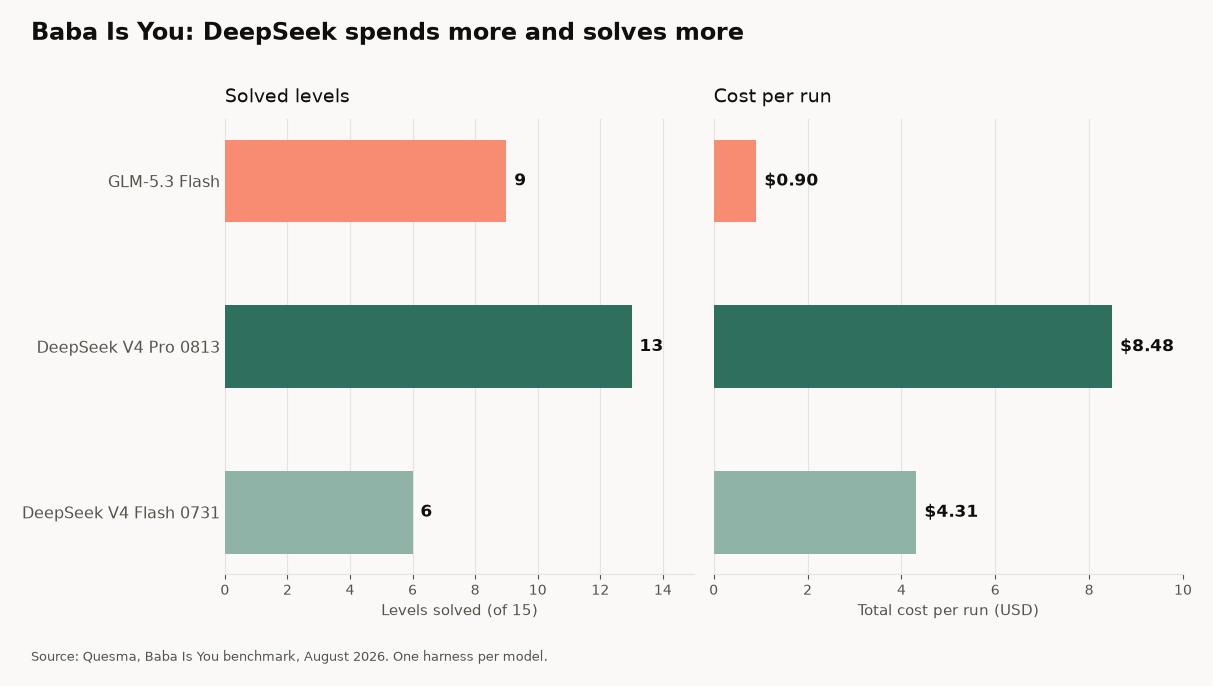
Read the invoice before the price sheet. In a published Baba Is You benchmark, one run of GLM-5.3 Flash cleared 9 of 15 levels on $0.90. DeepSeek V4 Pro 0813 cleared 13 levels on $8.48. DeepSeek V4 Flash 0731 cleared 6 on $4.31. Per level solved, those work out to $0.10, $0.65 and $0.72. Nothing in either list price predicts which figure belongs to which model.
What one solved level actually costs
Baba Is You turns its own rules into movable objects, so an agent has to plan a step, watch how the board reacts, then repair the rest of its plan. Quesma's Stage 1 covers fifteen levels, and the three figures above come from that stage. Their token counts spread wider than their bills: 8.6M output tokens for GLM-5.3 Flash, 75.6M for DeepSeek V4 Pro 0813, 92.8M for DeepSeek V4 Flash 0731.
A screening pass called Stage 0 points the same direction. GLM-5.3 Flash posted a 67% pass rate after 11 turns and $0.32. Every DeepSeek configuration reached 75%, each needing 18 to 55 turns, with bills from $1.16 up to $2.94.
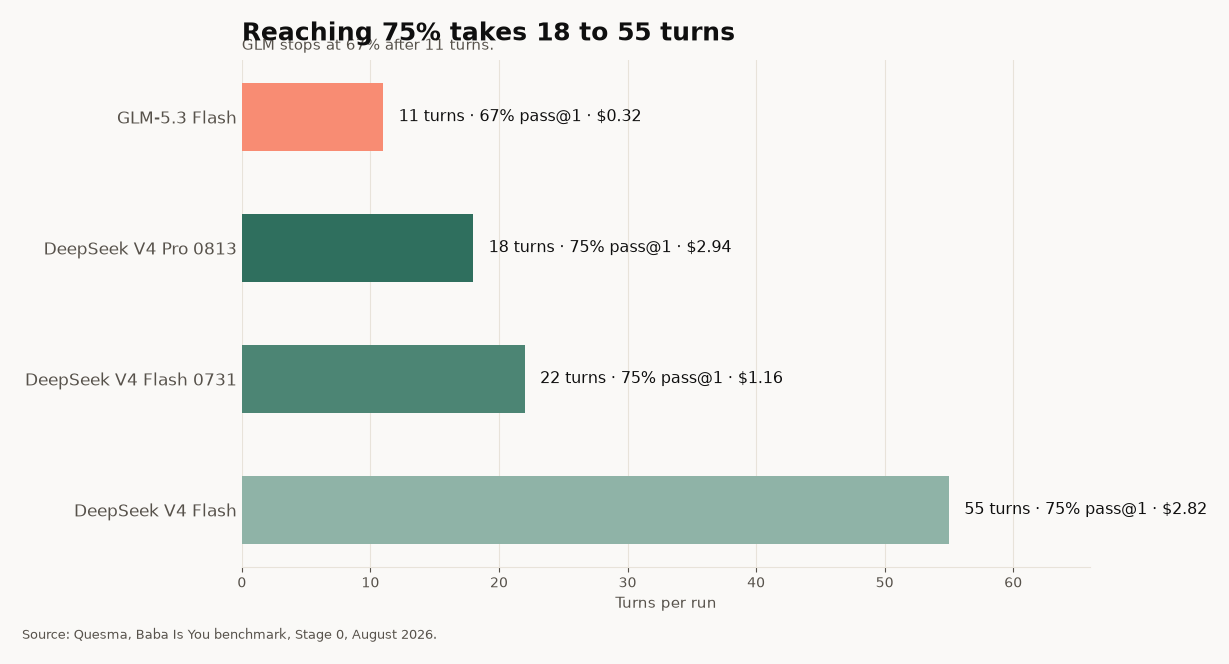
Two stopping styles, and neither one is free. The first ends a run early: fewer turns, less output, and a lower ceiling. The second keeps attempting: more turns, a better pass rate, a bigger invoice. Every extra attempt has a price, charged either as tokens or as elapsed time.
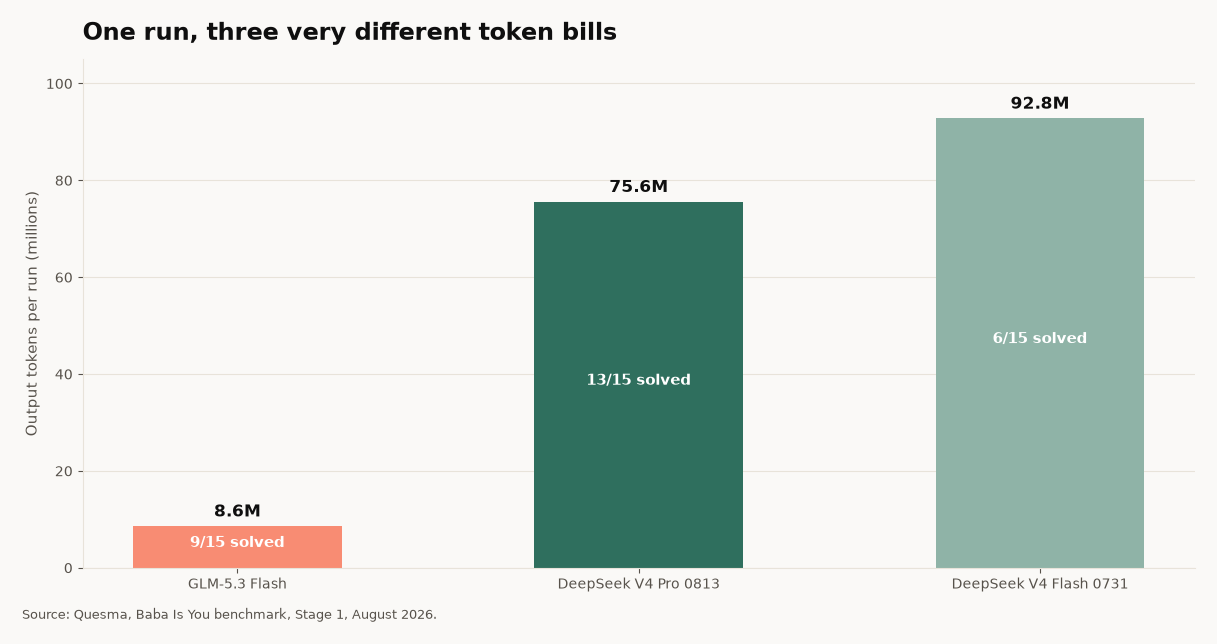
One caveat belongs beside these figures. The runs did not share a scaffold: GLM-5.3 Flash worked inside Terminus-2, while each DeepSeek measurement came through Claude Code. The numbers come from observed runs, not from one harness holding everything else fixed.
Two architectures, two billing clocks
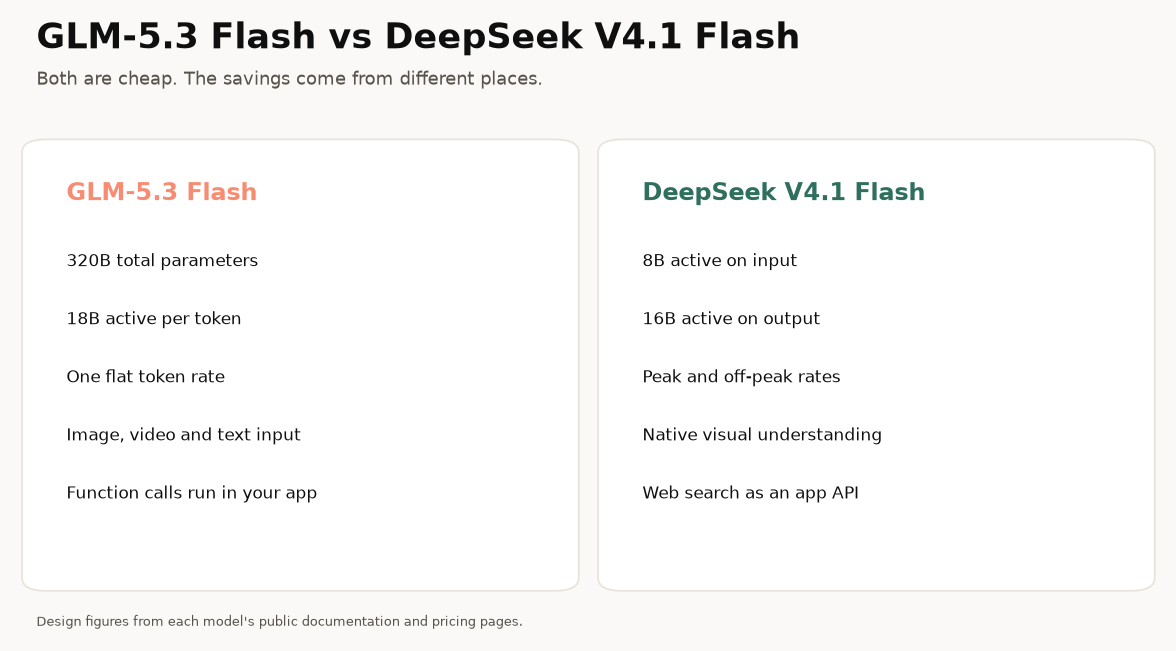
GLM-5.3 Flash retains the larger GLM architecture and shortens the compute path: 18B active weights on a 320B base, per token. Z.ai lists it at a tenth of GLM-5.3, falling to a twentieth while the launch discount holds. The input side accepts pictures, video, text and uploaded files; the output side returns text. A 1M-token window is available, and one reply can top out at 128K.
DeepSeek V4.1 Flash splits capacity rather than trimming it, running 8B active on input and 16B on output. Its release notes promise more speed and lower cost than the versions it succeeds. Until V4.1-Pro ships, DeepSeek sends V4-Pro traffic to it. Billing carries two numbers: full price at peak, half that figure off-peak.
The invoice follows the design. GLM sells a single rate for a single model; DeepSeek's price sheet has a light read path, a heavier write path, and a discount attached to the quiet hours. Traffic that runs continuously gets a bill it can forecast; traffic that can wait collects its saving overnight.
Your application still owns the loop
Neither model browses on its own. Both assume the surrounding program decides when a tool fires and what happens to the result.
Function calling is documented for GLM-5.3 Flash, and tool_stream carries the arguments as a stream. Nowhere on that reference is a built-in browsing endpoint listed. Anything pulled from the web arrives through a function you declare, and your code performs it.
The chat endpoint DeepSeek exposes speaks an OpenAI-compatible format. Reading a URL, uploading a file and running a search each live in their own application API, outside the completion request. The lookup is a call to a neighbouring service, not a step the model takes by itself.
Operationally the burden lands in the same place: the caller absorbs retry logic, timeouts and per-lookup cost. The packaging is what differs. GLM passes the schema for its tools inside one request and returns arguments as a stream. Search at DeepSeek lives in its own service, so swapping it or metering it separately is easier.
Match the design to the workload
GLM-5.3 Flash suits jobs that begin with a picture or a clip and continue as prose: intake of scanned documents, reading a screen, a long review in which the opening material stays loaded. One rate plus an early stop fits chat-like sessions and products whose bill has to be forecastable. When one key must serve both pictures and prose, it is the shorter path.
DeepSeek V4.1 Flash suits jobs you can put in a queue: overnight evaluation, extraction in batches, wide agent sweeps where another attempt improves the score. The off-peak number rewards work that can sit until the quiet window, and the 16B write path helps when the model produces a lot of text. Client code stays as it is for anyone already calling the DeepSeek API.
| Job shape | Better fit | Reason |
|---|---|---|
| Pictures or video in, prose out | GLM-5.3 Flash | Multimodal input is native on the budget tier. |
| Long context, opening material unchanged | GLM-5.3 Flash | 1M-token window, plus a single rate around the clock. |
| A bill that should not move with the clock | GLM-5.3 Flash | No peak and off-peak split to model. |
| Agents scheduled overnight | DeepSeek V4.1 Flash | The quiet-hours figure is 50% of peak. |
| Work that gets better with another attempt | DeepSeek V4.1 Flash | Measured runs kept retrying and scored higher. |
| Generation with a heavy write side | DeepSeek V4.1 Flash | The write path runs 16B. |
Neither model is wrong in the abstract. The shape of the job decides.
Run GLM-5.3 Flash through DSSUB
Both models are cheap; they are cheap in different places. If your workload opens on a picture or a long document and closes with text, GLM-5.3 Flash is the shape that fits. The GLM page on DSSUB lists the current model route and what the plan covers, which is worth checking before you commit a pipeline.