 dssub
By Cameron Voss · Reviewed November 20, 2026
The invoice is the quickest way to tell them apart
Give both models the same assignment: 100 million tokens read, 10 million tokens written. On GLM-5.3-Flash the meter stops around $20. On Gemini 4 Neon it stops around $450. Each holds a million tokens of context, each is open to anyone with an API key, and almost nothing else about how they charge is shared.
The published rates explain the intention behind each product earlier than any leaderboard does.
| Rate, USD per million tokens | GLM-5.3-Flash | Gemini 4 Neon |
|---|---|---|
| Input | $0.15 | $3.00 |
| Cached input | $0.03 | $0.15 |
| Output | $0.50 | $15.00 |
| Context window | 1M tokens | 1M tokens |
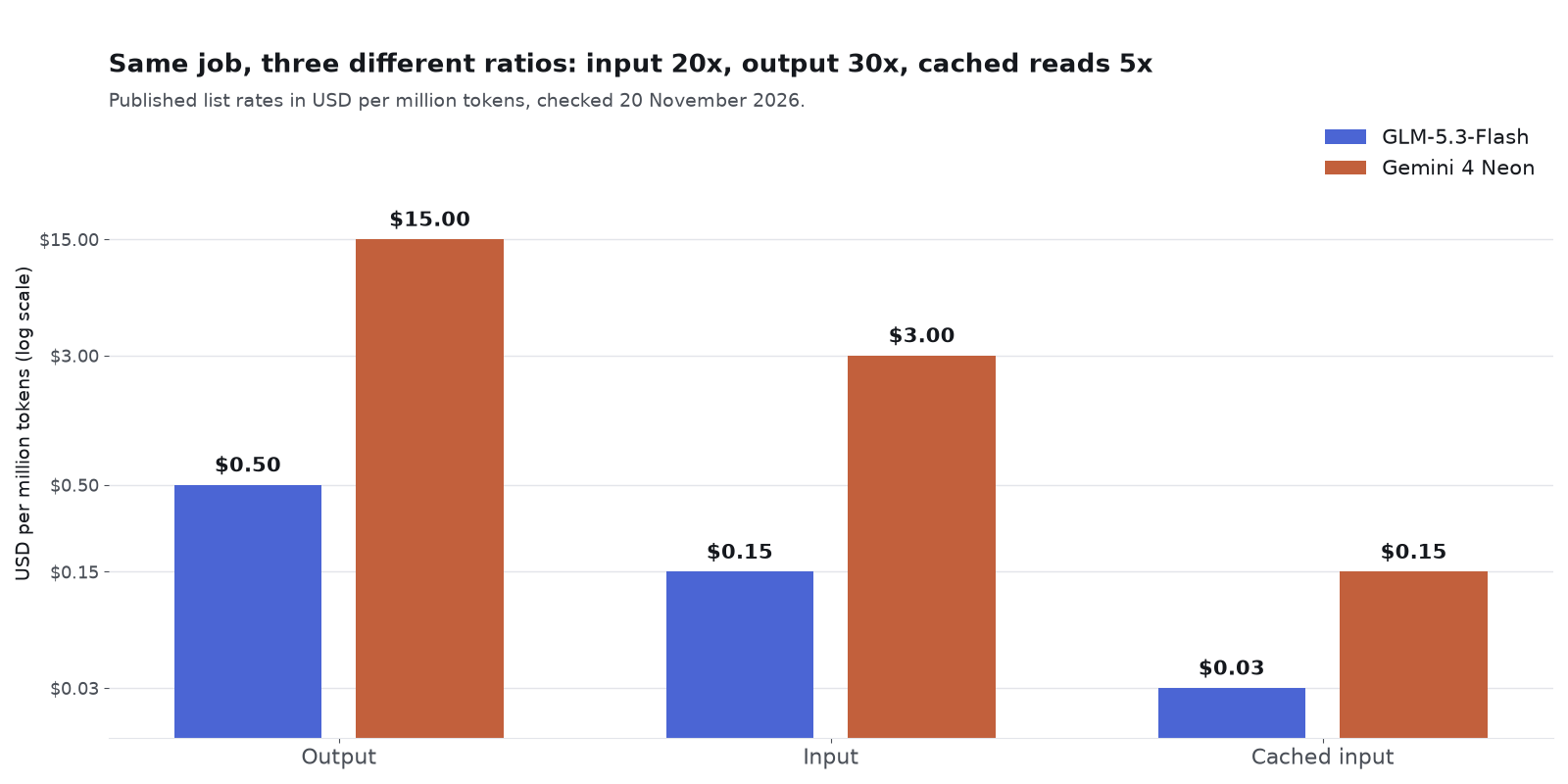
While a million input tokens cost fifteen cents, the whole product manual can travel with the question, so can a two-hour transcript, so can a folder of source files, and the bill stays inside rounding. Move to $3.00 and the context window becomes a budget you administer: something has to stay outside.
Release history fills in the rest. GLM-5.3-Flash appeared on 26 August 2026 with 320B parameters in total, a 1M-token window, 128K available for output, and images accepted next to text. Z.ai lists it close to one tenth of what GLM-5.3 costs, which places it in the GLM-5 line as the volume option, intended for passes nobody would pay frontier rates for: every document, every page, every inbound ticket.
Gemini 4 Neon is the fourth addition to its family, published on 18 November 2026. Its window matches Flash at 1M tokens, while the input it accepts spreads wider, covering text, image, audio and video. Google sits it one rung beneath the largest and slowest models it sells, so the model is quick but its price lives in the premium band.
Read the two sheets together and the strategies separate: hold the cost of one request near zero, or charge more and finish more work inside that request.
Nine rows for Neon, one row for Flash
Ten evaluations publish a result for both models. Neon leads nine.
| Benchmark | GLM-5.3-Flash | Gemini 4 Neon |
|---|---|---|
| Terminal-Bench 4.0 | 41.80 | 61.62 |
| Terminal-Bench 4.1 | 36.97 | 65.20 |
| FrontierCode 2.0 | 14.18 | 46.20 |
| SWE-sweep | 0.72 | 12.80 |
| Vibe Code Bench v1.1 | 30.76 | 93.70 |
| AA Intelligence Index v5.0.1 | 27.80 | 61.40 |
| Vals Index v2.2 | 50.86 | 70.87 |
| Tax Agent Bench | 31.55 | 54.89 |
| Legal Research Bench | 45.19 | 56.25 |
| Chartography | 78.00 | 73.50 |
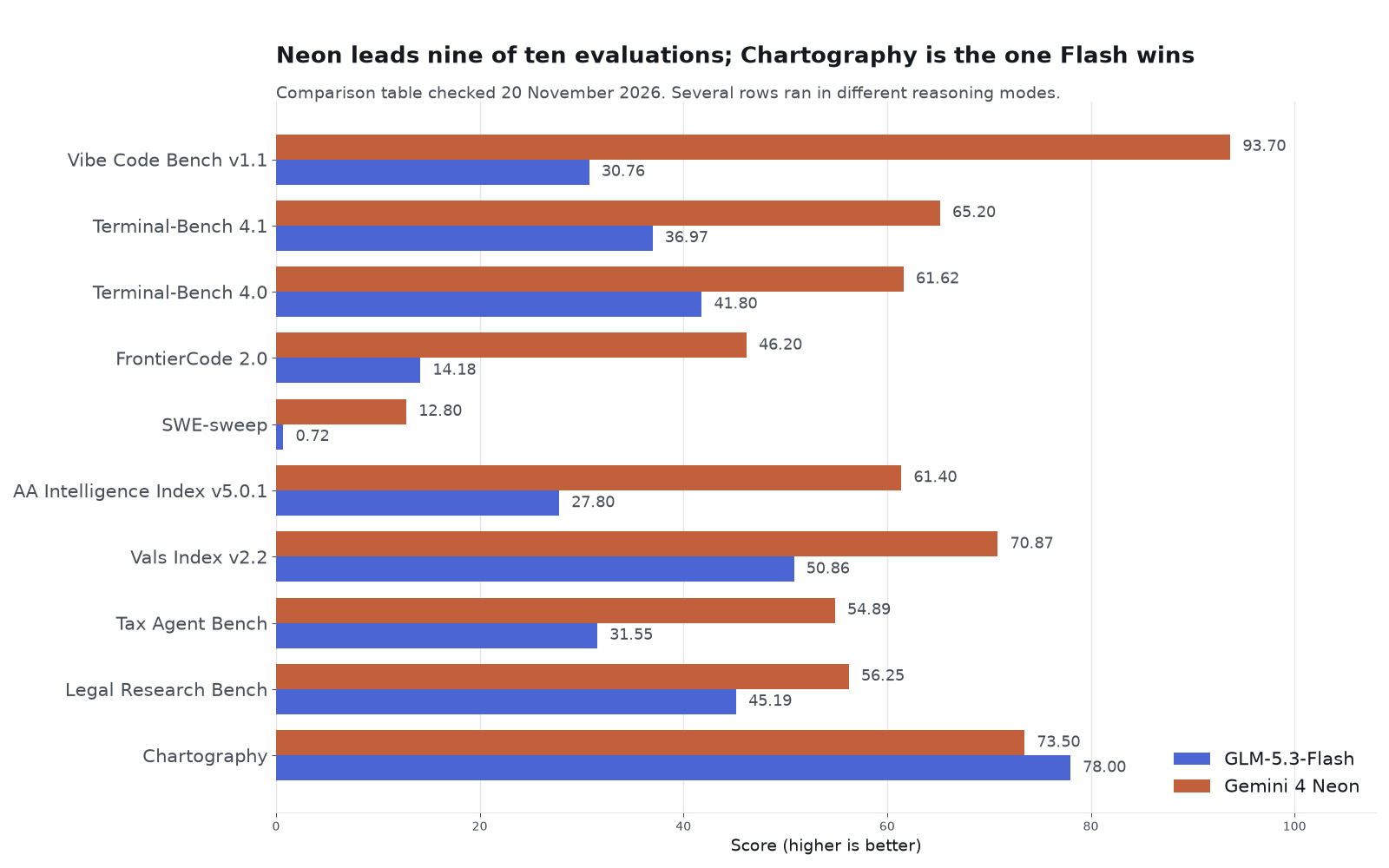
The widest distances are the ones an agent engineer notices. Vibe Code Bench v1.1 finishes 93.70 against 30.76. FrontierCode 2.0 finishes 46.20 against 14.18. SWE-sweep holds the emptiest cell on the page, 12.80 beside 0.72. The AA Intelligence Index v5.0.1, which compresses several tests into one figure, reads 61.40 versus 27.80.
Chartography breaks the pattern, and it is the row about reading pictures: 78.00 for Flash, 73.50 for Neon. Of the task rows Neon does take, the least lopsided is Legal Research Bench, 11 points apart instead of 30.
Short gaps deserve suspicion, because some runs used different reasoning settings and a few points then says very little; long gaps describe the products rather than the afternoon. Holding a low-priced 320B model responsible for a frontier release across a long agentic coding session was never a fair test. What matters is that the distance on charts and pages has collapsed far enough for cost to become the deciding variable.
Who runs the tools, and on whose server
Both APIs accept function definitions from the caller. They part company over what else gets executed, and over who executes it.
Neon keeps the tool loop inside the API
Provider-side capability does most of the work. Grounding through Google Search is switched on inside the request, and the reply comes back carrying the queries issued, the sources consulted, and support entries that attach individual spans of the answer to a source with a confidence score. Python executes in a managed sandbox whose library set is fixed beforehand and which has no outbound network. URL context pulls as many as 20 links into one request.
Architectural limits arrive with those conveniences. Your own functions and Google's search tools cannot occupy a single call, so every turn has to pick one side of that line. Thought signatures must travel back into the following turn exactly as they were issued; edit one and the private reasoning behind a tool call is gone.
Flash hands the tool loop back to your code
The endpoint is OpenAI-compatible chat completions, and the cycle lives in your code. Functions go in with the request, up to 128 of them; the model answers with tool_calls; your process performs the work; each result returns as a tool message quoting the call id it belongs to. tool_choice currently accepts nothing except auto, which hands timing to the model, and tool_stream emits arguments while they are still forming so an interface can render them live.
Reasoning behaves as a permanent feature rather than a switch. Three values exist for reasoning_effort — low, high, max — and max applies when you specify nothing. Because thinking interleaves, the model can keep working between calls and resume again once a result lands. Earlier reasoning survives into the next turn only if clear_thinking:false is sent; the coding endpoint retains it by default, the standard endpoint does not. Anything replayed has to be an exact copy of the text the model produced.
Some tools do run provider-side. retrieval searches a knowledge base Z.ai hosts. web_search is metered at $0.01 per call, each result arriving with its title, body text and link, and the model attributes claims to them through [Source: ref_N]. Check that route against your own traffic before building on it, since the Flash capability list leaves web search out and the documented search sample targets an earlier model. On this side, nothing executes code for you.
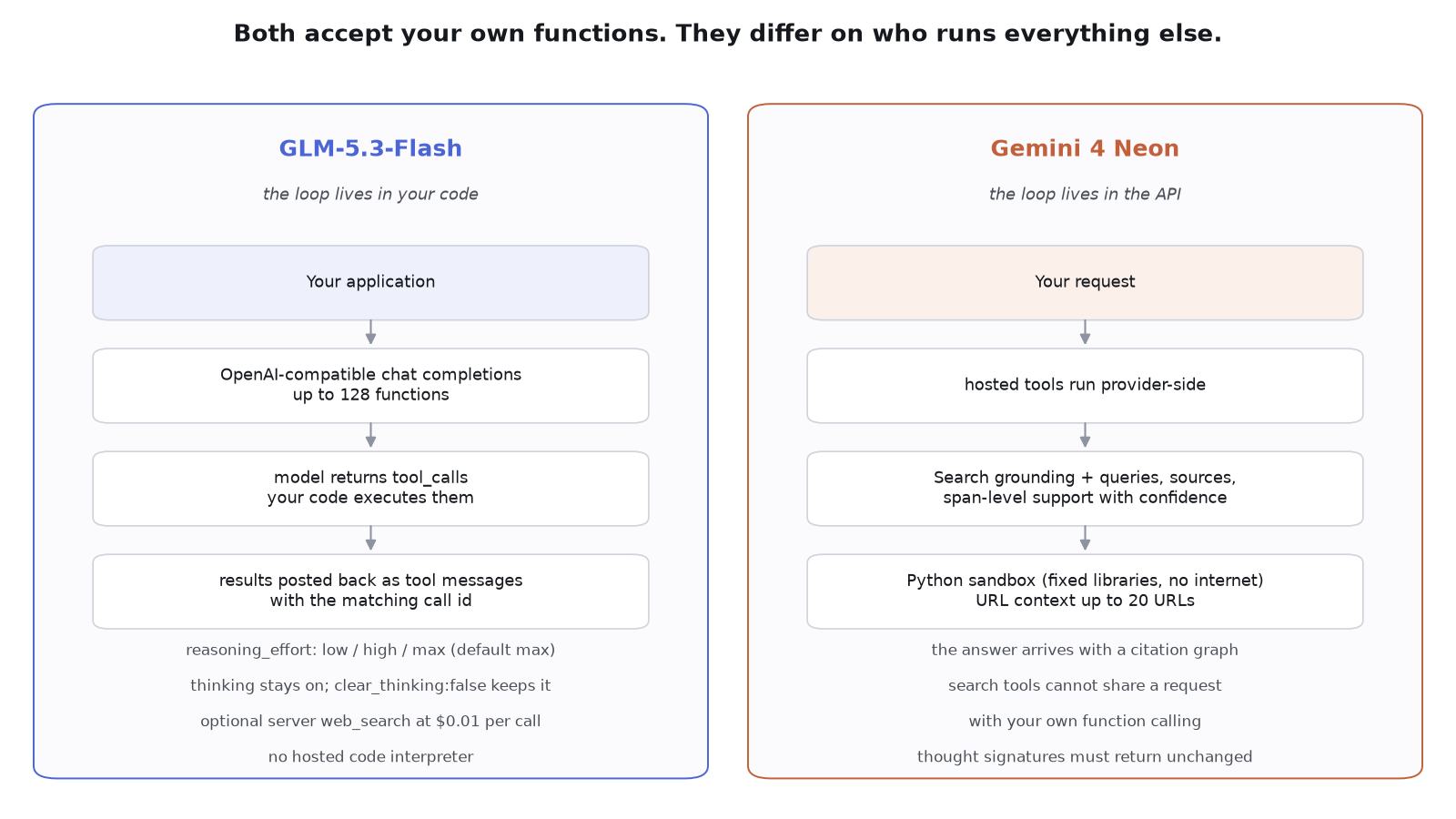
In practical terms, the Google route delivers work that has already been searched, executed and cited. The Z.ai route delivers a contract most clients already implement, with retrieval available as a metered extra.
Match the model to the shape of your traffic
A rate per token and a rate per task are different instruments. An answer that arrives in fewer turns, or a draft good enough to ship without rewriting, gives back part of a 20x spread, and the table above shows the same logic running in reverse. Workload shape predicts the better buy more reliably than leaderboard position.
Flash earns its keep where calls are small and repeated: fields pulled out of documents, items sorted into categories, long text condensed, dashboards and interface screenshots read, a large context walked one item at a time when each item needs its own judgement. Teams whose client already speaks OpenAI change two strings, the base URL and the key.
Neon earns its keep where one call has to carry a lot: answers that must reflect what is currently published, analysis where Python runs in the same turn as the question, long agent sessions a team is content to let the vendor hold, and coding work measured against the strongest results in the table.
Put the rate card next to the scores and the advice splits: twentyfold cheaper to read, thirtyfold cheaper to write, behind on nine of ten benchmarks. The two sheets disagree because they are priced for different purchases. A queue of ten thousand lookups and a single refactor that fights back are not one line item, and each rate card here was drawn up with one of them in mind.
Compare the GLM routes on DSSUB
Rates and capability lists move. Before committing a pipeline, the DSSUB GLM page sets GLM-5.3 and GLM-5.3-Flash side by side, with the connection details we can confirm today and the items still marked as unverified.