 dssub
By Cameron Voss · Reviewed November 21, 2026
Spec sheets flatten differences. GLM-5.3-Flash from Z.ai and MiMo-V2.6-Flash from Xiaomi carry near-identical labels: same architecture class, same context length, same license, input rates half a cent apart. Then an agent starts working, and the two part ways. A 20-task run published on 7 November 2026 separated them on two measures: how many jobs each finished, and how many tokens each spent thinking.
Two releases built for the same job
GLM-5.3-Flash came from Z.ai on 25 August 2026. MiMo-V2.6-Flash, the Xiaomi entry, followed on 21 September 2026, four weeks later. Both are sparse mixture-of-experts models aimed at high-volume coding and agent traffic. GLM carries 320B parameters in total and switches on 18B per token. MiMo carries 309B and activates 15B.
Each ships under MIT with open weights, each accepts a prompt of up to 1M tokens, and each reads images as well as text. GLM goes further on input: it also takes video and files. Output is text on both sides. Their published token rates sit in one bracket too, with half a cent between the input lines. Cached input and output rates diverge more, and those two numbers matter later.
How the two were tested
The comparison came from a public study dated 7 November 2026. Twelve open models entered. All of them faced the same 20 coding tasks for agents: SWE-bench Verified supplied eight, SWE-bench Pro five, Terminal-Bench 2.1 seven.
Settings were fixed. The agent was Terminus-2 running on Harbor, reasoning effort was set high, sampling temperature was 1.0, and the context ceiling was 262K tokens. Each model saw each task once, with no retries.
Two results came out of that run. The first was straightforward: did the model finish? The second was unusual: how much of its reasoning text was padding? For the second measure, the study stripped code blocks and shell commands, then sorted five groups of words (helper verbs, articles, connectors, self-talk, first-person pronouns) and measured each as a proportion of the remaining text.
The solved count
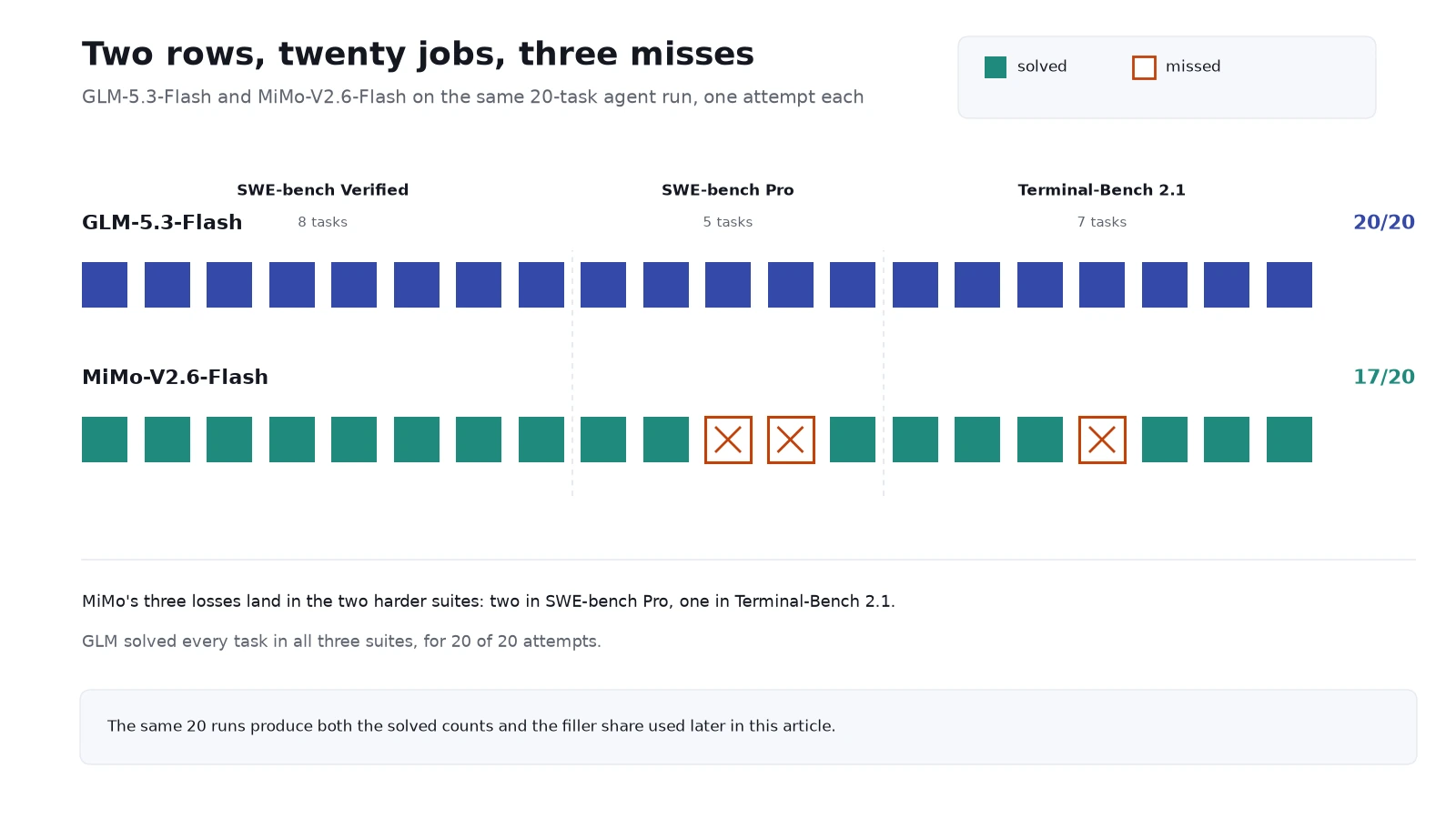
GLM finished the set without a gap. SWE-bench Verified 8/8, SWE-bench Pro 5/5, Terminal-Bench 2.1 7/7, for 20/20 overall.
MiMo finished 17. The two drew level on SWE-bench Verified at 8/8. The Pro suite ended at 3/5, Terminal-Bench at 6/7. Those three failures are the whole difference in completion.
The second score: words that do no work
Filler is not a grammar complaint. In an agent loop, every token a model writes is a token someone pays for. When a model narrates its way through a task, the narration shows up on the bill.
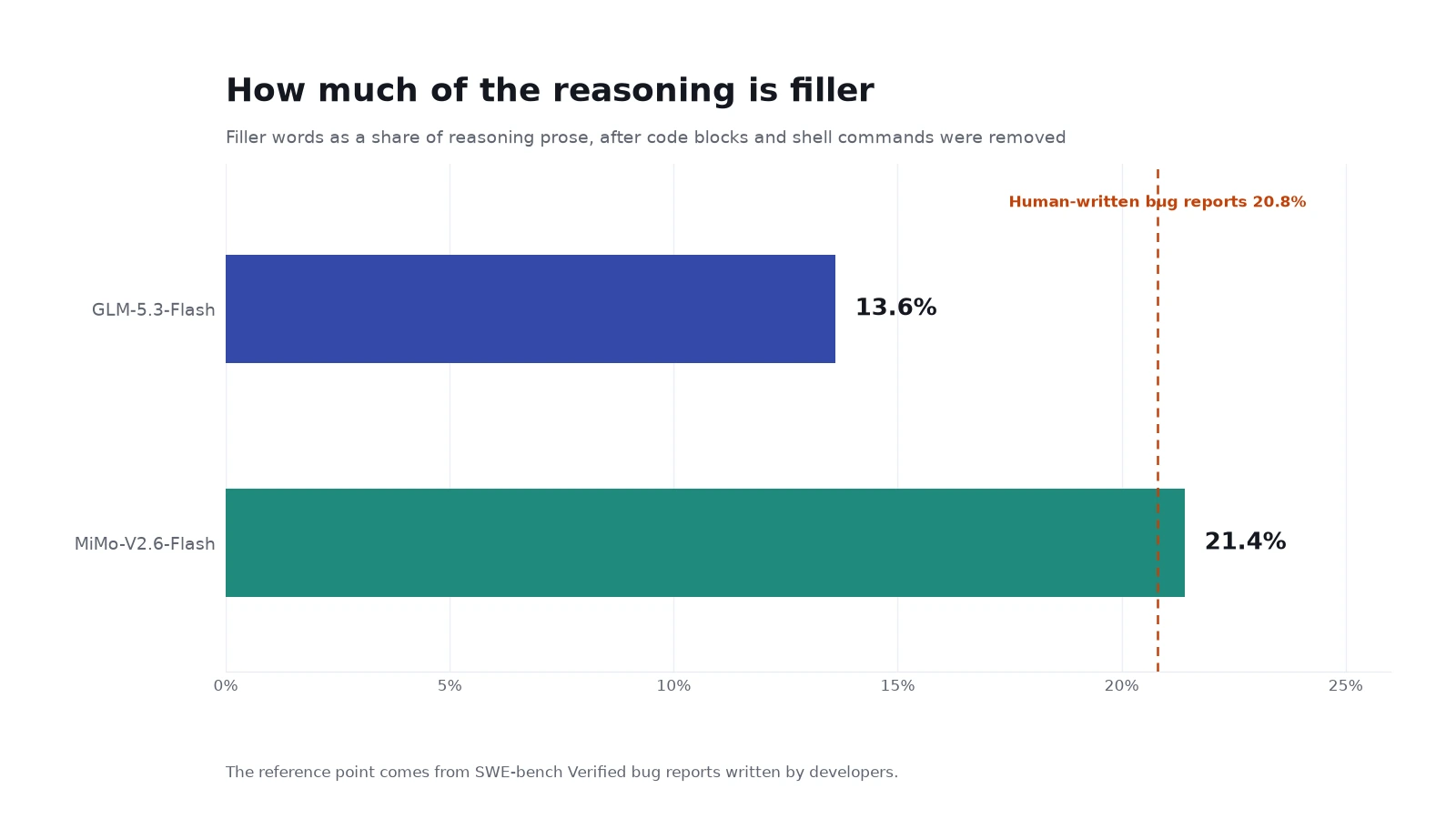
Across the 20 tasks, GLM's reasoning text was 13.6% filler. MiMo's was 21.4%. The study also measured a human reference point: bug reports filed by developers in SWE-bench Verified score 20.8% on the same scale. MiMo writes about as loosely as a person describing a bug. GLM writes tighter than either.
Where the padding collects
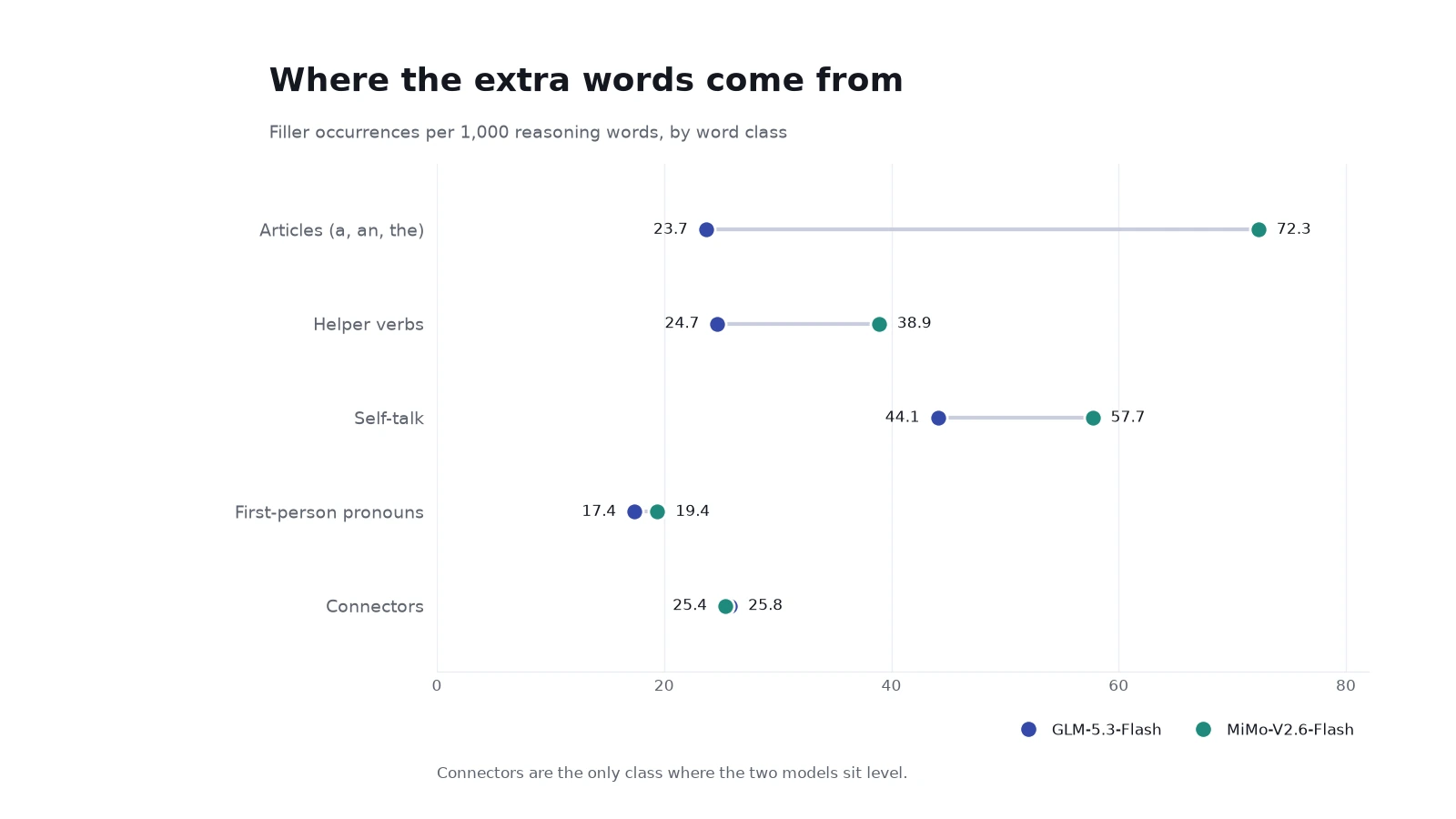
Breaking the total into word classes shows that the gap is not uniform. For every 1,000 reasoning words, the counts were:
| Word class | GLM-5.3-Flash | MiMo-V2.6-Flash |
|---|---|---|
| Articles | 23.7 | 72.3 |
| Helper verbs | 24.7 | 38.9 |
| Self-talk | 44.1 | 57.7 |
| First-person pronouns | 17.4 | 19.4 |
| Connectors | 25.8 | 25.4 |
Articles, meaning a, an and the, create most of the distance, roughly a factor of three. Connectors create almost none. Both models hedge at similar rates, so the surplus on MiMo's side is grammatical packaging around the same amount of uncertainty, not extra deliberation.
The same study found two related patterns. In all three families it examined, successive releases used 25% to 50% less filler than their predecessors without solving fewer tasks. Extra words were not buying better results. One family also spent less as it got terser. GLM-5.3-Flash needed 3,075 reasoning tokens at the median for each task, 18% less than GLM-5.2 managed in the same setup, and 7,809 output tokens at the median, 4% lower. MiMo's token medians are not in the study, so there is no matching figure for its reasoning spend.
The rate card cannot finish the calculation
A token budget for an agent run needs one number the rate card leaves out: the tokens a finished task actually spends. The table below is the starting point, not the answer.
| Billing line | GLM-5.3-Flash | MiMo-V2.6-Flash |
|---|---|---|
| Output | $0.45 | $0.28 |
| Cached input | $0.045 | $0.0028 |
| Input | $0.135 | $0.14 |
GLM's per-task count is public in this test: 3,075 reasoning tokens and 7,809 output tokens at the median. MiMo's is not. Without its medians, a per-task cost for MiMo would be a guess dressed up as arithmetic.
The table still supports three conclusions. MiMo's output rate is lower at $0.28 against $0.45. Its cache reduction is steeper, taking cached input to $0.0028 per million under the stated 98% reduction. And GLM is the only one of the pair with a published reasoning-token median from this run.
What one pass can prove
Single-run evidence has limits worth stating. One attempt per task means a flaky tool call can decide a result. The task list also sits toward the easier edge of agent work; older models in the same study solved 58 of 60 runs, newer ones 60 of 60, which says something about the difficulty of the set as well as the models.
Filler is a measure of style and spend, not a measure of intelligence. The study's own reading is modest: tighter wording cost nothing in quality, and one family also spent less.
No vendor benchmark appears here. All of the numbers come from a single harness, a single configuration and a single window of time.
Which one to start with
Both models can be self-hosted, since both publish MIT-licensed weights, and both can hold a long repository inside a 1M-token window.
When an agent loop runs long and reasoning tokens are metered, this test favors GLM-5.3-Flash. It cleared all 20 tasks, produced the leaner reasoning text, and its median reasoning spend came in below its own predecessor's.
MiMo-V2.6-Flash remains a reasonable second option. The two drew level on SWE-bench Verified, and MiMo's lower output rate suits short bursts that emit a lot of visible text. For the multi-file work behind its three misses, the evidence points to GLM for a first attempt.
Pricing an agent workload on GLM?
GLM is listed as a model family on DSSUB. The model page carries the reference and connection details we can verify today; availability and rates are confirmed per account.