 dssub
By Cameron Voss · Reviewed November 20, 2026
Why the same input price produces two different bills
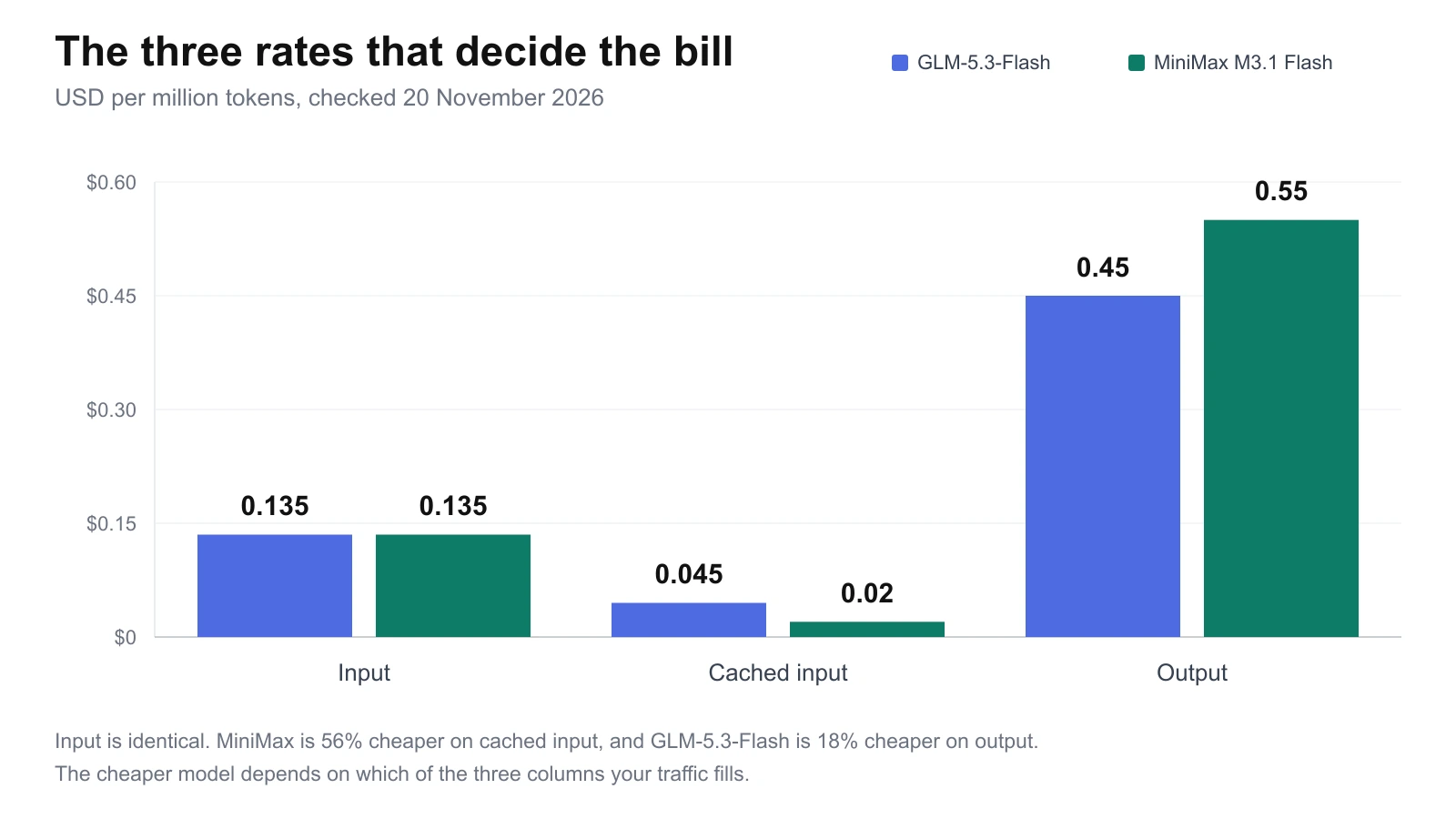
The first line of each rate card is identical, so a comparison that stops there settles nothing. The interesting part starts on line two.
| Billing line | GLM-5.3-Flash | MiniMax M3.1 Flash |
|---|---|---|
| Input | $0.135 | $0.135 |
| Cached input | $0.045 | $0.02 |
| Output | $0.45 | $0.55 |
MiniMax undercuts Zhipu by roughly 56% on cached input. On output the direction flips, and Zhipu is about 18% cheaper. Both margins are small, and neither decides anything on its own. What decides is which of those two lines your traffic loads up.
Reuse-heavy work sends a long prefix again and again and gets short replies back, so almost all of its spend sits in the cache column. Generation-heavy work arrives with a fresh prompt each time and writes 40K tokens back, so almost all of its spend sits in output. The top line matches, but the two bills underneath do not.
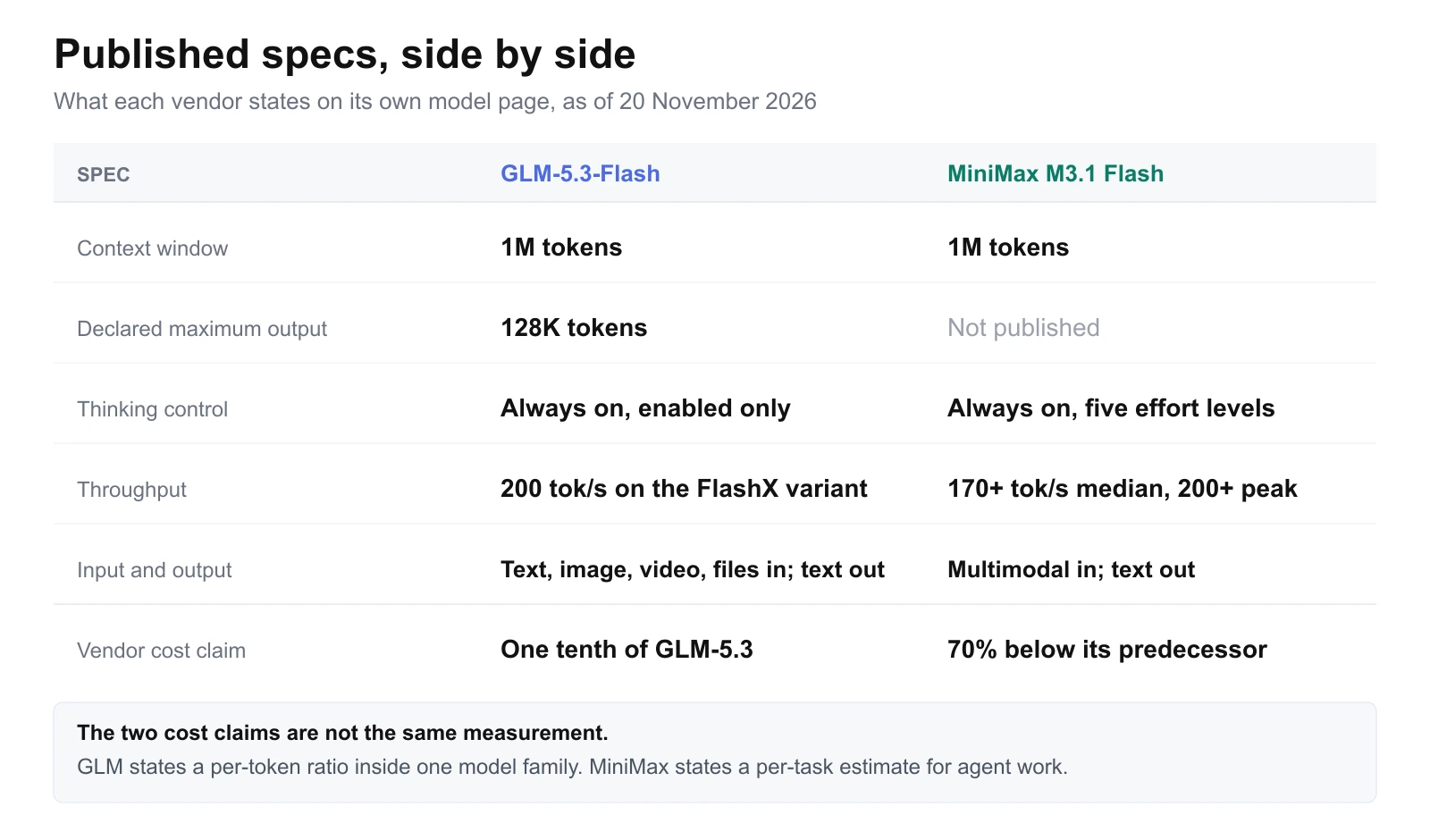
Vendor marketing adds a third set of numbers, and the units do not line up. Zhipu describes the budget tier of its GLM-5.3 line as a tenth of the full model, or a twentieth while the promotion lasts. Coding Plan subscribers get GLM-5.3 usage multiplied by three, and calls placed off peak consume half credits. MiniMax puts agent usage 70% below its previous model. The first group compares tokens inside one family. The second estimates what a finished job costs. They measure different things, so the two claims do not combine.
Which model can hold a long answer
The 1M-token context is common ground. What differs is whether the vendor tells you how much of a reply comes back. Zhipu publishes a maximum output of 128K tokens; MiniMax leaves the figure off its model pages entirely, which means the only way to learn its ceiling is to reach it.
That gap starts to matter when the deliverable is long. A broad refactor, a complete draft of a document, or a structured extraction of real size all have to land inside one turn, and 128K is what makes that plausible.
Zhipu's own architecture numbers explain the choice. The model carries 320B parameters in total and activates 18B per token, pairing sparse attention with a linear variant. Measured against GLM-5.3, the company reports attention work 3.01x lower and a KV-cache 4.44x smaller. Serving a million tokens at this price is only possible once the cache gets that much cheaper.
MiniMax has said nothing about parameter scale for M3.1 Flash. Its 19 October 2026 launch leads with throughput instead, quoting a peak above 200 tokens per second, a median above 170, and inference near three times the previous generation. The stated targets are agent tasks, coding, operating a computer, and security work.
On inputs, GLM-5.3-Flash reads files, video, images and text, and answers in text. MiniMax also takes multimodal input and returns text.
Can you turn the thinking down?
Reasoning runs whether you like it or not on both models, and then the two vendors part ways on everything else. On GLM-5.3-Flash, thinking.type has one legal value, enabled, and a request that asks for the opposite fails. Zhipu's guidance for this tier is reasoning_effort: max. MiniMax answers a disabled request with a 400 status, yet opens depth to five settings: low, medium, high, xhigh and max, with the deepest one preselected.
The knobs are different in kind on each model. Around GLM-5.3-Flash's fixed thinking posture you work on the reply length, the cached prefix, and whether earlier reasoning travels forward, which takes clear_thinking: false. MiniMax hands you a depth choice per request, and a batch of routine calls rarely needs the top setting.
Both return thinking apart from the visible answer. OpenAI-compatible endpoints expose it as reasoning_content. On MiniMax's Anthropic-compatible endpoint it arrives as a thinking block.
What counts as proof for agent work
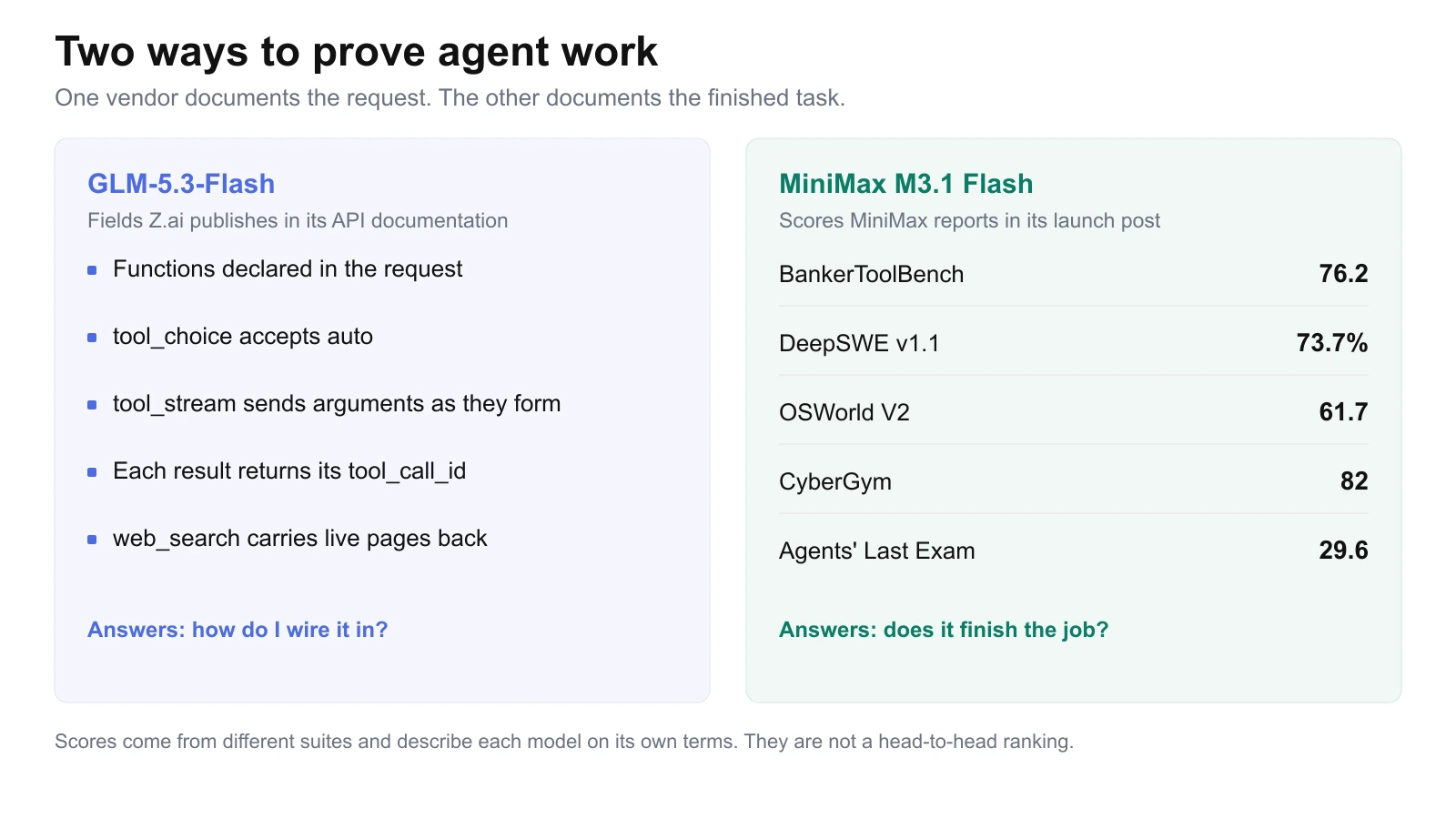
Zhipu makes its case with documentation. Function calling follows the OpenAI format, with functions declared per request. tool_choice offers auto for now. tool_stream releases arguments while they are still being written. Every result has to be echoed back under its own tool_call_id. Live pages from a search tool arrive in a web_search field, which keeps fresh material inside the loop. ZCode, Zhipu's own agent product, runs browser and computer-use sessions on top of the model, and that is where the longer jobs land.
MiniMax argues from results. The launch post describes tool chains and computer operation, then reports BankerToolBench at 76.2 and DeepSWE v1.1 at 73.7%, with OSWorld V2 at 61.7, CyberGym at 82, and Agents' Last Exam at 29.6. Schema details and any hosted search field are missing from the model pages, so an integrator reads the API documentation and tests.
Documentation answers the wiring question. The scores answer a different one: how often a multi-step job gets finished without help.
Which workload fits which model
GLM-5.3-Flash earns its keep when a single call carries a lot in and a lot out. Repository-scale review belongs there, as does analysis of video or images that ends in a written report, and extraction that must not cross a window boundary. A long fixed prompt pays for itself too, since the wider GLM-5.3 family discounts repeated prefixes.
MiniMax M3.1 Flash is the better buy when one task means many calls. Browser and desktop automation belongs there, because the user sees every second of it. High-volume tool routing fits the same shape, since a median above 170 tokens per second drains a backlog faster. So does any pipeline whose unit of account is the completed task rather than the token.
| Workload | Better fit | Why |
|---|---|---|
| Repository-wide review with a long written answer | GLM-5.3-Flash | 128K stated reply limit, prefixes billed at $0.045 |
| Video or image analysis that ends in a report | GLM-5.3-Flash | Accepts files, video, images and text in one call |
| Browser or desktop automation over many turns | MiniMax M3.1 Flash | Median above 170 tokens per second, five effort settings |
| Short calls that reuse one long prefix | MiniMax M3.1 Flash | Cached input at $0.02 per million tokens |
| Work that needs a stated output ceiling | GLM-5.3-Flash | MiniMax publishes no maximum output |
| Per-task budgeting for agent fleets | MiniMax M3.1 Flash | Vendor claims agent cost 70% below its predecessor |
There is no general upgrade in this pair. Each model protects a different budget, and the question worth asking is whether your work looks like one long turn or a run of short ones.
Common questions
Is GLM-5.3-Flash cheaper than MiniMax M3.1 Flash?
Only on some lines. The input rate is the same for both at $0.135. MiniMax is cheaper on cached input, $0.02 against $0.045. GLM-5.3-Flash is cheaper on output, $0.45 against $0.55. Whichever column your usage fills decides the answer.
Can I disable thinking on either model?
No. A disabled thinking.type is refused by GLM-5.3-Flash and answered with a 400 by MiniMax. Depth is the only variable, and MiniMax offers five settings with max preselected. Zhipu's own guidance for the Flash tier is also max.
Does MiniMax publish a maximum output length?
Its model pages carry no such figure. Zhipu states 128K tokens for GLM-5.3-Flash, and both vendors state a million-token window.
Comparing GLM for agent and long-context work?
GLM is listed as a model family on DSSUB. Exact model IDs, point rates and plan coverage are still confirmed account by account, and the GLM page carries the route details we can verify today.