 dssub
By Cameron Voss · Reviewed November 21, 2026
Same input rate, two different bills
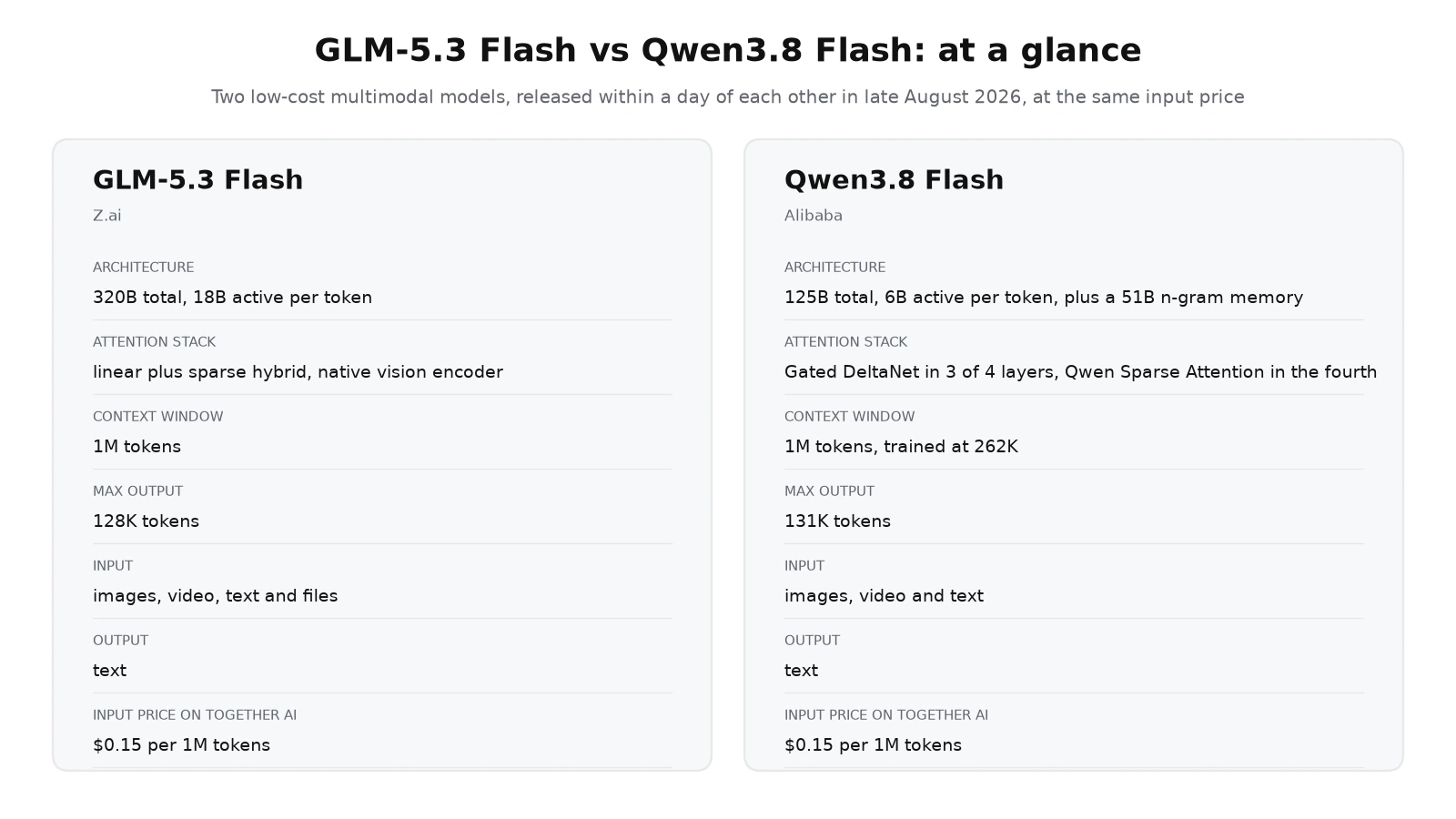
Open either rate card on Together AI and the first row matches to the cent: $0.15 per million input tokens. Output is where the cards first part, at $0.50 per million for GLM-5.3 Flash and $0.47 for Qwen3.8 Flash. Six percent is nothing on a prototype and something on a fleet, so volume decides whether that row matters.
The row that decides most agent bills is the third one. On Together AI, cache reads for GLM-5.3 Flash cost $0.03 per million tokens, a fifth of what fresh input costs, while no cache line appears for Qwen3.8 Flash. Agents that resend an unchanged long prefix with every request pay cache pricing on one card and list pricing on the other. For that traffic shape the budget tier stops feeling like a compromise: a repeated prefix turns into fixed overhead instead of a cost that recurs each turn.
Keep the sheets apart while reading those numbers. That $0.03 figure covers hosted inference at Together AI's list rate. Z.ai instead prices direct access as a slice of GLM-5.3: a tenth in normal times, a twentieth during the launch window. Subscription and reseller plans form a third sheet with terms of their own, and no per-token figure above carries over to it.
Four benchmarks line up, and no more
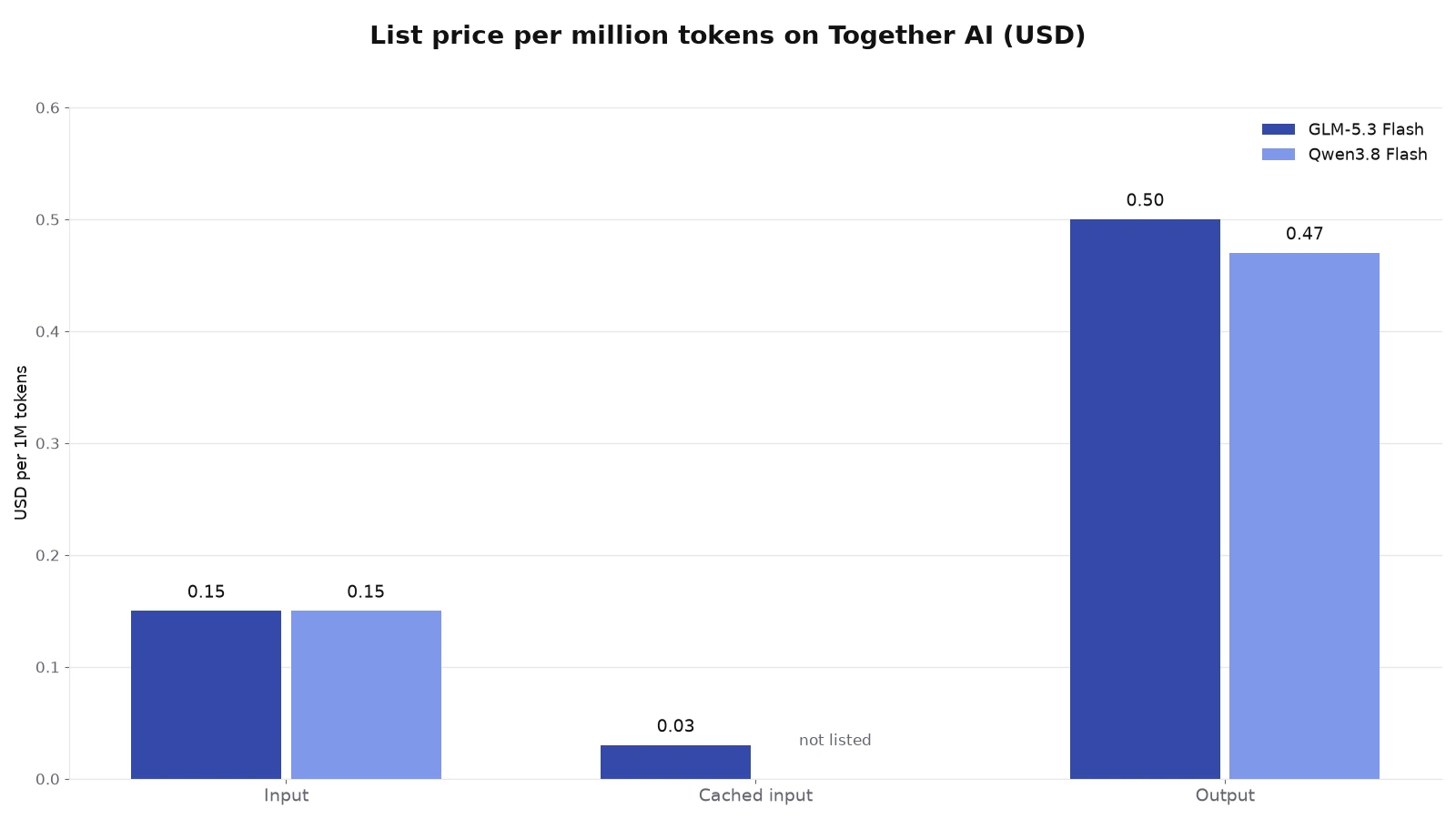
Vendor tables for the two models overlap on exactly four tests. Both vendor tables sit on Together AI's model pages, and those four rows are the sole direct meeting point.
| Benchmark | GLM-5.3 Flash | Qwen3.8 Flash |
|---|---|---|
| DeepSWE 1.1 | 63.4 | 58.7 |
| NL2Repo | 56.3 | 48.1 |
| Toolathlon Verified | 78.4 | 73.5 |
| Agents' Last Exam | 26.3 | 24.3 |
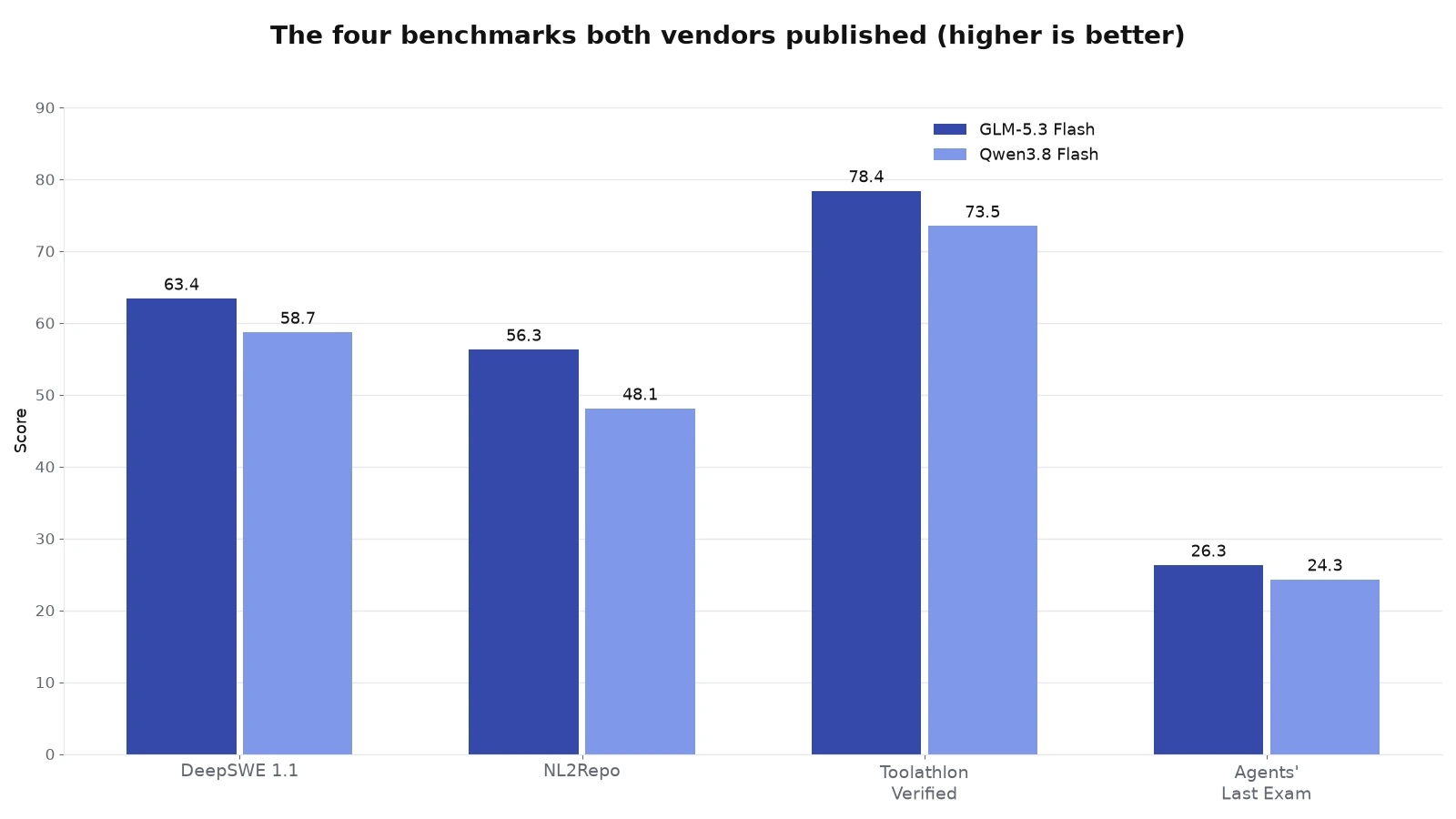
Gaps span 2 to 8.2 points. The widest sits on NL2Repo, which asks for whole-repository code generation. Toolathlon Verified, a test of end-to-end control over real tools, lands 78.4 against 73.5, same direction.
Qwen's own table opens on MathVision 90.6, GPQA Diamond 91.7 and LiveCodeBench v6 91.9, and adds SWE-bench Multilingual 81.0. GLM's table answers with MMVU 80.5, Terminal-Bench 2.1 84.3 and a tool-assisted Humanity's Last Exam at 55.3. None of those rows has a counterpart across the aisle, so they profile one model each instead of ordering the pair.
One caveat covers the section. Every score here was reported by its vendor, and nobody has published the evaluation harness details for both runs side by side. Treat each margin as a hint about direction rather than a measured difference.
Why a million tokens can cost this little
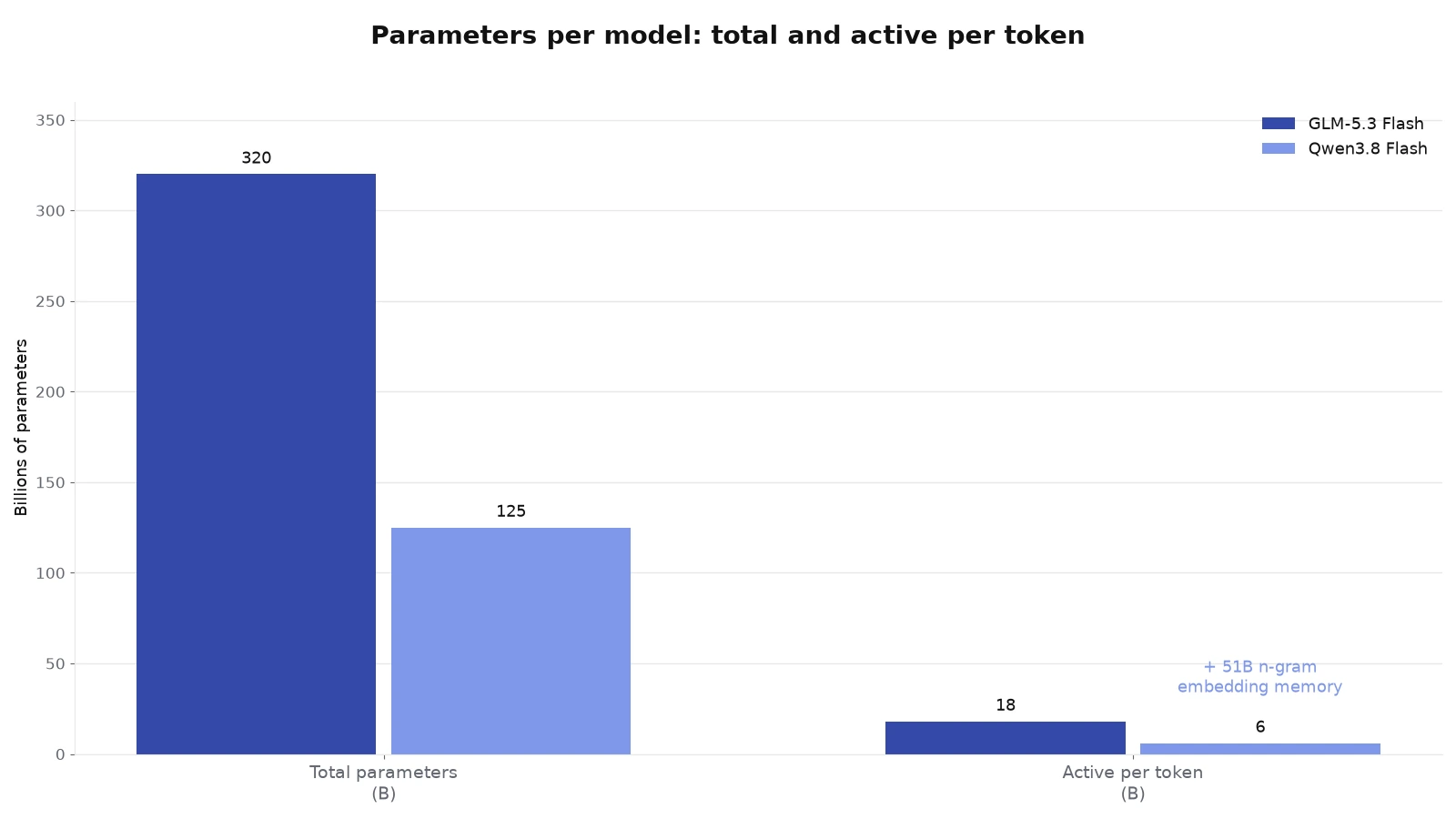
Inside GLM-5.3 Flash sits a mixture-of-experts design with 320B parameters, 18B of which fire on each token. Linear and sparse attention are combined in one hybrid stack, fronted by a native vision encoder, and Z.ai puts the gain at 3.0x lower attention compute plus a KV cache 4.4x smaller than full GLM-5.3. Hence the price: a tenth of GLM-5.3, halved again while the launch discount runs.
Qwen3.8 Flash goes sparser still. Six billion of its 125B parameters activate per token, and alongside the weights sits a separate 51B memory of n-gram embeddings that carries recall. Gated DeltaNet folds history into a constant-size state across three quarters of the layers; Qwen Sparse Attention lets the rest read the entire sequence. The model was trained with a 262K native context and now serves a 1M-token window.
The input menus nearly coincide. Images, video and text go into both models, with file input as a GLM extra, and text is the only output on either side. Each serves a 1M-token context, with reply ceilings of 128K tokens for GLM and 131K for Qwen.
Which workload belongs to which model
GLM-5.3 Flash suits pipelines that begin with pixels or files and finish as written text: ingesting documents, reading screens and video, and running long agent sessions against one cached prefix. Both the tool-loop results and the cache price point at that kind of traffic.
For Qwen3.8 Flash, the target is token-level reasoning: math and science problems, code repair across languages, reading charts and diagrams. A 6B active path holds per-token cost down, and recall lives in the embedding memory instead.
| Workload | Better fit | Why |
|---|---|---|
| Images, video or files in, text out | GLM-5.3 Flash | Ships a native vision encoder and accepts files |
| Long agent sessions that reuse a prefix | GLM-5.3 Flash | Together AI bills cached GLM prompts at $0.03 per million |
| Automation that calls tools | GLM-5.3 Flash | Terminal-Bench 2.1 and Toolathlon Verified both favor it |
| Reasoning in math and science | Qwen3.8 Flash | MathVision 90.6 and GPQA Diamond 91.7, from its own table |
| Code work across languages | Qwen3.8 Flash | 81.0 on SWE-bench Multilingual |
| Cheapest high-volume output | Qwen3.8 Flash | Output billed at $0.47 per million tokens |
Each card wins some columns and loses others, and the same holds for the benchmark sets. Money actually moves on two axes: the four shared test scores and the cached-input rate. Begin with those two, run your own traffic against both models, and commit a product only after that.
Common questions
Is GLM-5.3 Flash cheaper than Qwen3.8 Flash?
On input they are identical at $0.15 per million tokens. Qwen undercuts GLM by 6% on output, $0.47 against $0.50. GLM answers with the only cached rate in the pair, $0.03 per million on Together AI, while Qwen publishes none. Whichever column your traffic fills decides the bill.
Can the benchmark tables be read as a head-to-head?
Only on the four shared rows. Every other row was never run by the other side, so those scores have no counterpart to compare against. The runs are also vendor-reported, with evaluation harness details unpublished on both sides.
What context and output limits do they serve?
A 1M-token window on both sides. Maximum output is 128K tokens on GLM-5.3 Flash and 131K on Qwen3.8 Flash, whose training context was a native 262K.
Comparing flash tiers for agent work?
GLM is listed as a model family on DSSUB. Exact model IDs, point rates and plan coverage are still confirmed account by account, and the GLM page carries the route details we can verify today.