 dssub
By Cameron Voss · Reviewed November 20, 2026
Two agent models shipped three months apart, priced about ten times apart. The rate card is the smaller of the two differences.
Read the request shape before the spec sheet
Line the two data sheets up and a comparison writes itself. It is also the weakest evidence in this piece. Anthropic’s launch page publishes no context-window figure and no output ceiling, and each vendor grades its own harness. The request bodies say more.
One API hands your process a long conversation and expects it back on every call, reasoning included. The other accepts a goal, schedules its own workers, and returns a finished result. That split decides who pays for retries, who trims history, where permissions live, and what share of the invoice you can watch accumulate.
The model IDs, for the record: glm-5.3 on an OpenAI-compatible surface, claude-fable-5-2 on Anthropic’s.
The rate card, and the line each model reuses
Zhipu charges ¥8 per million tokens coming in and ¥28 per million going out; call that $1.13 and $3.94 once ¥7.1 buys a dollar. Input served from cache costs ¥2. Anthropic’s card reads $8 and $40, a markdown from the $10 and $50 of Fable 5.1, plus $0.20 for cache reads and a fast tier priced at double list, $16 and $80.
| Item | GLM-5.3 (Zhipu) | Claude Fable 5.2 (Anthropic) |
|---|---|---|
| Input price, per million | ¥8 (about $1.13) | $8.00 |
| Output price, per million | ¥28 (about $3.94) | $40.00 |
| Cache read price | ¥2 (about $0.28) | $0.20 |
| Context held | 1M tokens | no figure published at launch |
| Max reply length | 128K tokens | no figure published at launch |
| Reasoning switch | none; low, high, max (max default) | High, Xhigh in public runs |
| Accepted input | text alone | unstated at launch |
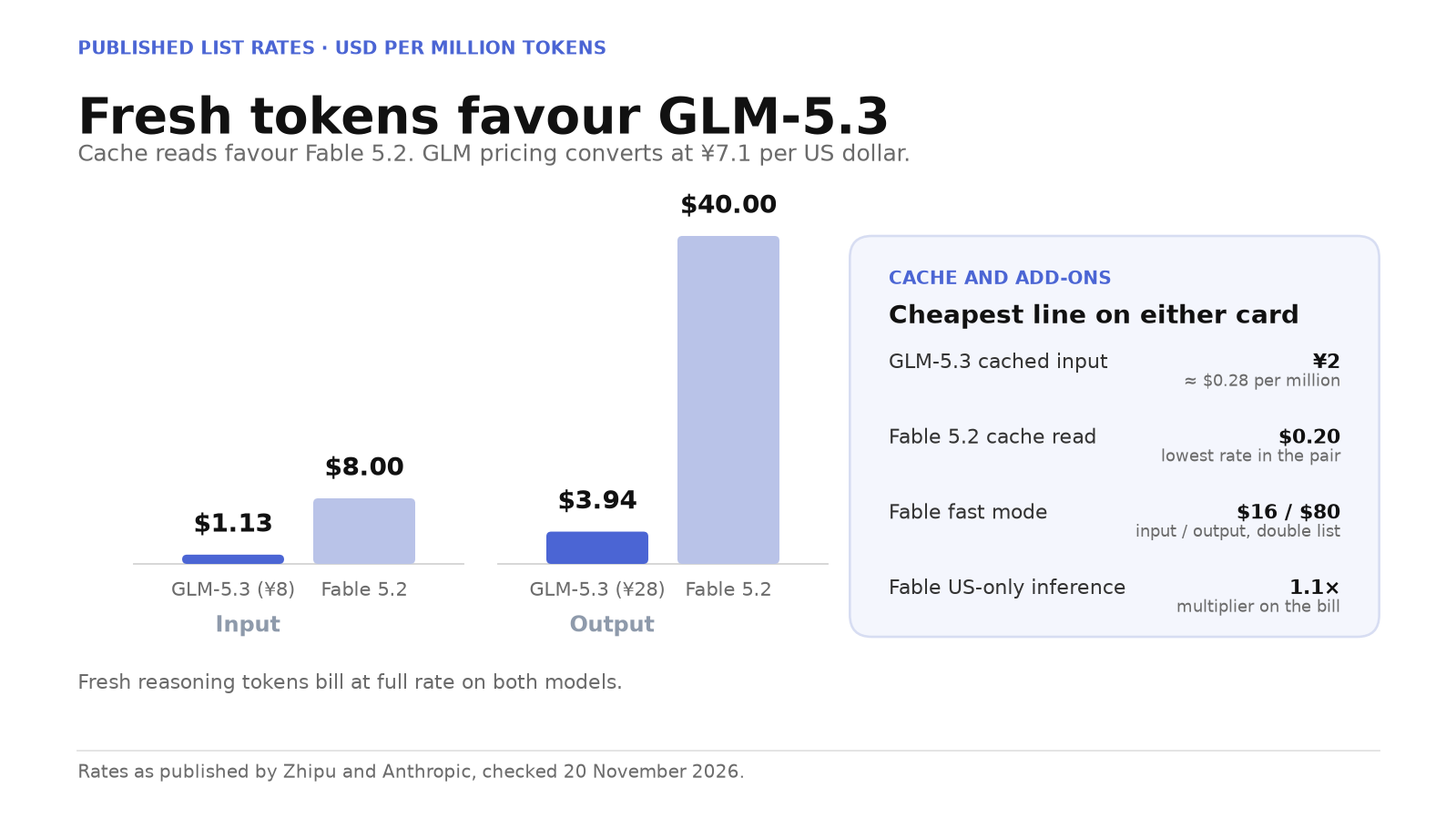
Reuse is where the order flips. A prefix of a few thousand tokens that never changes lets the implicit cache on GLM-5.3 do real work, and a million-token window means less chunking before the model sees the job. Claude workflows shipping the same big document or whole codebase on every call instead ride the $0.20 cache-read line, the cheapest entry on either card.
Thinking never gets a discount: fresh reasoning tokens are billed at list price by both vendors, and since GLM-5.3 cannot stop reasoning, every single call carries them.
Two switches move a Claude bill without touching the architecture: the fast tier doubles input and output, and US-only inference multiplies the total by 1.1.
Two benchmarks overlap; the rest do not
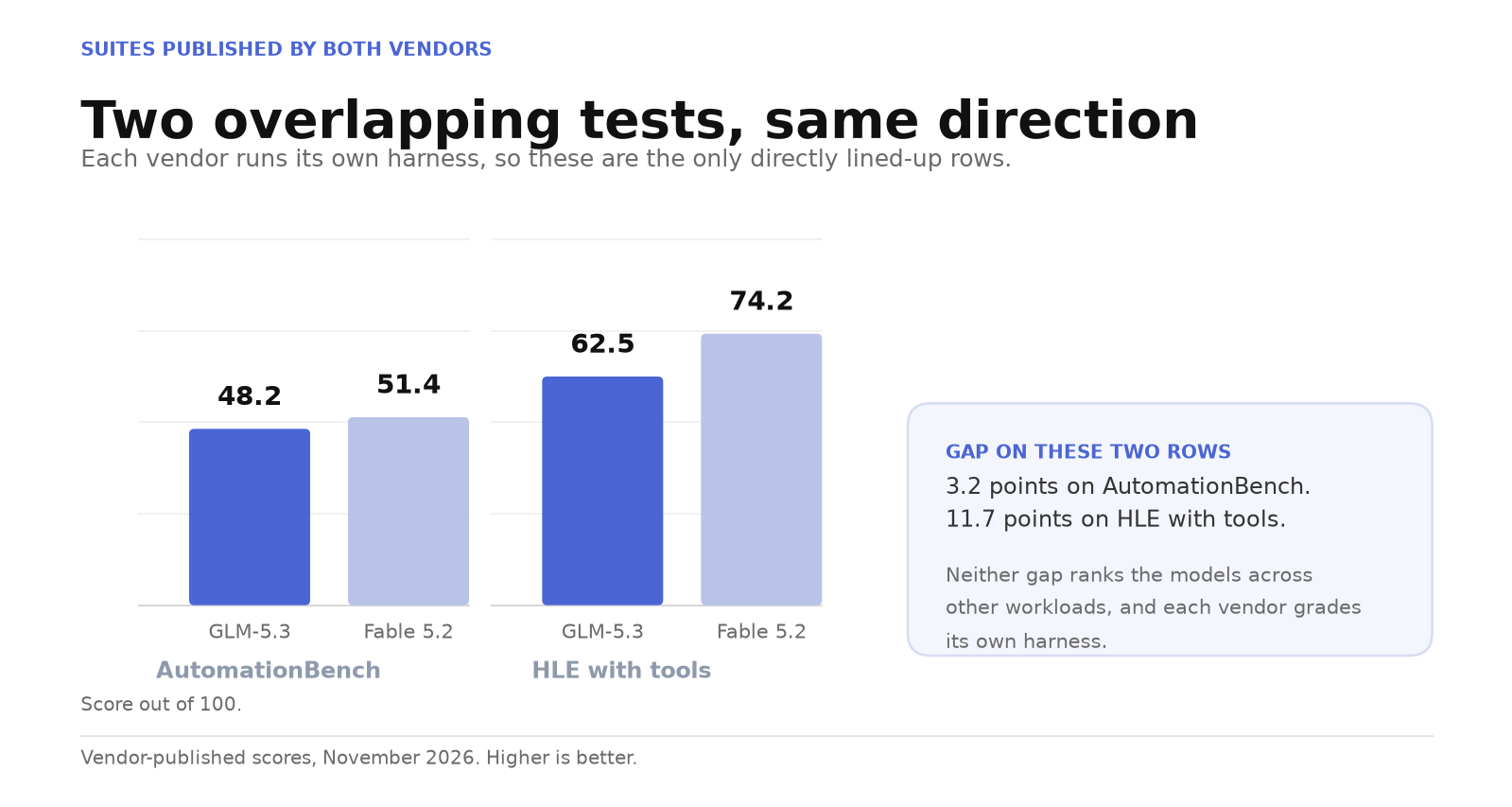
Only two suites appear on both scoreboards: AutomationBench plus the tool-assisted run of Humanity’s Last Exam. Fable 5.2 takes both rows: 51.4 against 48.2, then 74.2 against 62.5.
Everything else is single-vendor. GLM-5.3’s solo rows: Terminal-Bench 3.0, 28.3; DeepSWE v1.1, 66.9; FrontierSWE, 78.1; CyberGym, 84.5; ExploitBench, 54.4; Toolathlon, 73.0; Agents’ Last Exam, 28.5. Fable 5.2’s: FrontierCode 2.0 at Xhigh, 49.1; FrontierSWE v2, 69.9; Terminal-Bench-Science 0.1, 74.6; Remote Labor Index, 41.3; AA-Briefcase, 66.1; Chartography without tools, 73.4.
Merging columns would mislead: Zhipu’s FrontierSWE and Anthropic’s FrontierSWE v2 are separate editions of the suite, just as the plain Terminal-Bench 3.0 harness and its Science 0.1 sibling grade separate task sets. Two common rows indicate a tendency; they settle nothing about other workloads.
Where the loop executes
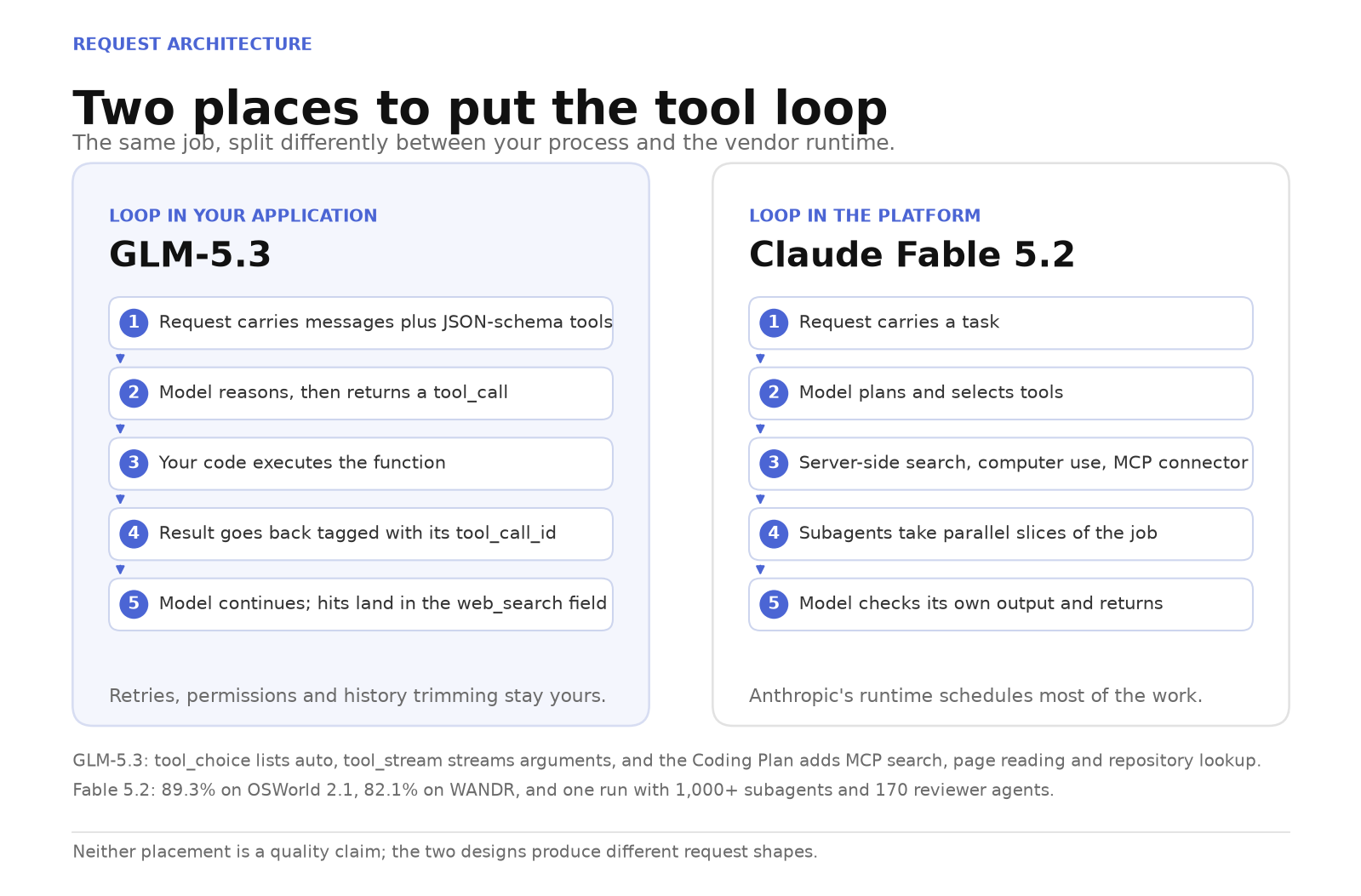
GLM-5.3 speaks the OpenAI function-calling dialect. Schemas for each tool ride inside the request; tool_choice currently offers auto; every tool result returns behind the assistant turn that requested it, tagged with the same tool_call_id. Arguments can stream out through tool_stream, and search results surface in a web_search field on the response. Subscribers to the GLM Coding Plan also get MCP tools covering web search, page reads and repository lookup.
Execution happens in your process, which also decides the model’s next view of the world; retry policy, permission checks and context pruning remain your code’s job. In exchange you keep a trace readable from first call to last, and a payload that an OpenAI- or Anthropic-style client can both carry.
Fable 5.2 works one layer higher: Anthropic’s platform itself performs cited web search, drives computers and exposes an MCP connector. Its launch numbers include 89.3% on OSWorld 2.1 in computer control and 82.1% on the WANDR agentic-search suite. One described orchestration spread work across a fleet past 1,000 subagents while 170 reviewer agents audited the results.
Plumbing disappears, and so does the turn-by-turn walk: you start a task and read a result while Anthropic’s runtime does the scheduling.
Reasoning you cannot switch off
GLM-5.3’s thinking.type field accepts enabled and rejects disabled — send the latter and the request errors out. Three effort tiers exist (low, high, max) and the default is the heaviest. Interleaved thinking reasons between tool calls and again after each result lands. Setting clear_thinking to false preserves prior reasoning inside the context; the reasoning_content echoed back must equal the model’s own output, since edits or reordering cost both the quality of answers and the cache-hit rate.
The rest of the contract is unchanged and worth restating: 1M tokens of context, a 128K output ceiling, and text as the only input, which rules out screenshot-driven workflows.
How each model got here
The Zhipu release landed 14 August 2026 on top of the unchanged GLM-5.2 checkpoint; the work went into post-training, with longer software jobs, more lifelike repositories and denser tool use. Anthropic answered on 9 November 2026 with what it calls its strongest GA model aimed at technical work. The framing is scope instead of thread length: jobs spanning days, vague briefs, self-checking code, many-subagent coordination, targeting coding, long-running agents, science, data analysis, finance, plus 3D or hardware design.
Deployment paths differ too. Shops already deployed on the Claude Platform — or on AWS, Google Cloud, Microsoft Foundry — reach Fable 5.2 with the least setup. Both releases chase the same buyer: a developer whose agent job outlasts a single turn.
Which workload fits which design
Give GLM-5.3 jobs that live in a single thread against a single codebase. Whole-repo review, analysis of long documents, deterministic batch extraction (do_sample: false), and migrations away from a client written for OpenAI or Anthropic APIs all fit that shape. The stable prefix feeds the implicit cache; the million-token window deletes a retrieval layer or two. The costs are the ones already listed: text in only, thinking always metered, loop yours to run.
Hand Fable 5.2 anything divisible: vague multi-day briefs, fleets of parallel subagents, computer control, security or science pipelines, financial and 3D analysis. Cache reads make repeated context inexpensive, and the vendor runtime absorbs most scheduling.
No general upgrade exists in either direction. Zhipu sells cheap, inspectable length; Anthropic sells coordination as a service. Your answer is whichever half of that sentence you want to be responsible for.
Running GLM in a coding loop? The GLM page on DSSUB collects model details, connection formats and current availability in one place.
See the GLM model page → Availability and supported API formats are listed there; confirm before you migrate.