 dssub
By Cameron Voss · Reviewed November 20, 2026
Two answers to one question: where does the loop run?
On 14 August 2026, Zhipu published GLM-5.3. Nothing changed underneath: the checkpoint is the GLM-5.2 base, and the gains come from post-training that used longer and more realistic tasks. Google’s Gemini 4 Carbon arrived on 28 October 2026; general availability followed on 11 November. Built on top of Gemini 4 Argon, it aims at long-horizon engineering, security work and scientific research.
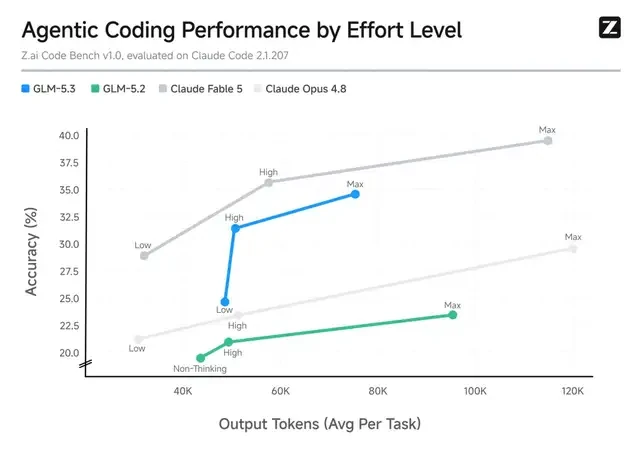
GLM-5.3 runs as one text thread. Its window holds 1M tokens, and a reply can reach 128K. Thinking is mandatory: every request has to send thinking.type: "enabled". Effort offers low, high and max, max being the default. Reasoning counts as output, so max_tokens must leave room for the hidden work as well as the answer.
Once tools join the run, two thinking behaviours matter. Interleaved thinking allows reasoning before a tool call and again after the result lands. Turning clear_thinking to false keeps earlier reasoning available on the next turn. The Coding Plan endpoint enables it by default; the standard API endpoint leaves it off.
Carbon is described in sessions rather than requests. Google says it can keep running for days, exhaust dead ends, and complete engineering work such as tracking down subtle defects in a large codebase and patching them. It accepts images, audio and video alongside text, and its 1M-token allowance is shared by input and output. Work gets launched from the Gemini app or inside Antigravity, and the outcome is read there.
The API surface makes the split concrete. Integrating GLM-5.3 means writing the loop yourself: your code sends the request, handles the tool call, executes it, and returns the output. Integrating Carbon is closer to filing a job, with the platform choosing how many turns to take and which internal steps to run.
Tools: assembled by you, or shipped by the platform
GLM-5.3 follows OpenAI-style function calling. Tools go into the request as declarations, tool_choice currently accepts only auto, and each tool result has to reference the tool_call_id issued by the assistant turn that asked for it. tool_stream releases arguments incrementally, which helps a progress display. If the search tool brings back pages, those pages come through in a web_search field on the response, keeping live results inside the same run. The endpoint also speaks Anthropic Messages, OpenAI Responses and OpenAI Chat Completions, so most migrations amount to a new URL and model name.
The documentation is blunt about the gaps. Strict json_schema mode does not exist, so structured output leans on json_object, field instructions, and a check you run locally. Text is the only modality. Retry logic, permission checks and the message history are still yours to manage.
Carbon moves those pieces into the Gemini API rather than asking you to wire them up. Grounded Google Search and code execution ship as platform features; the agent products handle the turns. Google’s model card flags slow responses, timeouts and a heavier token bill when thinking runs deep. That is the price of delegating the session.
Price and cache: the invoice follows the architecture
On per-token rates, GLM-5.3 is cheaper on both sides of the exchange. Carbon wins on cached reads, a line that matters when every turn resends the same context.
| Spec | GLM-5.3 | Gemini 4 Carbon |
|---|---|---|
| Price, input | $1.20 | $2.00 through 30 Nov, $4.00 after |
| Price, output | $4.00 | $10.00 through 30 Nov, $20.00 after |
| Cached input | $0.50 | $0.10 through 30 Nov, $0.20 after |
| Context window | 1M input / 128K output | 1M shared total |
| Input types | Text | Text, images, audio and video |
| Access | Public API | Antigravity, AI Studio, API, Gemini app |
GLM-5.3 caches without any setup. Any prefix that repeats and runs past roughly 500 tokens gets billed at close to half the usual input rate, and cached_tokens in the usage block confirms the hit. Keep the prompt and the rule set stable, and each repeated call earns that discount.
Access belongs on the cost sheet too. Carbon first reached a closed group of cyber defenders and vetted partners, then general availability; the cybersecurity numbers Google published for the model came out of that programme. No equivalent gate exists for GLM-5.3. The public API is open to anyone.
Benchmarks: read the harness before the score
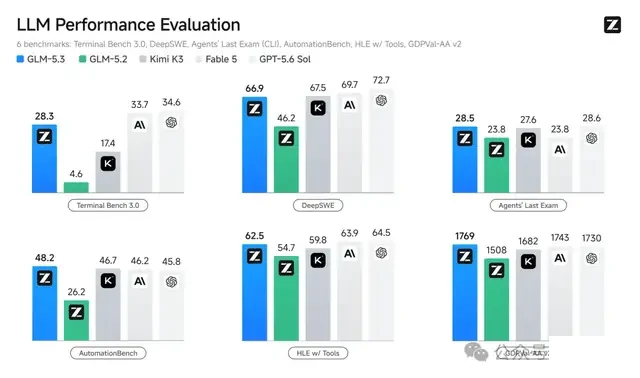
Zhipu’s published set: 28.3 on Terminal-Bench 3.0, up from 4.6 for GLM-5.2; 66.9 on DeepSWE v1.1; 28.5 on Agents’ Last Exam; 48.2 on AutomationBench; 84.5 on CyberGym.
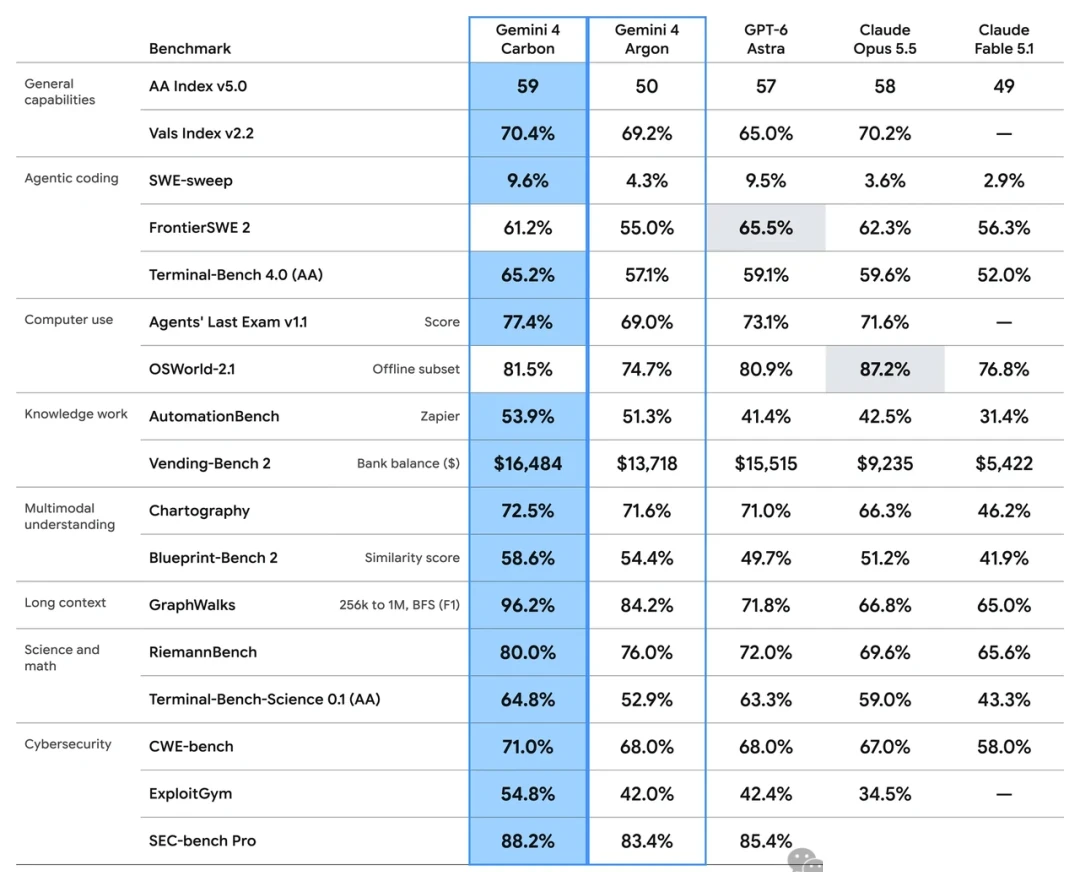
Google’s set: 59 on the Artificial Analysis Intelligence Index v5.0; 65.2 on Terminal-Bench 4.0; 64.8 on Terminal-Bench-Science; 96.2 on GraphWalks between 256K and 1M context; 77.4 on Agents’ Last Exam.
The Terminal-Bench pair is not a head-to-head. Version 3.0 and version 4.0 are separate suites, so 28.3 and 65.2 come from two different tests, not one test measured twice. Most of the table has the same problem: each vendor picked its own tasks. Only a third-party run covering both models puts them on the same footing.
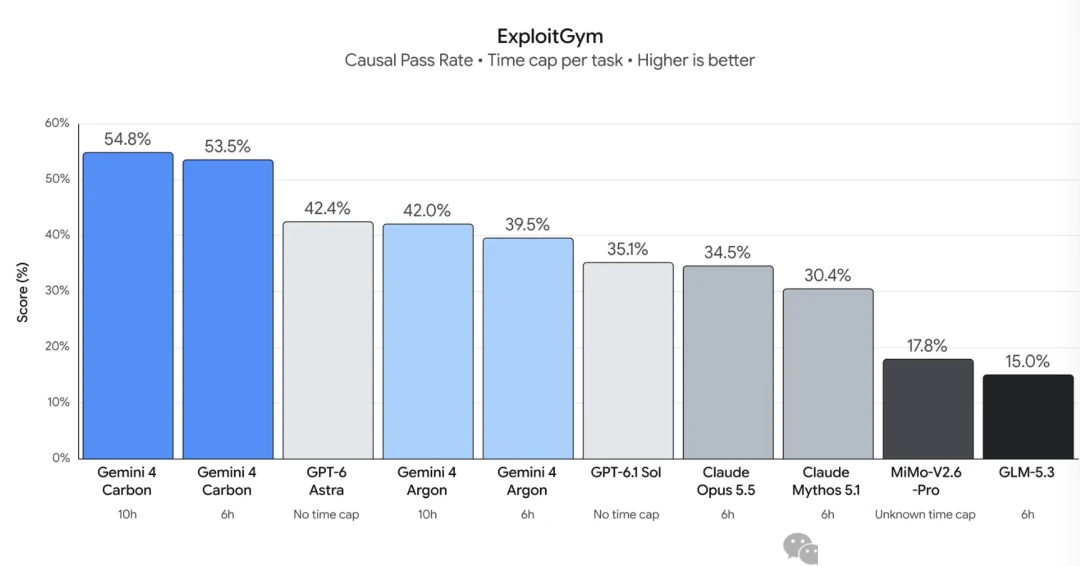
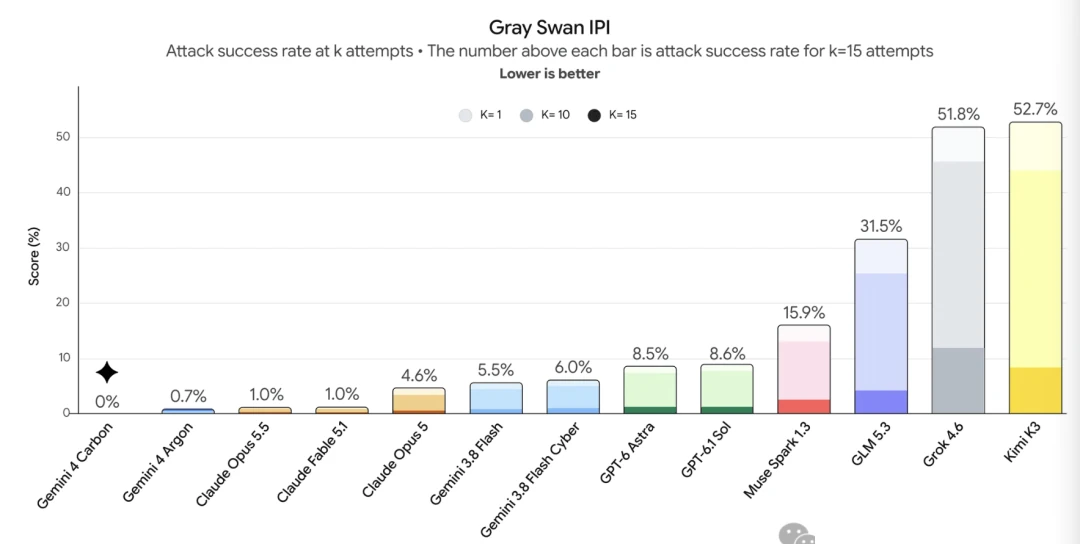
Two charts do put both models on one axis. In Google’s ExploitGym figure, Carbon tops the group at 54.8%, and GLM-5.3 appears lower in the same chart. Gray Swan’s prompt-injection test shows zero successful attacks against Carbon. Both are security evaluations rather than general coding tests, and nothing else published puts the two models on one board as directly as these do.
Pick the workload, not the leaderboard
Choose GLM-5.3 when a job lives in a single text thread and a single repository. Reviewing a whole codebase, analysing long documents, running batch extraction where do_sample: false keeps output repeatable, and moving a client that already targets OpenAI or Anthropic all play to its shape. Keep the prefix stable and the tool schema fixed, and the cache does more of the work.
Carbon is the better pick for jobs that run unwatched for hours and need more than words: multi-hour autonomous coding, security work across big repositories, research that has to read papers alongside screenshots and audio clips, plus jobs where the platform checks its own work before handing it back.
The two products attack the same problem from opposite ends. With GLM-5.3, the conversation stays under your control and your code handles coordination. Carbon takes the session, and the coordination that comes with it, into the product. Neither one is a straight upgrade over the other. The decision is where you want the loop to live.
Run GLM-5.3 through dssub
GLM access sits in the dssub catalog under one account and one API key, alongside the models you already call. The GLM page carries the route details, the supported formats and the current availability note.
Availability and supported API formats are marked for confirmation on the listing; check them before you plan a migration.