 dssub
By Cameron Voss (pen name) · Reviewed November 19, 2026
One model sells turns, the other sells finished work
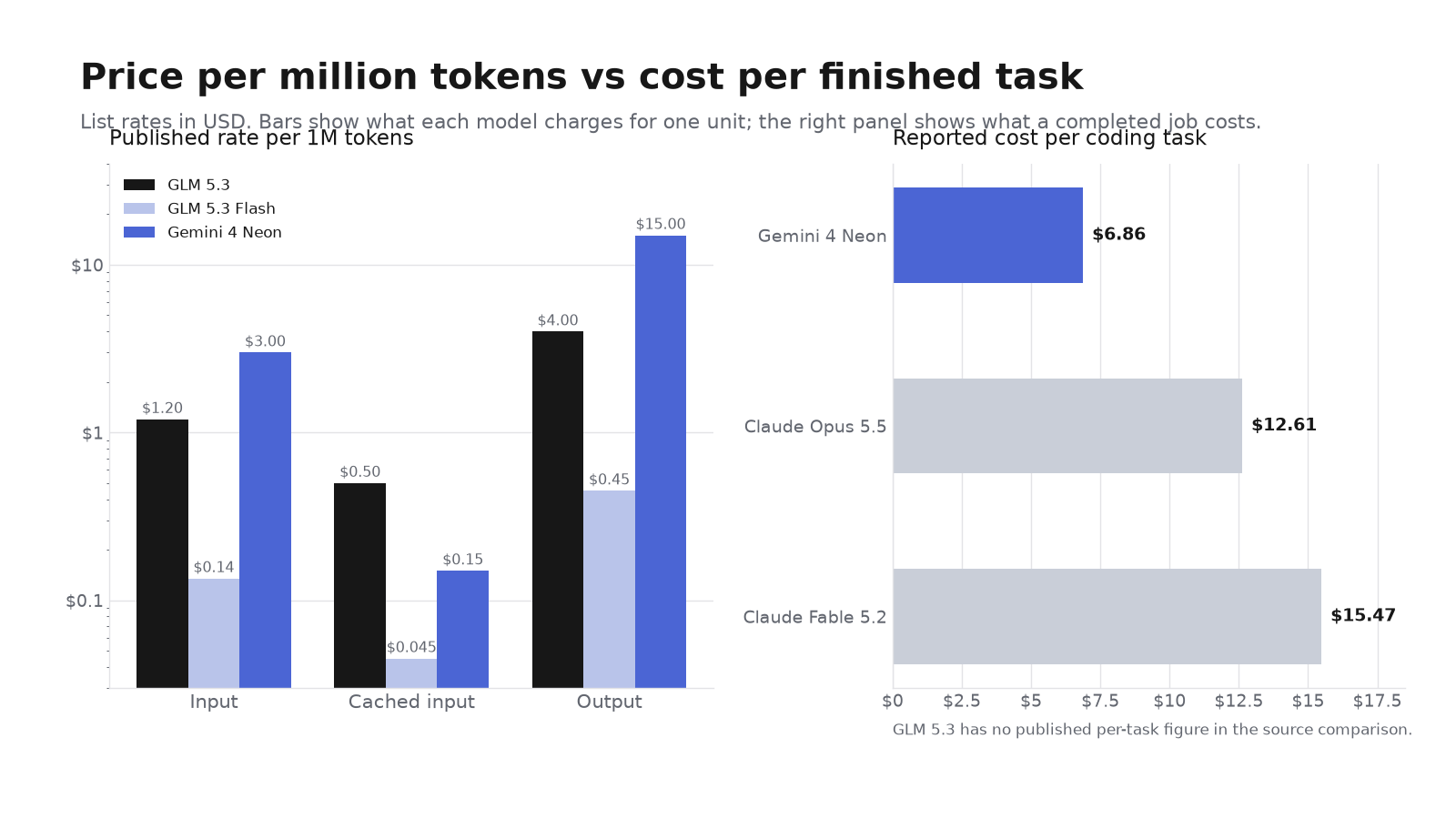
Put the two numbers side by side and the usual instinct fails. Google’s harness puts the average at $6.86 for each coding task Gemini 4 Neon finishes. GLM 5.3 carries a list rate of $1.20 per million input tokens and $4.00 per million output tokens. Stop at the token price and GLM looks cheaper by a wide margin, which is correct for a single call. The question changes once a job needs a plan, several tools and a check at the end.
A token rate describes a request. A task rate describes a product. Neon is offered as a system that plans, delegates and verifies, so its bill covers turns nobody typed. GLM 5.3 is offered as a request path, so its bill stops where the caller’s loop stops. Both measurements are valid. They use different units.
The published rates, line by line
Both sets were checked on 19 November 2026. The GLM values are list prices published with the comparison; the Neon values are Google’s. Treat them as third-party figures rather than dssub billing.
| Rate, USD per 1M tokens | GLM 5.3 | GLM 5.3 Flash | Gemini 4 Neon |
|---|---|---|---|
| Input | $1.20 | $0.135 | $3.00 |
| Cached input | $0.50 | $0.045 | $0.15 |
| Output | $4.00 | $0.45 | $15.00 |
| Context window | 1M tokens | 1M tokens | 1M tokens |
Neon wins a single line: cached input, at $0.15 against $0.50. Google prices cache reads 95% below ordinary input, so a prompt with a long, stable prefix can look far cheaper than one that keeps arriving with new text.
The task side opens the gap further. Next to Neon’s $6.86, the same harness quotes $12.61 for Claude Opus 5.5 and $15.47 for Claude Fable 5.2. Zhipu publishes no per-task figure for GLM 5.3, which leaves the comparison uneven: one model has a measured cost per outcome, the other has a price sheet.
Different machines behind the rates
GLM 5.3 ships as a post-training release. Zhipu kept the GLM 5.2 base and trained on longer, more realistic work: environments stocked with storage, clusters, internal documents, source code, experiment results, a reviewer and a verifier. No new runtime shipped alongside it. Retries, permissions and conversation history stay with the calling application.
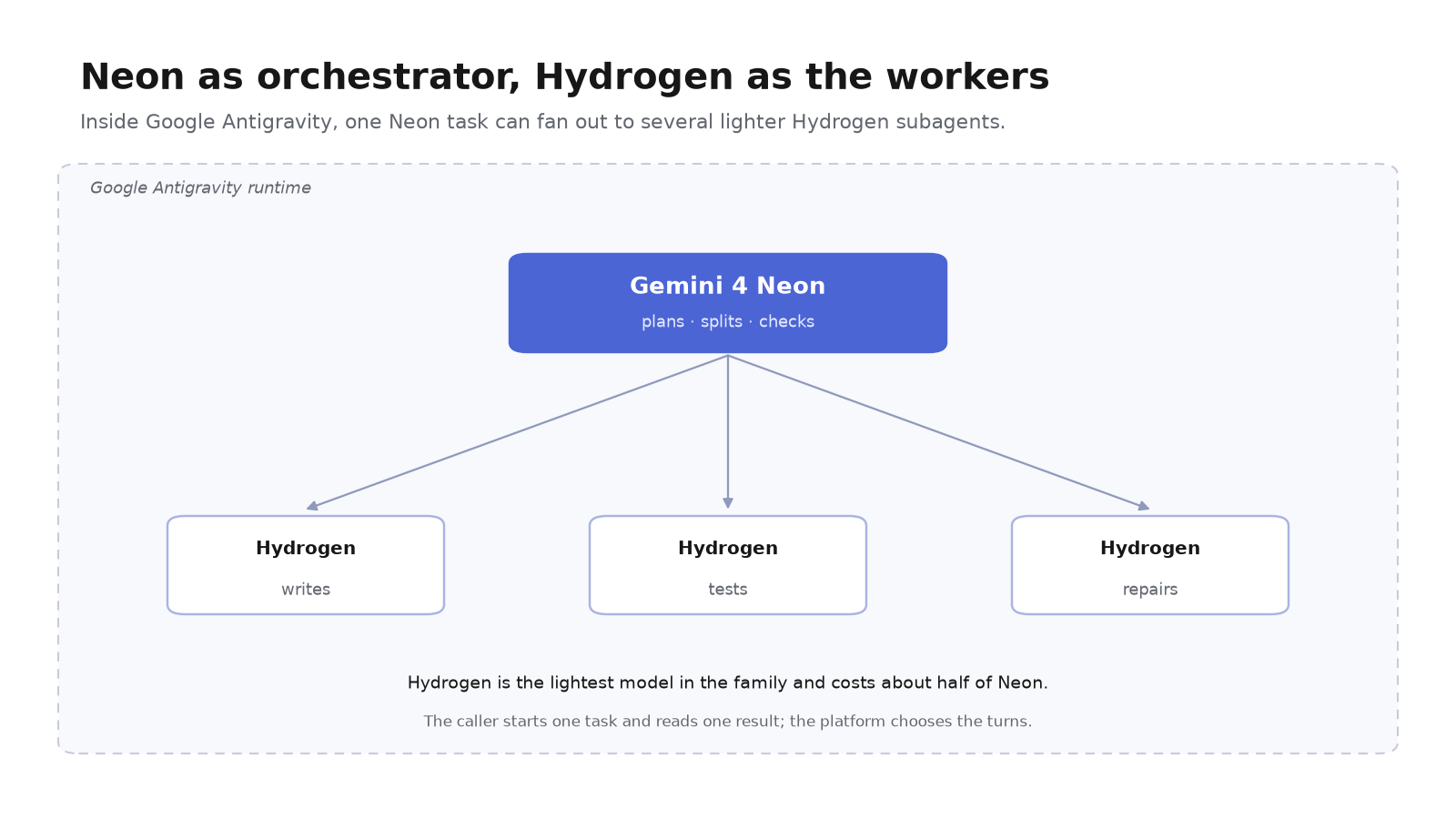
Gemini 4 Neon, announced on 18 November 2026, is the fourth entry in the Gemini 4 family. Much of the coordination lives inside the product. Within Google Antigravity, a large Neon task can be divided and handed to Hydrogen subagents working in parallel. Hydrogen is the least capable model in the family and carries roughly half of Neon’s price, which is what makes delegation pay. The intended shape is fewer, longer turns: the premium model plans and checks while cheaper workers absorb the repetitive writing and testing.
Its launch scores describe the assembled system rather than one model answering alone: 61 on the Artificial Analysis Intelligence Index with extended thinking, 58.6 on the coding-agent index, and about 110 output tokens per second.
Where the thinking switches sit
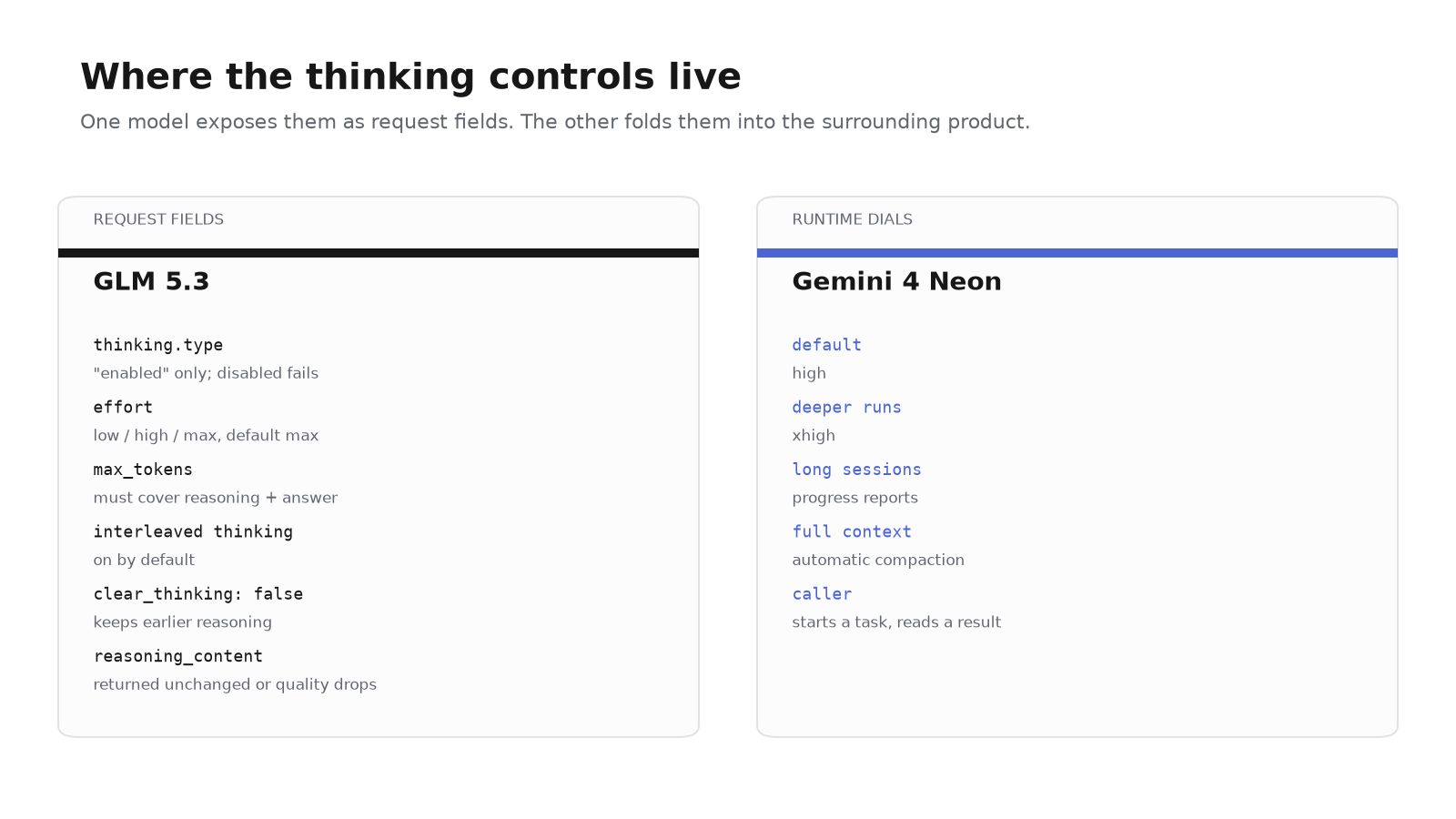
GLM 5.3 treats reasoning as part of the request. It cannot be switched off: a call has to set thinking.type to “enabled”, and anything that asks for “disabled” is rejected. Effort accepts low, high or max, and max is the default. Reasoning tokens count as output, so max_tokens must include both the reasoning and the reply. GLM’s approach is to make each turn affordable, reasoning tokens included.
Two more options matter over long sessions. Out of the box, the model may reason inside a tool loop and once a result comes back. Preserved thinking is switched on with clear_thinking: false; the Coding Plan endpoint enables it by default, while the standard API leaves it off. When the caller returns reasoning_content, it has to be identical to what the model produced. Trimming or reordering that content damages the answer and lowers the cache hit rate.
Neon gives the caller fewer handles. High is the starting point, xhigh exists for deeper runs, and Antigravity posts progress while a long job runs and compacts the context when it fills. With GLM the caller tunes the request. With Neon the product tunes the run.
Tools, search and what the scores measure
GLM 5.3 uses the OpenAI function-calling format. Each call names its tools. At the moment tool_choice accepts auto and nothing else, and each result must carry a tool_call_id tied to the assistant turn that asked for it. tool_stream returns arguments as they form. A search returns a web_search field in the response. Structured output has no strict json_schema path; it is built from json_object, explicit field instructions and a check on the caller’s side. Input is text only. Retries, permissions and history remain in the application.
Neon includes Search grounding and code execution in the Gemini API. Its public scores were produced inside agent products, which matters when reading them: second on the Arena agent leaderboard, 56.3% on Zapier’s automation benchmark and 90.5% on SEC-bench Pro. The coding-agent figure comes from the Antigravity CLI. In that arrangement the caller starts the job and reads the outcome, while the platform settles the turn count and picks the subagents.
Which workload belongs where
GLM 5.3 suits work that stays inside a single text thread and a single codebase. Reviewing a whole repository, working through long documents, running batch extraction with do_sample: false, or porting a client already built for OpenAI or Anthropic all fit. Implicit caching rewards a stable prefix, and a fixed system prompt or rule block of at least 500 tokens can halve the input charge on repeated calls. GLM 5.3 Flash takes busy, simpler traffic at $0.135 per million input tokens.
Neon suits jobs that divide into pieces and can be verified at the same time, especially for teams already inside Google’s stack. Extended unattended coding runs, refactors spread across branches, image and 3D work, and studies that need live search results while the job runs are the natural cases. It is not the answer to everything. Opus 5.5 still leads Terminal-bench 4.1 and FrontierCode 2.0, which leaves the toughest single-file jobs for another model.
The short version
Neither design is a blanket upgrade over the other. GLM 5.3 keeps the intelligence inside one conversation the caller controls and charges for that conversation by the token. Neon relocates the coordinating work into the product and prices outcomes, paying lighter workers underneath. Match the design to the way the work divides, then compare prices in the unit you actually pay.
If the request path matters more to you than the headline benchmark, the dssub GLM model page lists the model facts and connection details we can confirm today, and marks the items still under verification.