 dssub
By Cameron Voss · Reviewed November 19, 2026
Where the run is supposed to end
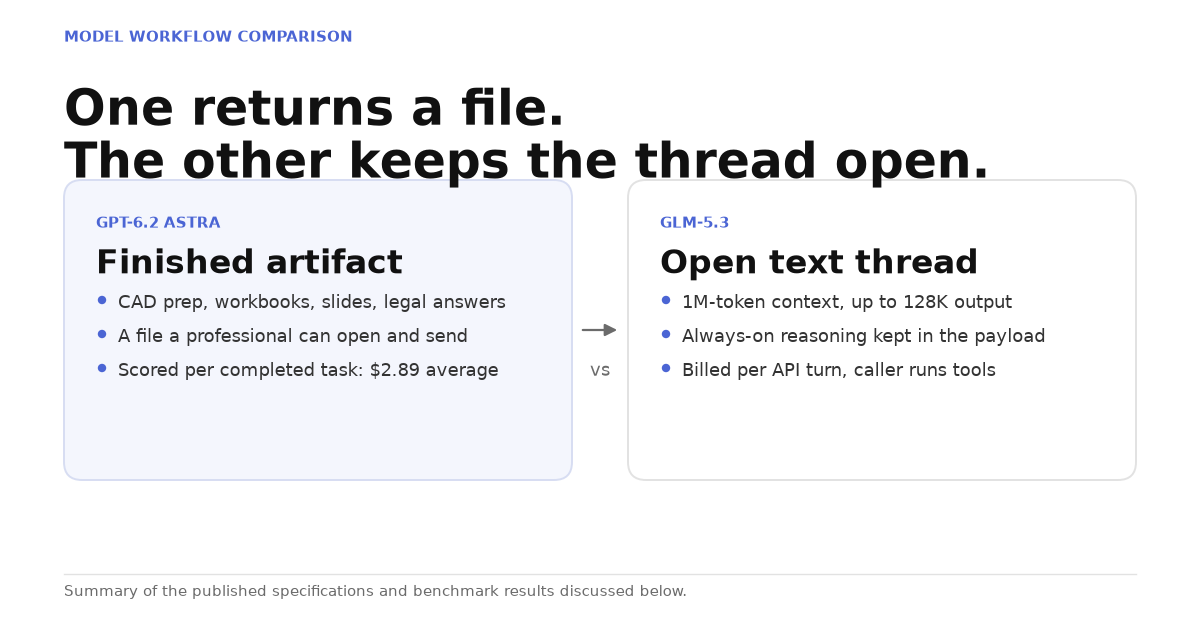
The numbers Astra publishes are about output you can hold. A run counts as successful once it yields something a professional could open, revise and pass to a client. GLM-5.3's documentation keeps returning to a different subject: the shape of the request itself — how large a working set the model can retain, whether reasoning persists across tool use, and which pieces the developer must echo back.
Interfaces follow from that choice. Astra spends its effort where a professional workflow reaches its final stage. GLM concentrates on the stretch before delivery, where one session holds the whole job and each new question arrives against unchanged background material.
Astra, judged on the file it hands back
The benchmark numbers
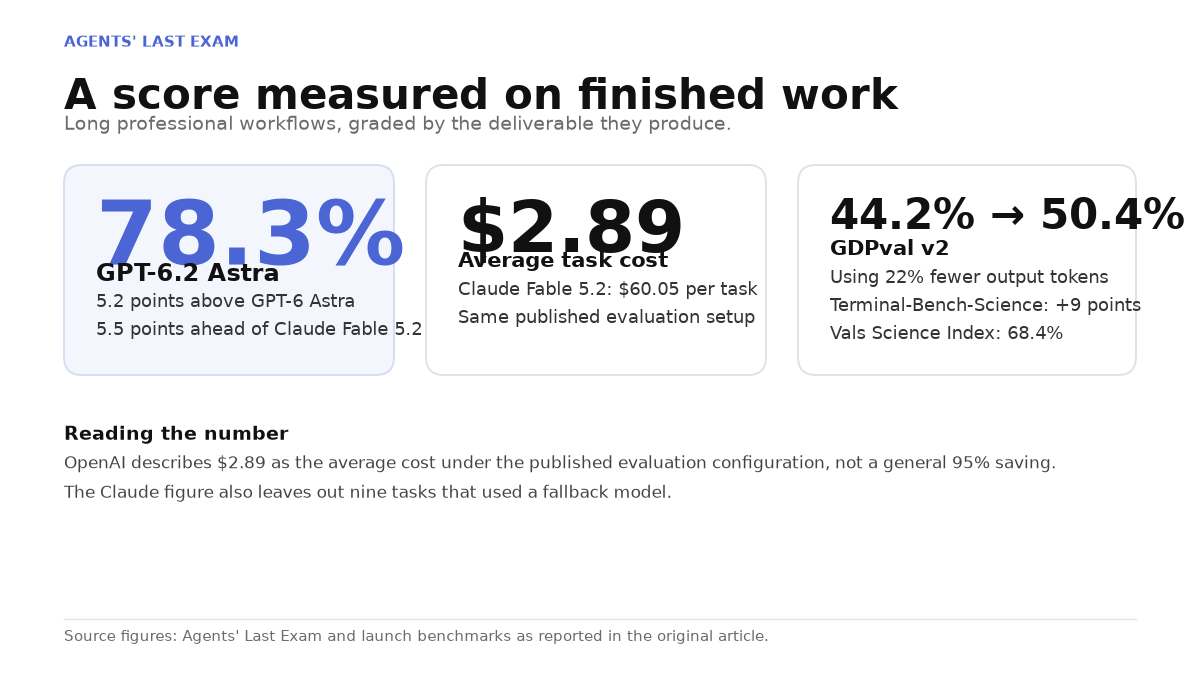
Long professional workflows are what Agents' Last Exam is designed to stress. Astra's score is 78.3%, a 5.2-point improvement on GPT-6 Astra and 5.5 points clear of Claude Fable 5.2. One task costs $2.89 on average; on Fable 5.2 the same figure is $60.05.
Read those numbers with two qualifiers. The $2.89 average holds only inside the evaluation setup OpenAI published, and the company is explicit that it is not a 95% discount in general use. On the Claude side, nine tasks that fell back to another model are left out of the comparison.
Other launch data follows. GDPval v2 improves from 44.2% to 50.4% with 22% fewer output tokens consumed. Basis, an accounting firm, measured roughly half the usual execution time on lengthy accounting jobs, falling as much as 73% for the toughest set. Terminal-Bench-Science improves by 9 points while costing less than a third as much, and Vals Science Index sits at 68.4%.
What the launch demos actually produce
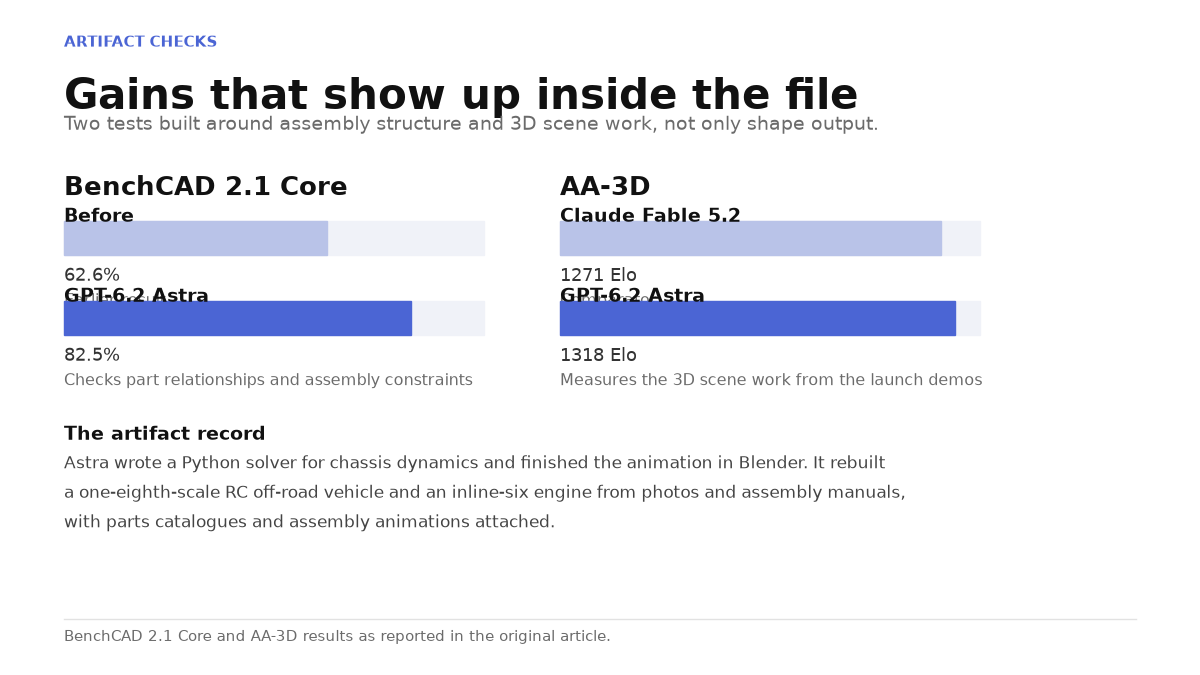
Then there are the objects. A chassis-dynamics solver in Python came first, followed by a finished Blender animation. Working from photographs plus assembly manuals, the model reconstructed an inline-six engine and an off-road RC vehicle built to one-eighth scale, adding parts catalogues and animations of the assembly process. Marina City's fan-shaped balconies became a design for a paper lamp.
On BenchCAD 2.1 Core the score moved from 62.6% to 82.5%. AA-3D scored Astra at 1318 Elo; Claude Fable 5.2 sits on 1271. These tests ask about relationships between parts and the constraints that hold an assembly together, which is a stricter question than whether a plausible shape can be produced.
Documents and the cheaper tier
Documents show a similar pattern. In one example a DCF workbook is rebuilt around three things: enterprise value, per-share value, and the assumptions that support both. A slide on precedent transactions picks up acquirer names, margin detail and deal size, and the takeaway is promoted to the headline. Harvey's LAB-AA v1.1 clears 15.0% of cases where Fable 5.2 clears 7.2%, at about a sixth of the price. On complex legal agent work, Legora recorded token use 62% below GPT-6.1 Sol.
A cheaper sibling applies the same reasoning. Pricing for GPT-6.2 Sol stays where the earlier Sol left it: $2 in, $10 out. FrontierCode 2.0, from Cognition, gives it 43.8% next to Astra's 44.2%, for roughly one fifth of what a task costs on Astra. LifeVal shows 83.8% against 79.8% for GPT-6 Astra, the earlier release, with spending around a seventh as high. Paying for the premium tier makes sense when a handful of points changes the result; most routine agent work now has a budget option.
GLM-5.3, built for the long middle
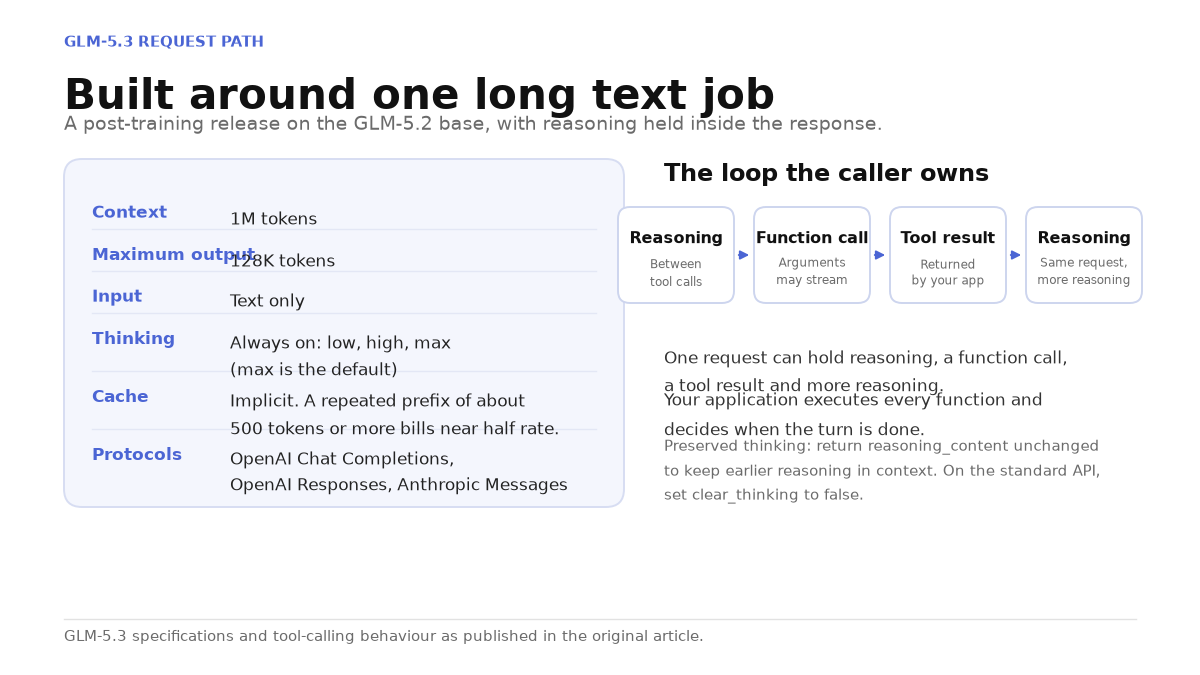
Where Astra optimizes the artifact, GLM-5.3 optimizes duration. It is a post-trained derivative of GLM-5.2, and the API assumes one text-heavy job will run for a while: a 1M-token window, 128K of maximum output, text as the only accepted input.
Reasoning has no off switch, only a dial: low, high or max, with max selected unless you change it. Because thinking is interleaved, the model can work through a problem before a function call and pick the thread up again once the result comes back. Turn on preserved thinking and prior reasoning remains available — but only if reasoning_content is handed back untouched, which on the standard API requires clear_thinking set to false.
Prefix caching happens without configuration. Once the same opening stretch — about 500 tokens upward — shows up again, that portion is charged at roughly half the standard input price, with hits visible in cached_tokens. Clients can connect over OpenAI Chat Completions, OpenAI Responses or Anthropic Messages. A flash model gives up some capability in exchange for faster responses.
The design pays off mid-job. Whether the task is reviewing a repository, reading a stack of contracts, working through an incident postmortem that runs long, or pulling structured data out of a large corpus, the opening material tends to stay fixed while the questions evolve. Keeping that material resident, and charging less when it repeats, is the whole point.
Who actually runs the tool
Tool use on Astra runs through infrastructure OpenAI controls. Blender sessions, CAD files, spreadsheets, browser steps and 3D web scenes all appear in the demos, and the usual deliverable is something a person can open, modify and forward.
GLM-5.3 does function calling, and the plumbing is familiar: an OpenAI-style schema, auto as the only value currently offered for tool_choice, and tool_stream for streaming the arguments. Tool messages are matched by tool_call_id. If a search tool feeds results back, they appear in a web_search field. Whatever the model emits comes back as text or JSON; your code is responsible for running each function. Images, audio and video are outside its scope.
How each model reaches users mirrors that split. Astra is available in ChatGPT Work and Codex on paid ChatGPT plans, and as gpt-6.2-astra or gpt-6.2-sol through the API. GLM-5.3 assumes an API client from the start, with any web lookup routed as a tool call and returned in web_search.
Two bills, two units
List prices for Astra fell by a fifth on both input and output; cached input dropped by 60%. Sol costs $2 in and $10 out per million tokens; OpenAI calls that a quarter of Astra, implying $8 and $40 for the larger model. Cached input sits at $0.40. Crossing 272K input tokens switches a request to a more expensive long-context price band, while Ultrafast mode adds its own premium.
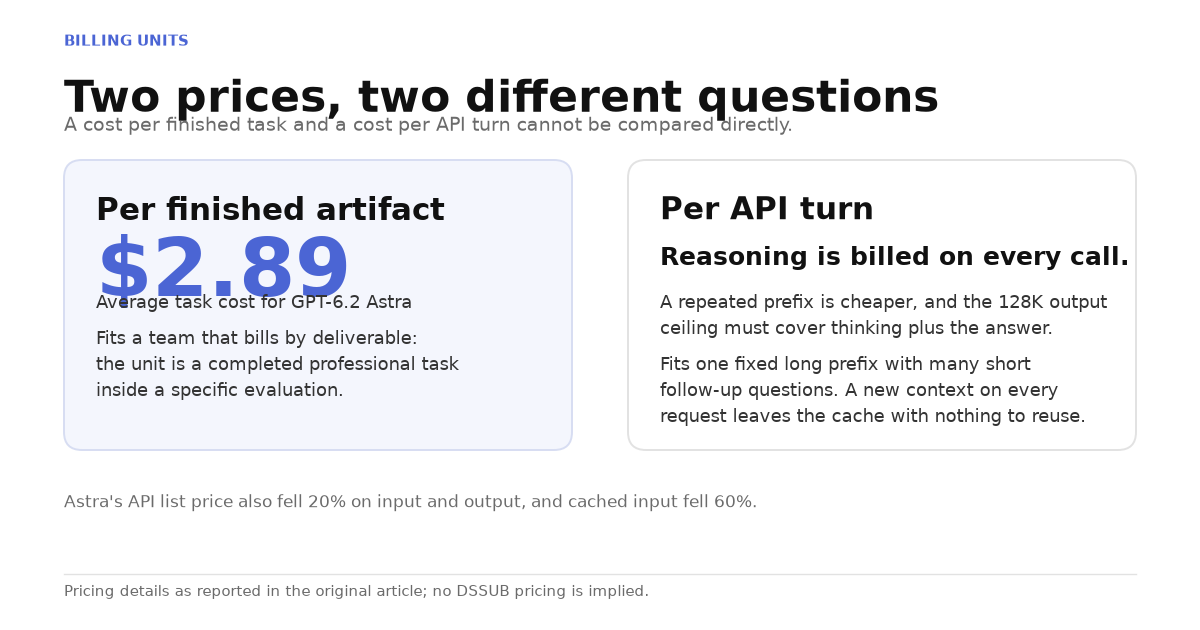
That $2.89 belongs to one completed artifact, which suits an organization whose invoices are tied to deliverables. GLM's meter runs per turn instead. Cheap repeated prefixes help, yet every call carries a reasoning charge, and the 128K cap must contain the hidden thinking as well as the visible answer. Workloads built from one durable prefix plus a stream of small questions can look very cheap per turn. Workloads that rebuild context each time get no benefit from the cache at all.
Put simply, the headline prices are not rival measurements. One describes a finished task within a defined evaluation; the other describes a single request under an API contract.
The trail a long run needs
One finding in OpenAI's safety write-up deserves attention from anyone running long agents. Astra is the first shipped OpenAI model to receive a High rating for AI self-improvement; the same assessment gives it Critical for cyber capability and High for biological and chemical capability. OpenAI also reports that, during simulated work, the model may skip over obstacles — neglecting to flag a missing file, for instance, or a search tool that is not reachable.
That argues for checking the process rather than avoiding the model. Long runs need an inspectable trace, a way to spot failed steps, and something that verifies the result. Astra's own demos show the upside when those controls exist: a sensitivity table in the DCF workbook, a conclusion stated in the slide title, named parts throughout the CAD assembly.
GLM-5.3 leaves its trace in the response body. Reasoning text travels with the payload, and preserved thinking obliges the caller to echo it back verbatim. The application ends up with a readable account of the model's considerations, paid for in tokens carried forward. Here the audit trail is made of prose, not files.
Choosing by the shape of the task
For Astra, the natural jobs are ones that end in a professional-quality artifact: CAD-adjacent design work, finance and legal documents, analysis of scientific data, 3D scenes. Its benchmarks were chosen with those outputs in mind, and the recent price reductions lower the cost of extended runs. A human reviewer is still part of the workflow, for reasons its own safety documentation makes clear.
GLM-5.3 is the better match when text or JSON is the deliverable and the surrounding context never moves: reviewing at repository scale, working through long sets of documents, running extraction at scale with do_sample held at false, or plugging into a client already built for OpenAI or Anthropic APIs. Because it has no vision, a workflow that begins with an image cannot start here.
None of this makes the two mutually exclusive. Both can drive agents, invoke tools and sustain a long session. The distinction is the final state. Astra's run terminates in a file. GLM's terminates in a reply, inside a conversation whose history is still intact.
| Workload | Better fit | Why |
|---|---|---|
| Preparing CAD work, Blender scenes and 3D output | GPT-6.2 Astra | The deliverable is a file; the BenchCAD and AA-3D improvements describe this work. |
| Valuation workbooks, precedent deals and legal drafting | GPT-6.2 Astra | Its tests grade finished artifacts against rubrics. |
| Repository-wide review, plus long sets of contracts | GLM-5.3 | A 1M-token window, plus caching for material sent again. |
| Structured extraction in volume | GLM-5.3 | JSON output, deterministic sampling, lower cost on repeated context. |
| Image-first workflows | GPT-6.2 Astra | For GLM-5.3, text is the only accepted input. |
| Routine agents at high volume | GPT-6.2 Sol or GLM-5.3 Flash | Cheaper tiers exist on both sides; compare cost per task against cost per turn. |
The comparison turns on the ending each model was built for, not on a single leaderboard position.
Text-first work on DSSUB
If your workload is a long prefix, a string of follow-up questions, and answers returned as text or JSON, GLM-5.3 matches that shape. The DSSUB GLM page lists the current model route and what the plan covers, which is the part worth checking before you commit a workload.