 dssub
By Cameron Voss · Reviewed November 19, 2026
A cheaper token is not a cheaper task
An agent bill has three moving parts: what a token costs, how many tokens a task burns, and how much input you send again. A model can win on one line and lose on another. GPT-6.2 Sol and GLM-5.3 sit on opposite sides of that ledger, which is why a simple price comparison misleads.
Line one: the rate
Sol keeps the price card from the previous Sol release. Input costs $2 for every million tokens; output costs $10 for every million. Astra, the larger GPT-6.2 model, charges four times as much on both. Cached input runs $0.10 per million on Sol and $0.40 on Astra. The source used here does not disclose GLM-5.3's input or output rates, so the rate line cannot be settled for GLM.
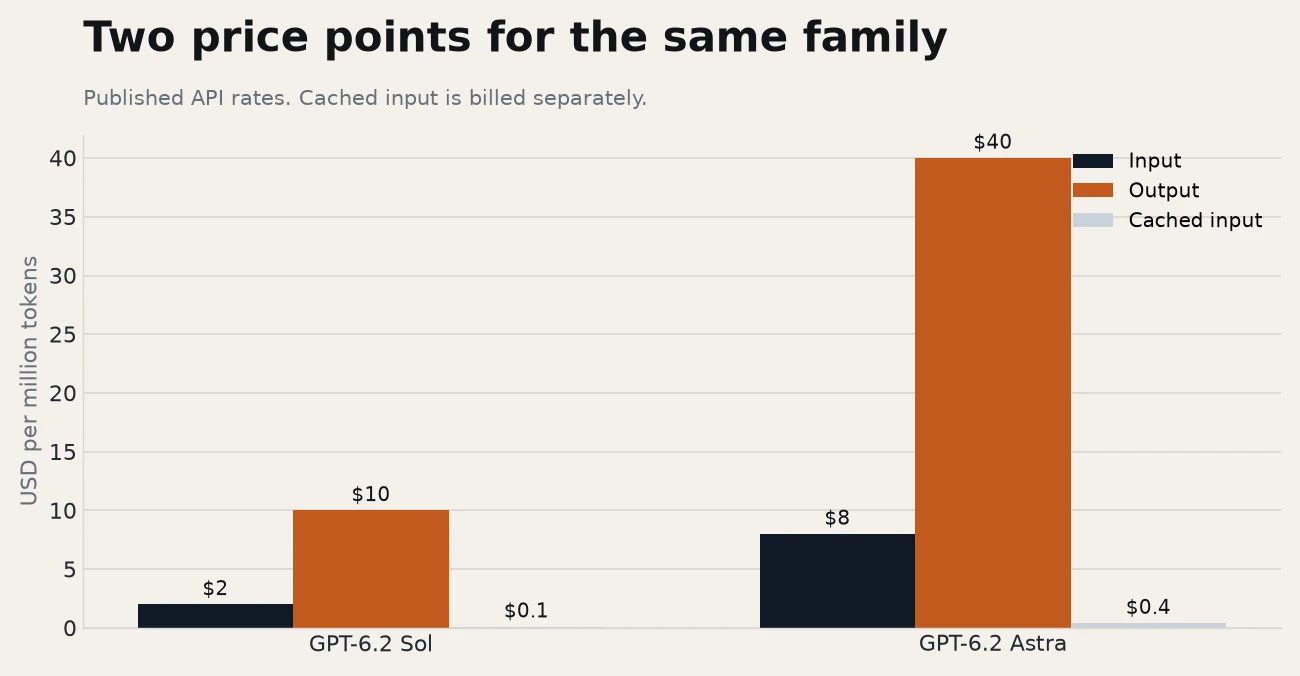
Rate alone rarely decides the bill. A model with a higher sticker price can finish with fewer calls and fewer tokens, and a model with a low sticker price can spend those savings on retries.
Line two: how many tokens the job burns
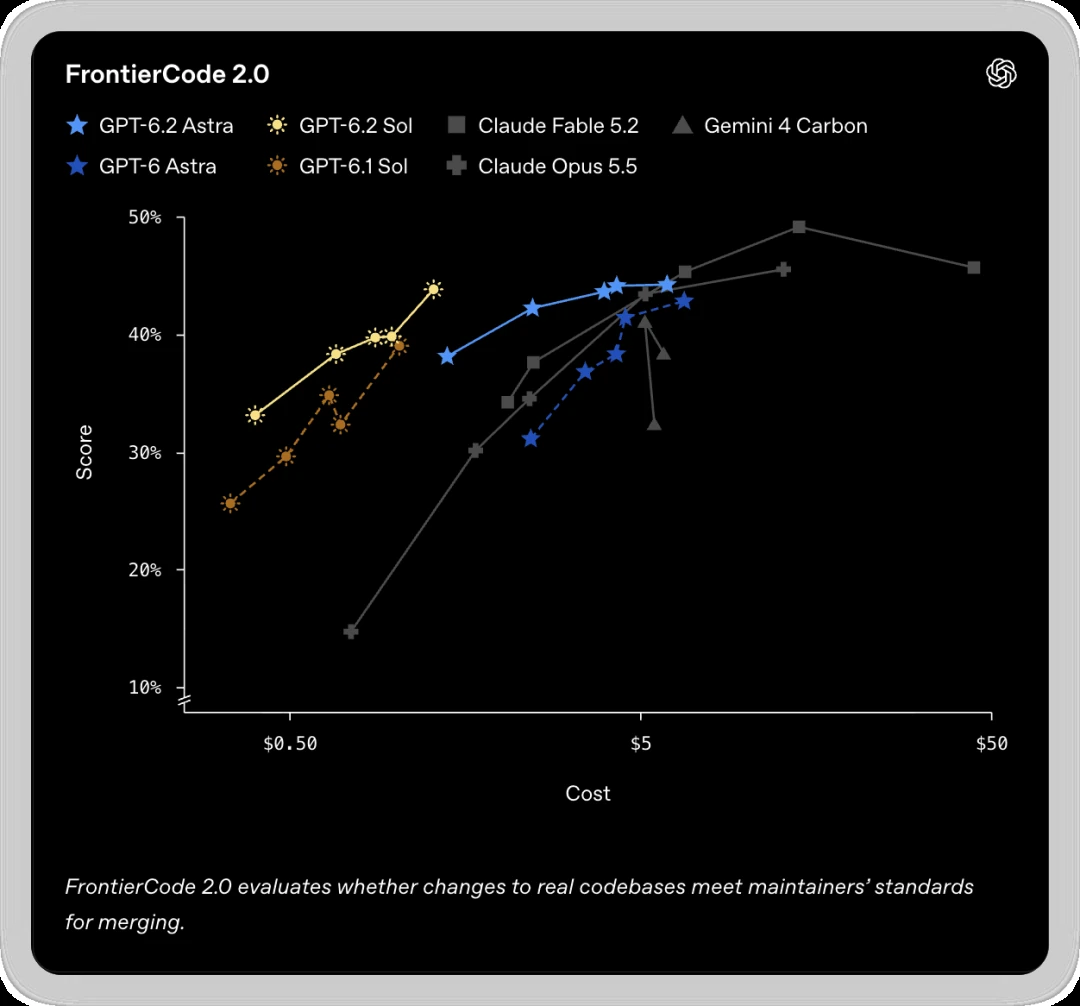
FrontierCode 2.0 gives a model a real repository and asks for a change that would pass review. At top effort, Sol reaches 43.8%; Astra reaches 44.2%. The 0.4-point gap is small. The cost gap is not: an Astra task costs about five times what a Sol task costs.
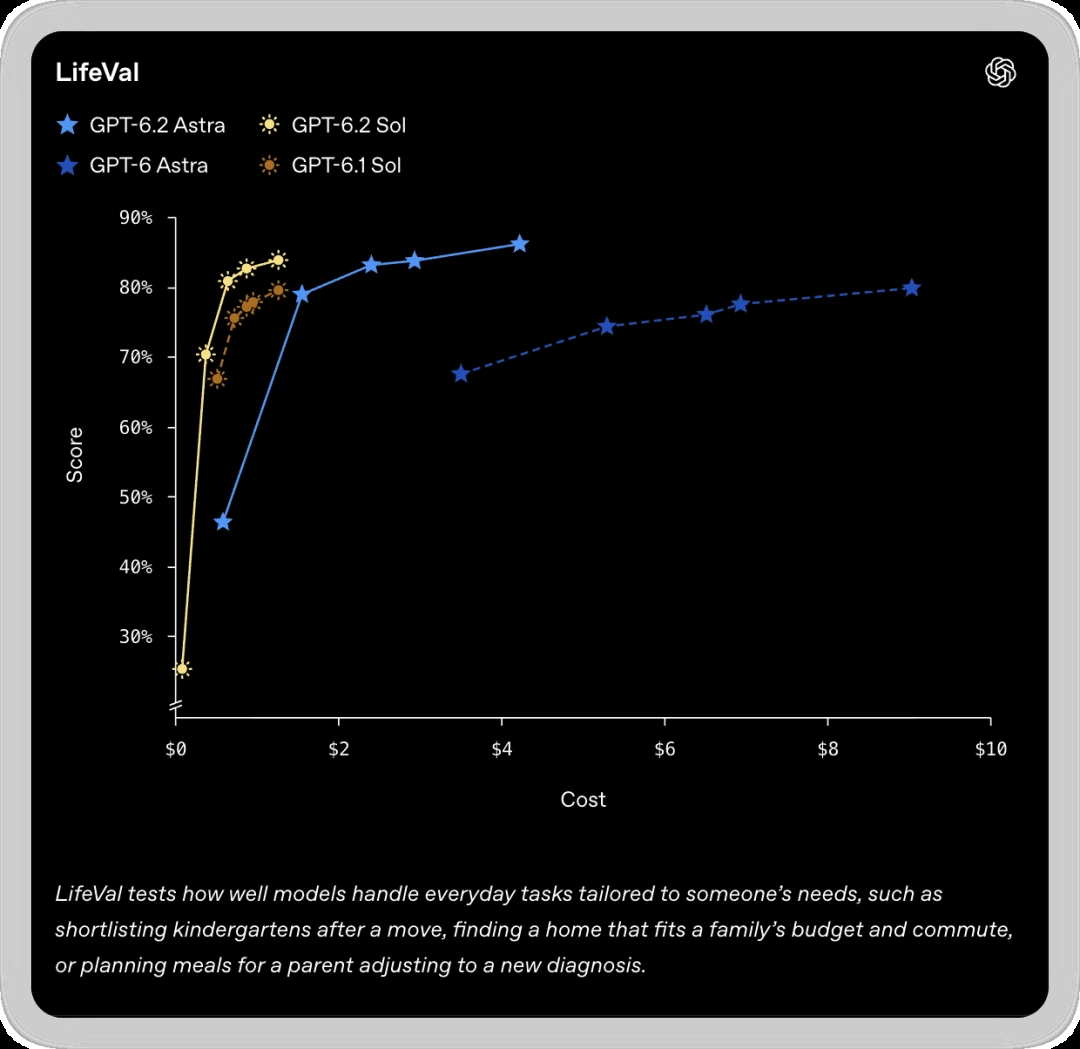
LifeVal, which tests ordinary planning under real constraints, puts Sol at 83.8%. The earlier GPT-6 Astra manages 79.8% at roughly seven times the cost. The tasks range from picking a school after relocating to trading commute time against rent and arranging meals for someone with a dietary restriction.
OpenAI also says the GPT-6.2 generation plans further ahead, so it retries less and calls fewer tools. Astra's GDPval v2 run used 22% less output than its predecessor. Sol shares the generation, so the same behavior applies. Fewer output tokens cut the total whatever the rate.
Distribution matters for the same line. Sol is reachable through the API and Codex. ChatGPT Work also carries it for Edu, Enterprise, Pro and Plus plans. The standard ChatGPT chat picker leaves Sol out. Sol also ships with Ultrafast mode from day one; that mode reaches Pro subscribers on the $200 tier first.
Line three: the input you send twice
GLM-5.3 targets workloads where the same context returns. Its window holds 1M tokens; the output ceiling is 128K; the model reads text and nothing else. Thinking is mandatory: the API requires thinking.type be "enabled"; anything else is rejected. Three effort levels exist, low, high and max, and max is preselected.
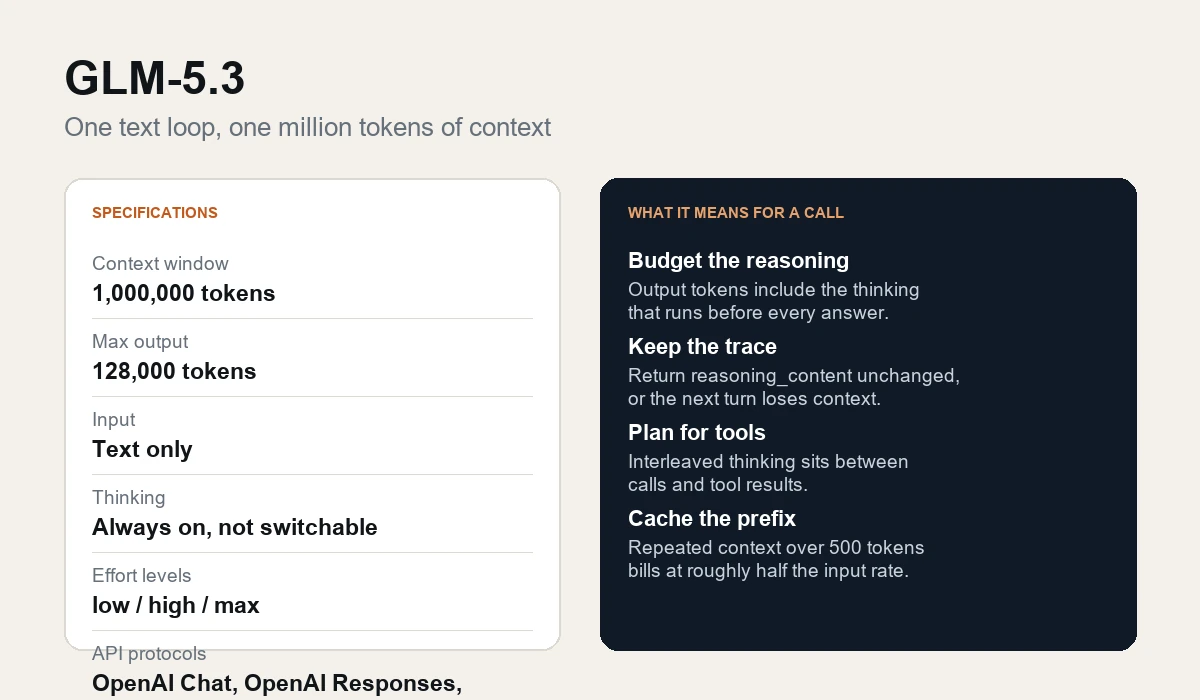
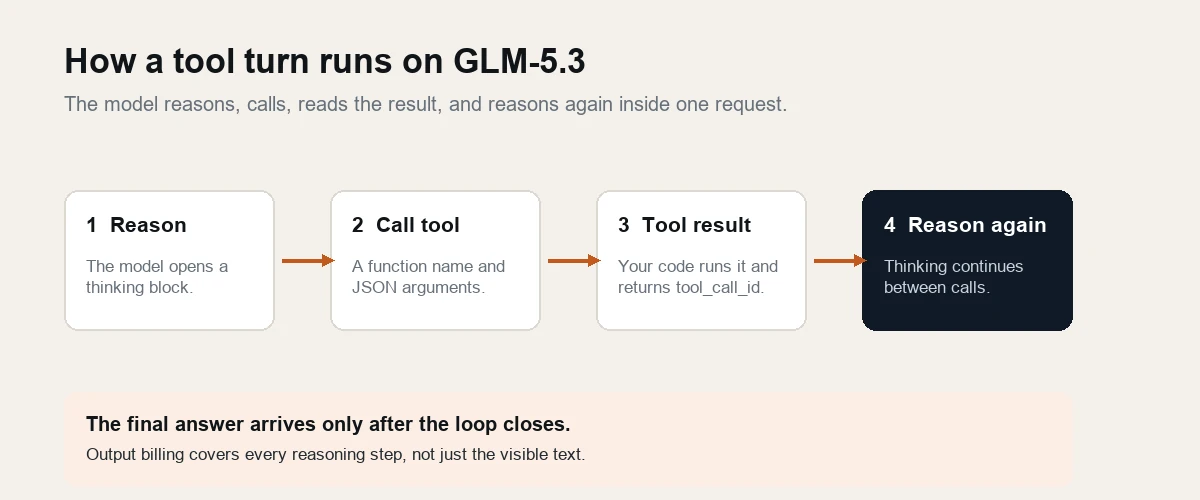
Caching works without configuration. Once roughly 500 tokens repeat, the input price drops to about half. The cached_tokens field inside usage.prompt_tokens_details confirms it. Preserved thinking improves cache hits, but the caller must return reasoning_content unchanged, byte for byte. Interleaved thinking keeps reasoning around tool calls and tool results; turn-level thinking changes the thinking setting between turns.
Reasoning is charged on each request. That is the trade: a long, stable prefix gets cheaper, but a long exchange of brief turns may exceed what the price list suggests. GLM-5.3 speaks Anthropic Messages, OpenAI Responses and OpenAI Chat Completions. An existing client only needs a different endpoint and model ID. A flash variant, by contrast, trades peak capability for latency under high concurrency.
The same job on two meters
Published specifications and rates used here.
| Spec | GPT-6.2 Sol | GLM-5.3 |
|---|---|---|
| Token input | $2 per 1M tokens | Not disclosed in the source |
| Token output | $10 per 1M tokens | Not disclosed in the source |
| Cache | Cached input is discounted; keep the prefix stable | Implicit; 500+ token prefixes bill near half rate |
| Context | Not disclosed in the source | 1M tokens |
| Output cap | Not disclosed in the source | 128K tokens |
| Reasoning mode | Effort can be selected | Mandatory; low, high or max |
| Modality | Text; agent tooling via Codex | Text only |
Sol discounts two lines: the rate and the token count. GLM-5.3 discounts the third: input that repeats. The table also shows where information is missing; GLM-5.3's rates and Sol's context and output limits are not stated in the source used here.
The loop belongs to someone
With GLM-5.3, your application owns the agent loop. Function calls follow OpenAI's function-calling schema. tool_choice accepts auto. Arguments may stream through tool_stream, and each reply has to echo its own tool_call_id. Search results come back with a web_search field. Your code still owns permissions, execution and failures.
Sol sits within OpenAI's agent products. Codex makes code changes; the rest of the GPT-6.2 line handles 3D scene generation, browser interaction and computer operation. OpenAI's API guidance is to keep the opening prompt stable and append new instructions, the same discipline that earns GLM's cache discount.
GLM exposes the full loop and its intermediate steps. Sol keeps more orchestration in the harness, so the application only sees calls that leave it.
Where the cheaper option runs out
Astra remains the stronger model. FrontierCode separates them by 0.4 points, but both ran at top effort, and the hardest jobs still pull them apart. The standard ChatGPT chat surface does not include Sol either, a problem for teams that want a consumer entry point. Its strength is the routine middle of the queue: ordinary code edits, paperwork, and the agent work that keeps a queue moving.
GLM-5.3's limits are structural. Reasoning cannot be turned off, so short turns in a long conversation carry a cost the input rate does not show. The 1M window and the cache both reward repetition; a pipeline with a new prompt every call gets less from them.
Pick by prompt shape
Choose Sol for high-volume coding or office work where the target is a pull request a maintainer would merge, or a document someone can use. With the price fixed and fewer tokens per job, it is easy to keep running. If Codex or ChatGPT Work is already part of your stack, setup takes the least work.
Choose GLM-5.3 when a text pipeline reuses a long, stable prefix: a repository kept open for hours, one document collection queried many times, or an extraction run with do_sample off so output repeats exactly. The 1M window replaces part of the retrieval and chunking stack; the half-price cache pays when the prefix stays stable.
There is no universal winner on price. A new prompt each time favors Sol; a repeated context favors GLM.
If the second pattern sounds like your workload, the GLM model page on dssub lists the current model details and access status.