 dssub
By Cameron Voss · Reviewed November 26, 2026
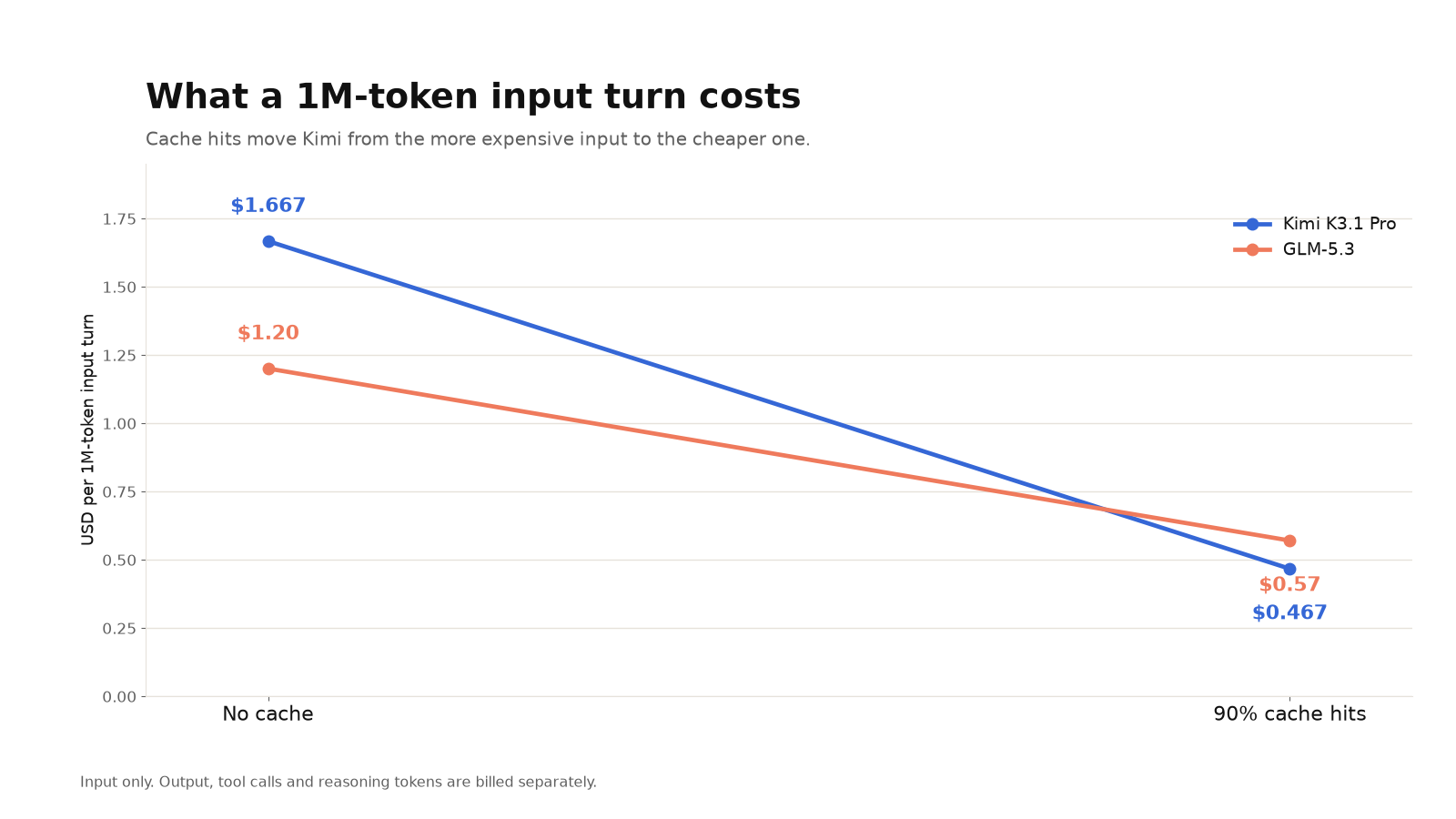
Feed the same million-token prompt to both models and the cheaper invoice depends on a detail no spec sheet lists: how much of the prompt was already cached. With an empty cache, GLM-5.3 bills $1.20 for input and Kimi K3.1 Pro bills $1.667. At 90% hits those figures drop to $0.57 and $0.467, which reverses the order. Benchmarks and plan points answer other questions. The input bill hinges on it.
GLM-5.3 launched on August 14, 2026, and Kimi K3.1 Pro arrived on October 23; the weights followed in early November. Most rows on the two spec sheets match: a window of one million tokens, reasoning on every request, three effort settings, a reasoning stream that can be carried forward. Four items outside those rows drive the decision — test scores, cache rates, the output ceiling and speed tier, and plan points.
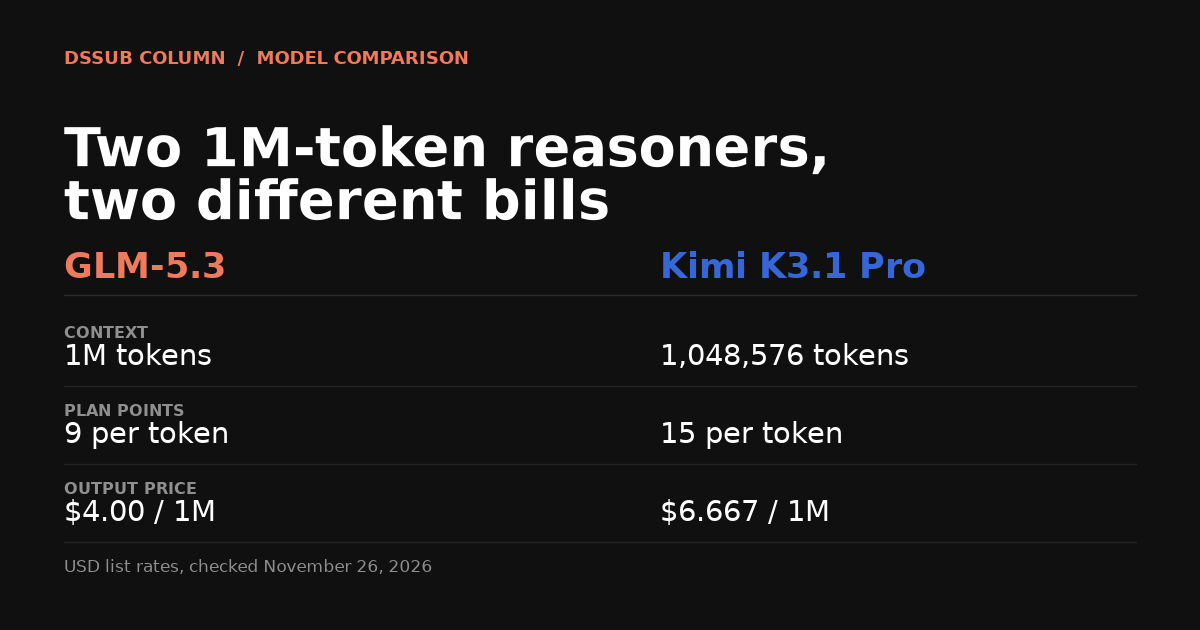
The spec sheet is nearly a draw
Both accept 1M tokens. Kimi's documentation gives the precise limit, 1,048,576. Each model reasons on every call, exposes low, high and max effort, and defaults to max. Each returns reasoning_content. Keeping the chain in context means sending the whole assistant message back, reasoning included. GLM's answer stops at 128K; Kimi's documentation leaves the output ceiling unspecified. GLM is text-only. Kimi's page does not mention image input.
Beyond those rows, two differences stand out. Kimi's Highspeed variant runs at 2-3× the speed; GLM has no equivalent. Kimi also publishes open weights for a 2.8T sparse MoE. Serving a model that size is a data-center undertaking, not a laptop test.
| Item | Kimi K3.1 Pro | GLM-5.3 |
|---|---|---|
| Vendor | Moonshot AI | Z.ai |
| Release | October 23, 2026 | August 14, 2026 |
| API model ID | kimi-k3.1-pro | glm-5.3 |
| Context | 1,048,576 tokens | 1M tokens |
| Maximum output | Not stated | 128K tokens |
| Input | Image input not listed | Text only |
| Reasoning mode | No off switch on either; three effort levels (low, high, max), max by default | |
| Returned field | Both return reasoning_content | |
| Faster tier | kimi-k3.1-pro-highspeed, 2-3× | None |
| Weights | Open weights, 2.8T sparse MoE | API only |
| Plan points | 15 per token | 9 per token |
| Input price | $1.667 / 1M | $1.20 / 1M |
| Cached input | $0.333 / 1M | $0.50 / 1M |
| Output | $6.667 / 1M | $4.00 / 1M |
Kimi takes the published tests
The v5 Intelligence Index, published by Artificial Analysis on October 27, gives Kimi 46 and GLM 32. Among third-party measurements, this one is the most credible. The index combines nine tests: coding takes a quarter of the score, Terminal-Bench 4.0 a tenth, and science, knowledge work and general reasoning supply the rest. A 14-point gap means Kimi handled that mix better. That does not make it 44% better at your workload.
Terminal-Bench is trickier. Kimi's 65.7% is a 4.0 result, produced at max effort through the Claude Code harness. GLM's 28.3 belongs to version 3.0; Z.ai has released no 4.0 run. Because the task sets and harnesses differ, a direct subtraction proves nothing. If a 4.0 number is required, only your own evaluation can supply it.
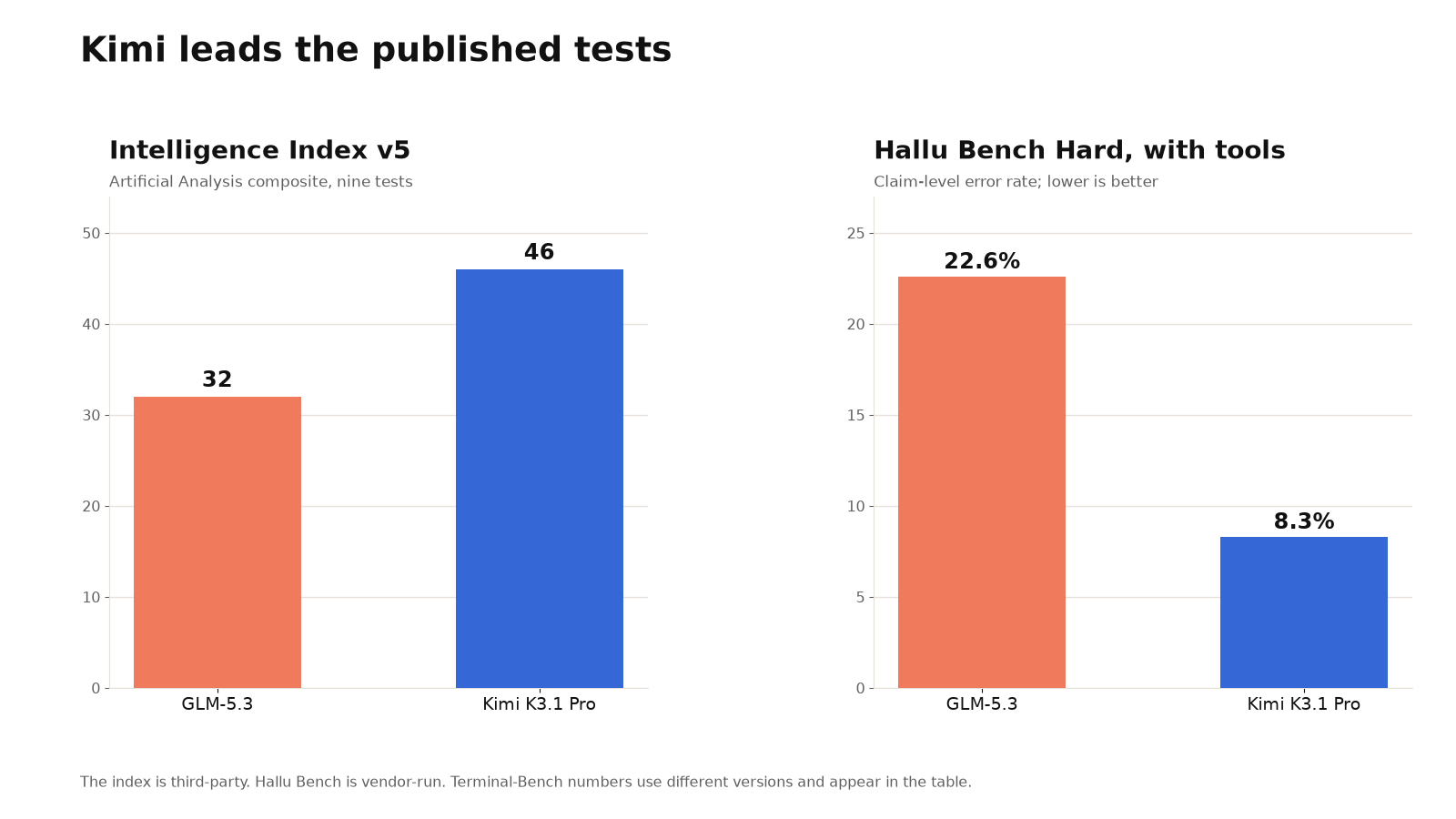
Moonshot ran additional comparisons. Hallu Bench Hard, with tool access, measures claim-level errors at 8.3% for Kimi and 22.6% for GLM; lower wins. xdev-bench-hard has Kimi at 81.0% pass@3, GLM at 57.1%. On OfficeQA Pro v2 the two sit at 64.4 and 31.1, and Frontier Finance nearly ties, 58.6 versus 57.5. Moonshot produced all four, so treat them as directional. Differences that large on hallucination and xdev justify a rerun on your own tasks.
| Benchmark | Kimi K3.1 Pro | GLM-5.3 | Note |
|---|---|---|---|
| AA Intelligence Index v5 | 46 | 32 | Nine-test composite |
| Terminal-Bench 4.0 | 65.7% | No run | GLM's 28.3 is Terminal-Bench 3.0 |
| Hallu Bench Hard (tools) | 8.3% | 22.6% | Claim-level errors; lower is better |
| xdev-bench-hard | 81.0% pass@3 | 57.1% pass@3 | Vendor-run |
| OfficeQA Pro v2 | 64.4 | 31.1 | Vendor-run |
| Frontier Finance | 58.6 | 57.5 | Vendor-run |
Cache flips the input bill
With no cache and a 1M-token input, GLM charges $1.20 and Kimi $1.667. At 90% hits, those amounts fall to $0.57 and $0.467. The cached rate explains the move: Kimi bills $0.333 per million, GLM $0.50. A long, stable prefix therefore benefits Kimi more. At 1M tokens and 90% hits, its input edge is about 10.3 cents.
Output gives it back. GLM charges $2.667 per million less for output, so about 39K output tokens wipe out the entire input saving. A repeated long context plus a short answer favors Kimi; a smaller prompt and tens of thousands of output tokens favor GLM. If the work is patch-sized changes across a long repository, Kimi wins when cache hits are high. For code generation with heavy output, GLM does.
GLM takes the rate card and the plan
Z.ai's list, in yuan per million tokens: ¥8 input, ¥2 for cached input, ¥28 output. With ¥7.1 buying a dollar, the equivalents come to $1.13 for input, $0.28 cached, $3.94 output. Moonshot's yuan figures are ¥13, ¥1.30 and ¥68; at the same rate they land at $1.83, $0.18 and $9.58. For Highspeed, input and output double to ¥26 and ¥136; the cache price holds at ¥1.30.
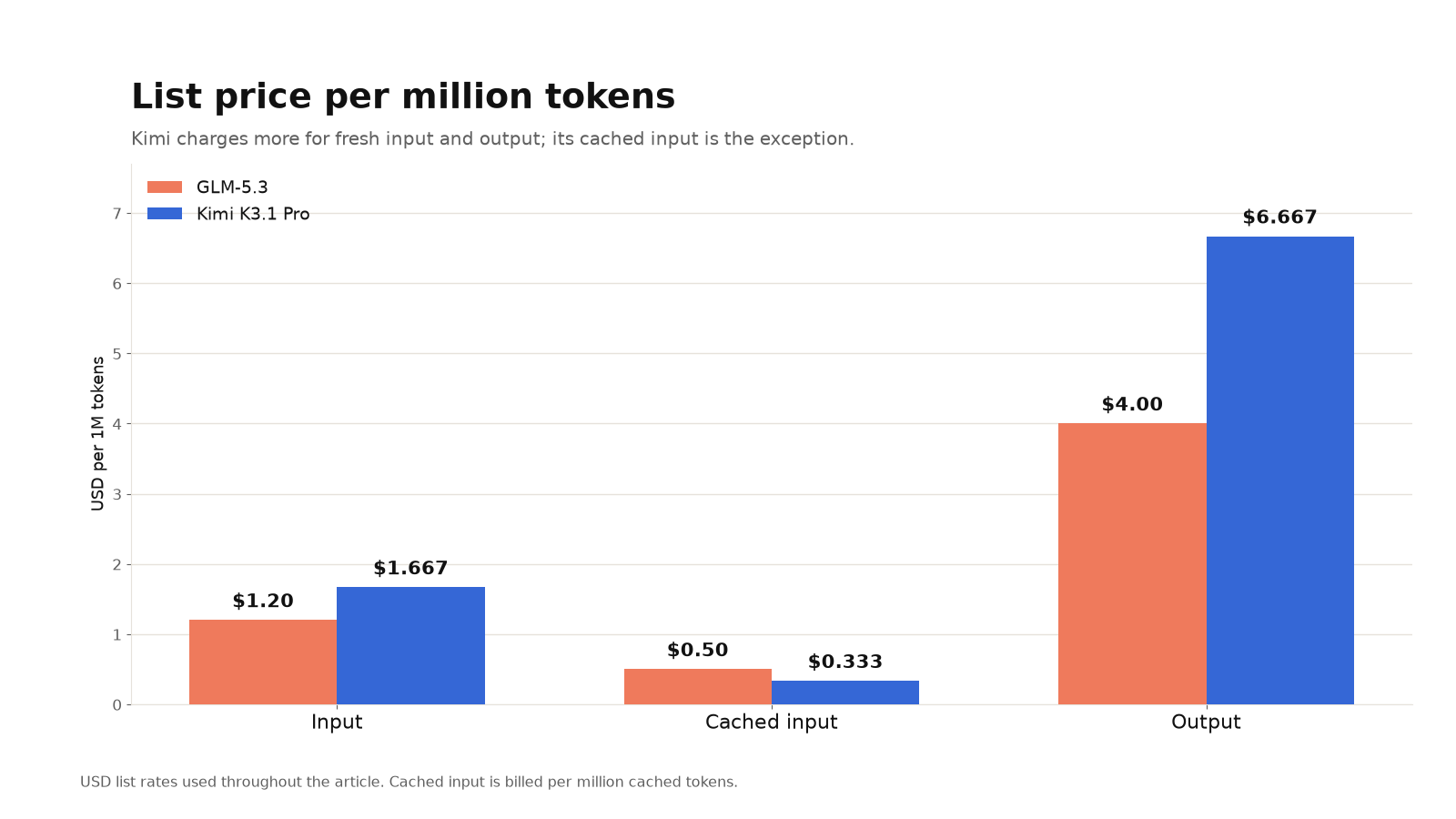
On the USD rate card used for this article, GLM's rates read $1.20 input, $0.50 cached input, $4.00 output. Kimi's read $1.667, $0.333, $6.667. Fresh input costs 39% more on Kimi, output 67% more; the cached line is the only one in GLM's favor.
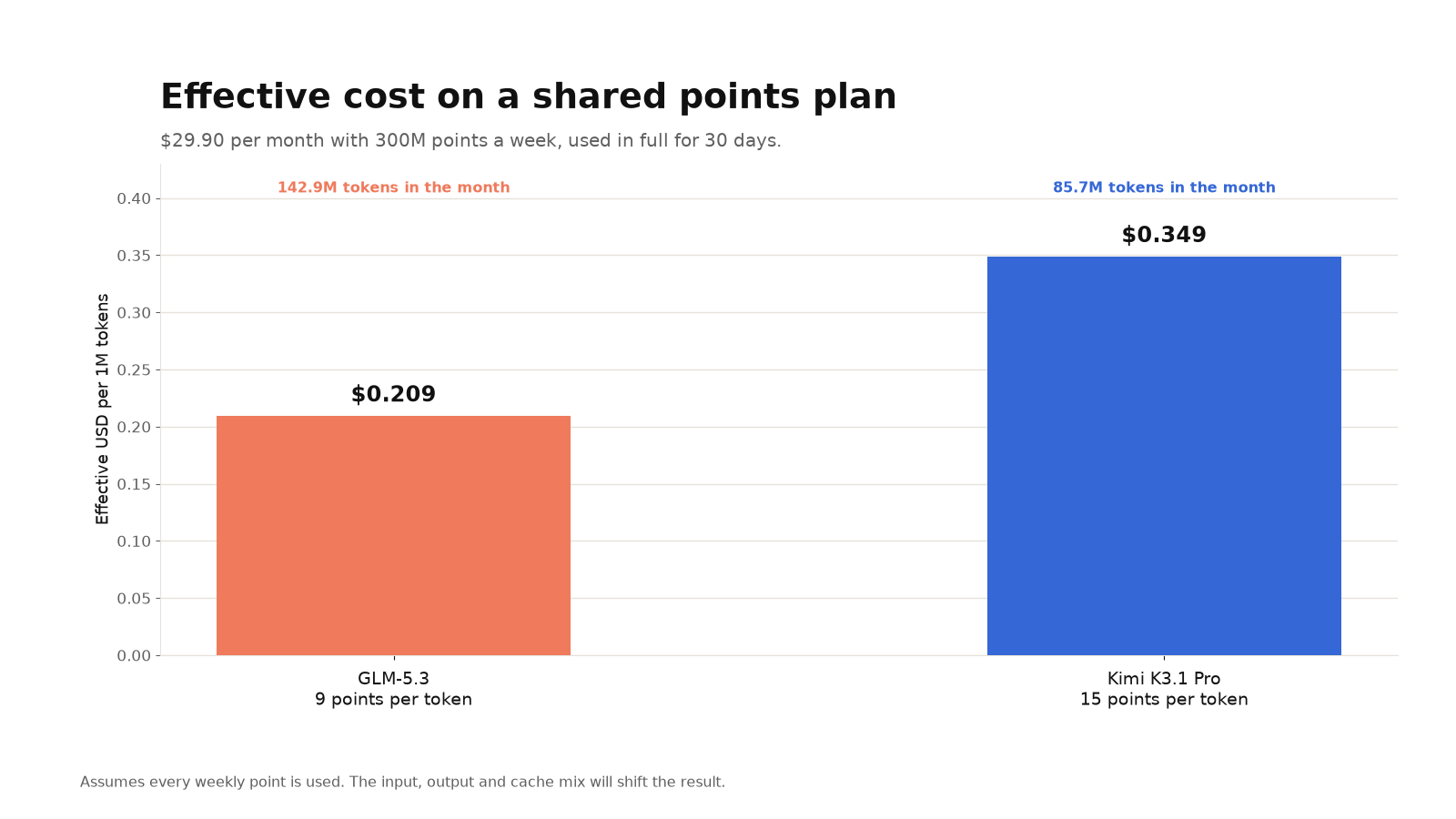
The plan points show the same gap. A GLM token costs 9 points, a Kimi token 15. Take a $29.90 monthly plan with 300M points each week: 30 days of full use buys roughly 142.9M tokens on GLM, or 85.7M on Kimi. The fee divided by those volumes gives $0.209 per million for GLM and $0.349 for Kimi, a 67% difference. The estimate assumes full use; your input, cache and output mix will move it.
Reasoning controls match; the edges do not
Neither model can stop reasoning. Low, high and max are the available effort settings, max is the default, and reasoning_content comes back on every response. To keep the chain, resend the full assistant turn with its reasoning block. GLM interleaves thought with tool calls; Kimi's preserved-thinking mode stays active across multi-turn tool use. No summary-only mode appears in either vendor's documentation. The old visible-versus-hidden distinction does not help you choose. What differs is operational: GLM ends output at 128K, Kimi sells Highspeed at 2-3× speed on a 20-point rate with token prices of $3.333 and $13.333 per million, and Kimi's weights are open.
The demo is a debugging story
The walking-simulator clip from Moonshot lasts 35 seconds. This was not a matter of shaping a reward until the figure balanced. A controller fault turned up first, followed by 36 errors in the moment-arm calculation for the shoulder muscles, all inside the simulator. It repaired the physics and trained again. The gait lasted 11.2 seconds.
Long-horizon debugging of that kind is what the scores try to capture. The footage still comes from the vendor. It proves nothing about a bug in your codebase, and it never shows the token bill.
Choose by workload, then test
Kimi K3.1 Pro suits terminal-heavy work, outputs that cost a lot to verify, coding that runs for hours, finance research, and agent loops judged on terminal results. Highspeed fits interactive sessions where a pause ruins the flow. Set aside 15 points and expect the higher output price. Open weights matter only if a 2.8T MoE fits your data-center footprint.
GLM-5.3 suits long text threads with many short replies, high output volume, and the lowest plan cost. That covers codebase review, data extraction from documents, and batch jobs that reuse a fixed prefix. The 1M window and the 9-point rate are the draw. Two limits apply: no image input, and output stops at 128K.
| Workload | Better fit | Why |
|---|---|---|
| Latency-sensitive chat | Kimi K3.1 Pro | Highspeed runs 2-3× faster, at 20 points, with token rates doubled. |
| Output-heavy generation | GLM-5.3 | Output costs 40% less; longer answers widen the lead. |
| Text threads at volume | GLM-5.3 | 9 against 15 plan points; $4.00 against $6.667 output per million. |
| Research where false claims are costly | Kimi K3.1 Pro | Claim-level errors at 8.3%, against GLM's 22.6%, on the vendor's Hallu Bench Hard. |
| Terminal-first coding | Kimi K3.1 Pro | A 65.7% Terminal-Bench 4.0 result; Z.ai published none for GLM. |
Before committing, give both the same task. The benchmark lead is real, though the vendor produced it. The price lead is arithmetic, though cache hit rate and answer length decide how much of it you keep. A single repository task on your harness beats either spec sheet.
Compare both on one plan
Both models appear in the DSSUB Multi-Model catalog, with coverage and point rates set by tier. The plan is in preview, so check the model page for the version and rate that apply to you before moving a workflow.
FAQ
Which model is better?
The public numbers favor Kimi: 46 to 32 on the v5 AA index, plus a 65.7% result on Terminal-Bench 4.0. Cost favors GLM-5.3: cheaper tokens and a 9-point rate against Kimi's 15.
Which is cheaper at 1M context?
Cache decides. Empty cache: $1.20 for GLM, $1.667 for Kimi. Ninety percent hits: $0.57 and $0.467. About 39K output tokens cancel Kimi's input advantage.
Do both support 1M context and always-on reasoning?
Yes. Kimi accepts 1,048,576 tokens. GLM accepts 1M and stops output at 128K; Kimi publishes no output cap. Effort runs low, high or max, defaulting to max, and both expose reasoning_content.
Are Kimi's weights open?
Yes. Moonshot published weights in early November 2026 for a sparse MoE with 2.8T parameters. At that size, self-hosting remains a data-center project; most teams will use a hosted endpoint.