 dssub
By Cameron Voss · Reviewed November 21, 2026
Two meters, no exchange rate
Anthropic prices in tokens, line by line: input at $4 per million, output at $20, cache reads at $0.20, cache writes billed separately. Fast mode doubles input and output to $8 and $40 and moves up to 2.5x quicker. Anthropic sells direct and through the major clouds. The launch post adds a 20% cut versus Opus 5, cache traffic 60% cheaper, fewer tokens burned per task for a 40% lighter typical bill, and generation that finishes more than 30% sooner. Hard tasks still grow the bill, thinking tokens included.
Z.ai meters differently. No per-token price appears on the GLM-5.3 model page; a credit-based Coding Plan sells turns. Off-peak calls draw half the standard credits. Keep a conversation's opening fixed past roughly 500 tokens and the input side settles near half rate.
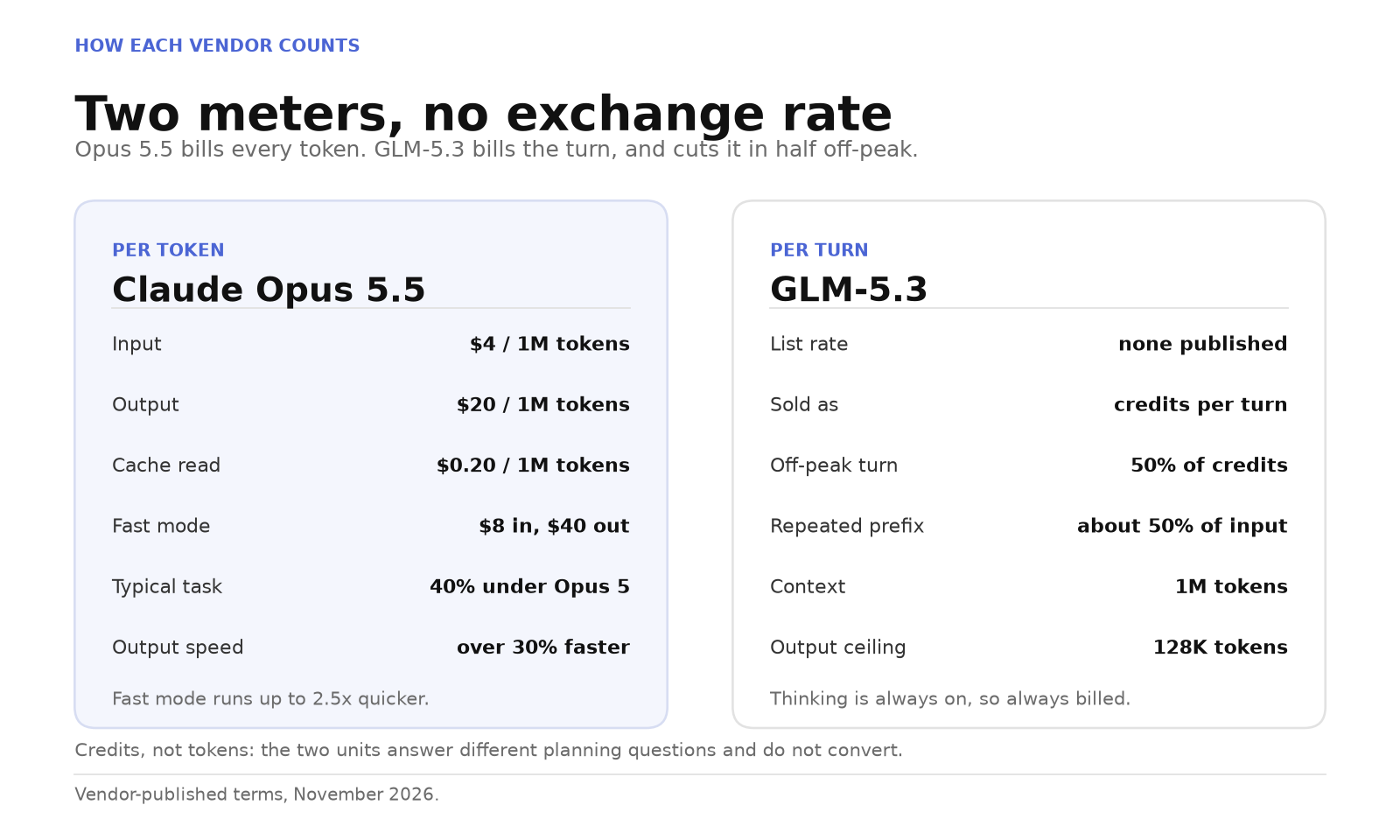
Each unit answers a different budget question. Paid per artifact, a team quotes cost per finished deliverable. Paid per turn, it quotes cost per question. Move a forecast across models and the number shifts while the work does not.
Each vendor keeps its own scoreboard
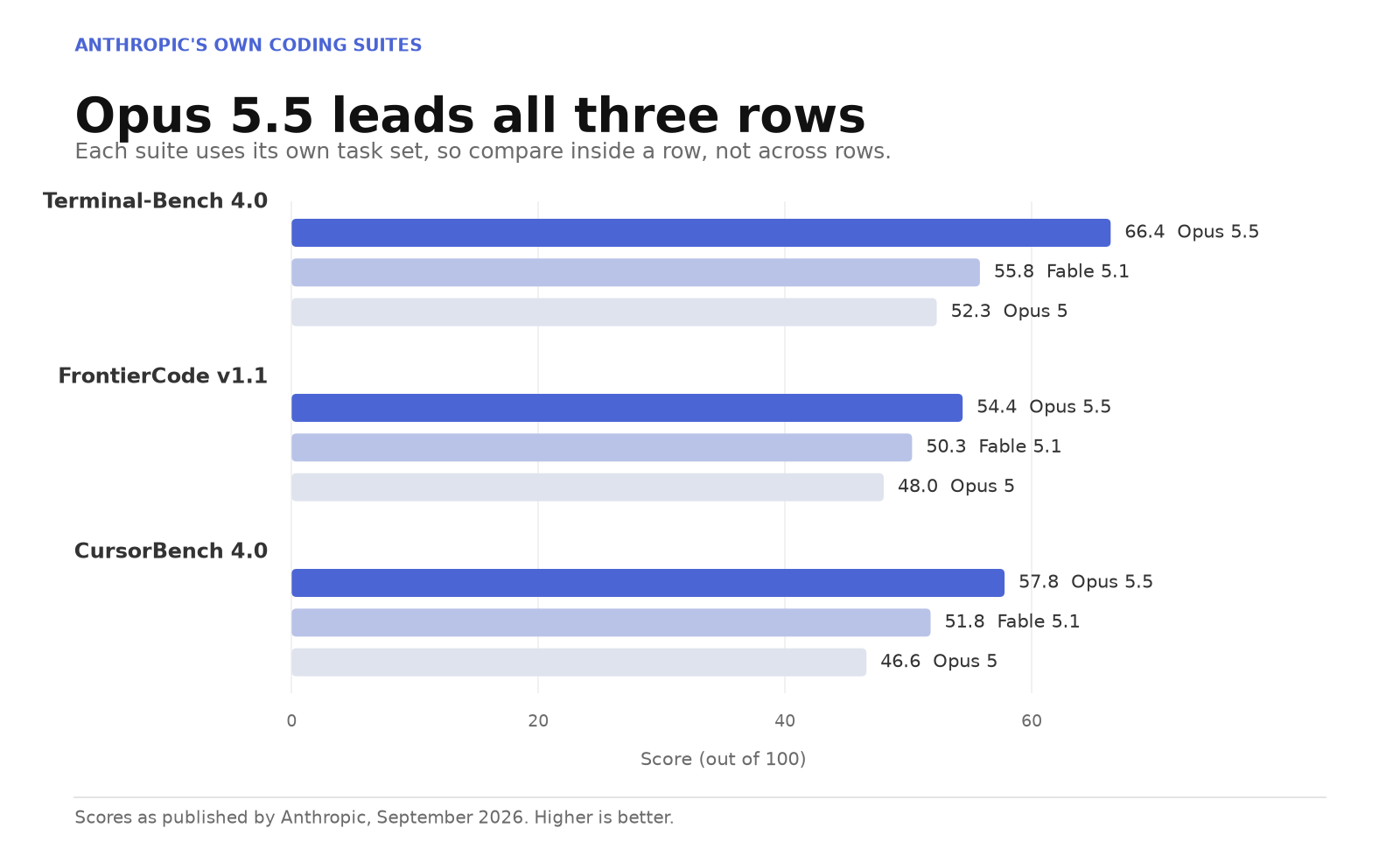
Anthropic published eight numbers for Opus 5.5. Coding first: CursorBench 4.0 at 57.8%, FrontierCode v1.1 at 54.4%, Terminal-Bench 4.0 at 66.4%. Knowledge and computer work follow: Chartography 89.0% with tools, OSWorld 2.1 at 81.8%, Humanity's Last Exam 67.7% with tools, AutomationBench 40.0%, GDPval-AA v2.1 at 1846 Elo.
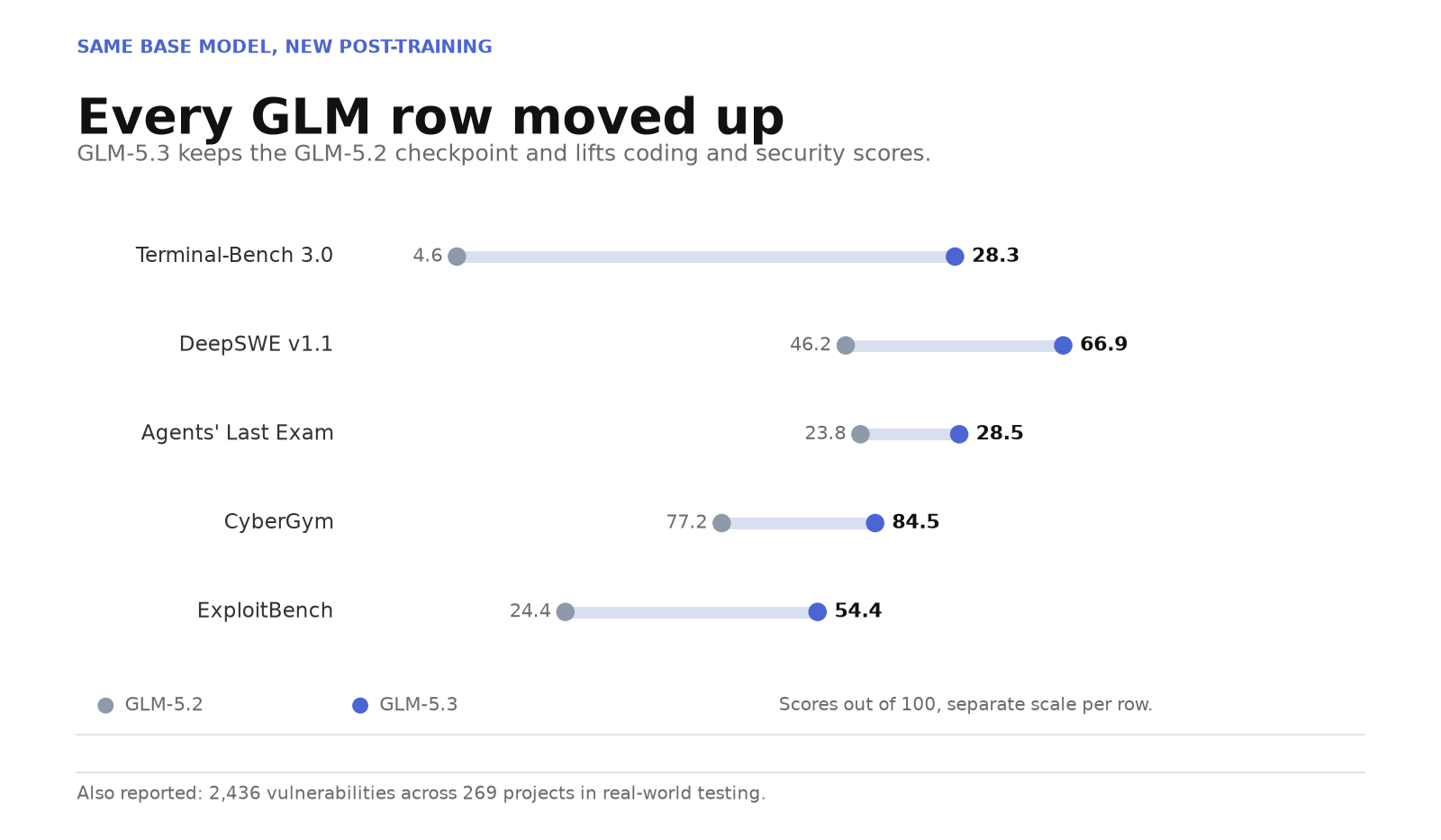
Z.ai's sheet works as a before-and-after on one checkpoint. Security moved hardest: ExploitBench 24.4% to 54.4%, CyberGym 77.2% to 84.5%. DeepSWE v1.1 climbed 46.2 to 66.9. Terminal-Bench 3.0 went 4.6 to 28.3, and Agents' Last Exam 23.8 to 28.5. Auditing live repositories, the team logged 2,436 vulnerabilities in 269 projects.
The one curve that prices an answer in tokens
Z.ai also runs a Code Bench in-house that plots accuracy against average output tokens. It is the only efficiency curve either vendor shows. GLM-5.3 at Max effort: 34.5% for roughly 75,000 output tokens. GLM-5.2 at Max: 23.4%, near 96,000. GLM-5.3 at High: 31.4% on about 50,000, which beats Claude Opus 4.8's 29.5% at roughly 120,000. A dashed line records Fable 5 Max at 39.5%, its token count withheld.
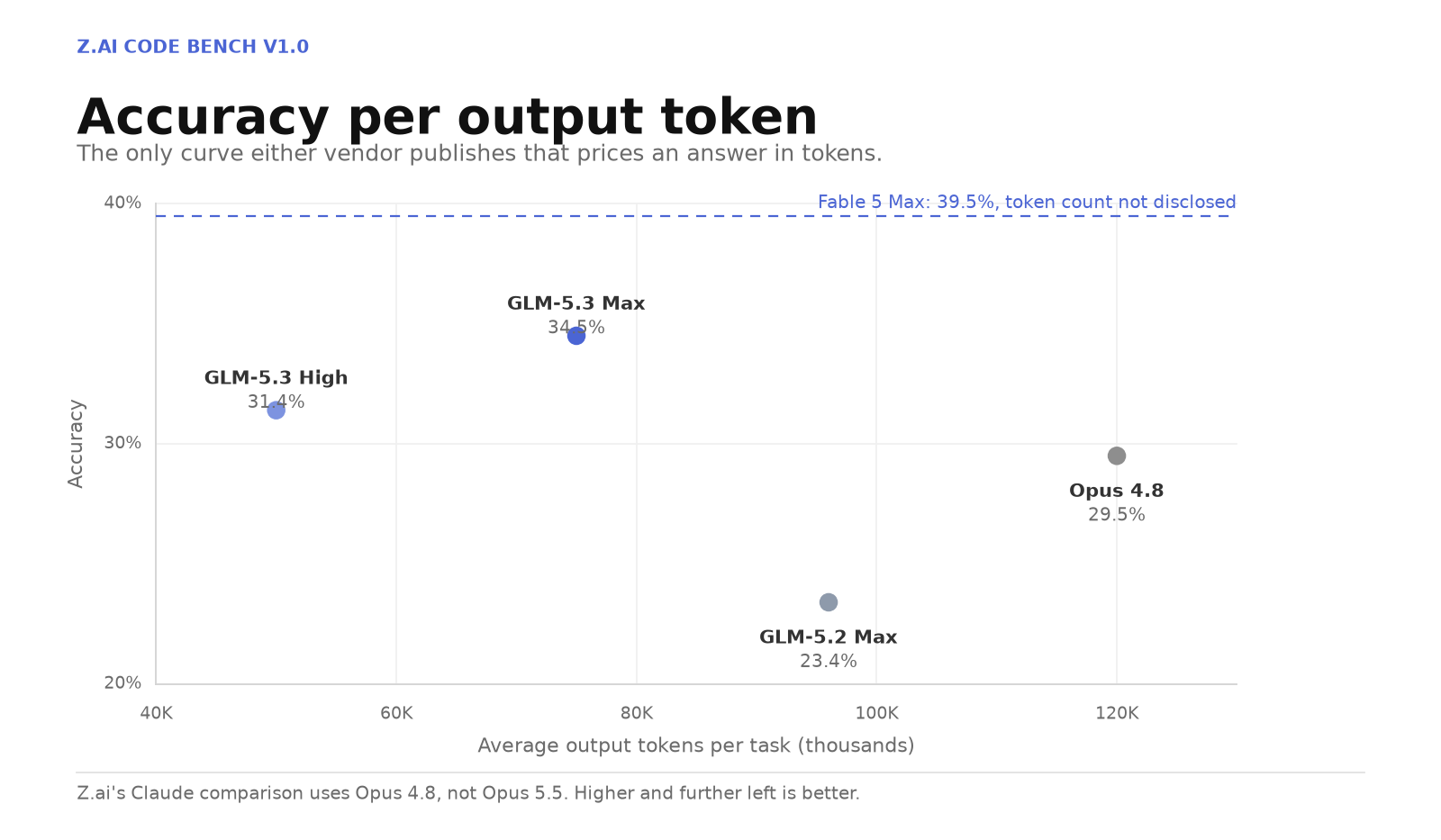
Two cautions come attached. Z.ai's benchmarked Claude is Opus 4.8, not 5.5, and its Terminal-Bench row measures version 3.0 of that suite, where Anthropic quotes 4.0. Different harnesses, different task mixes, and each publisher grading its own model.
Who owns the loop
Opus 5.5 arrives with scaffolding included. Browsing, computer control and tool invocation sit inside Claude's product and platform; Anthropic says it tested how prompt injection behaves in each. The bundle adds an action classifier, a sandbox that can be audited, and code-review tooling. Visibility is what you trade away: the runtime belongs to Anthropic, and so does the meter.
GLM-5.3 hands control back at the API boundary. Functions follow OpenAI's calling schema; tool_choice takes auto, with no other value offered yet; tool_stream streams arguments as the model emits them. Your process runs each function and ships the return value under the tool_call_id that asked for it, which keeps retry policy, permissions and history pruning local. Interleaved thinking keeps reasoning going between calls and after each result. The Coding Plan endpoint turns preserved thinking on by default: earlier reasoning stays in context only if the caller returns it unchanged.
Search comes from the platform, not the model. The stack includes a Web Search API, in-chat search and an MCP server; Sogou, Quark and Z.ai's own engine supply the results, and matches surface in a web_search field. Three protocol surfaces reach the same weights: OpenAI's Chat Completions, its Responses API, and Anthropic's Messages format. An existing client gets repointed, not rewritten.
One release each, pointing opposite ways
Opus 5.5 opened the Claude 5.5 line on 22 September 2026, slotted near Claude Fable 5.1. GLM-5.3 is Z.ai's coding and agent flagship, still on the GLM-5.2 checkpoint, with the work done in post-training.
Anthropic builds toward a surface: its apps, Claude Code and the Claude Platform carry browsing and computer control in one place. Z.ai builds toward a thread: wide context, reasoning the caller carries forward, an endpoint that slips into another system's loop. Two published examples fit that shape: a 680,000-line move finished inside a day, and an audit of 200,000 lines closed in under three hours, against more than twenty on Opus 5.
Match the job to the meter
| Workload | Meter that fits | Why |
|---|---|---|
| Unattended coding sessions run from Claude Code | Opus 5.5 | Harness, computer control and long-run cases ship with it. |
| Computer-control sessions and knowledge-work outputs | Opus 5.5 | Scores on OSWorld 2.1, GDPval-AA and Chartography. |
| Whole-repository review, lengthy contract bundles | GLM-5.3 | A 1M window plus caching for the part that repeats. |
| High-volume structured extraction | GLM-5.3 | Text or JSON replies from three protocol entries. |
| Stacks with an OpenAI or Anthropic client already wired | GLM-5.3 | Swap the endpoint; the loop stays yours. |
| Jobs that begin with an image | Opus 5.5 | GLM-5.3 has no image input. |
Opus 5.5 suits jobs that end in something a person signs off on: an audit write-up, a migration branch, a computer-use session. Native browsing deletes a layer of glue, yet a reviewer stays in the loop. Anthropic's safety write-up says why.
GLM-5.3 suits anything textual that keeps a single history: review across an entire repository, long contract bundles, structured extraction, products already speaking OpenAI or Anthropic protocols. A 1M-token window plus prefix caching does the lifting. A task that opens with a screenshot is out of scope.
The overlap is genuine: agents, tool calls, hours of unattended work. What separates them is where the run ends, with a reviewed artifact in a product or an answer still attached to its conversation history.
Run GLM on a recurring plan
Most of your tokens sit in a fixed opening, with dozens of short questions after it? The GLM page on DSSUB puts model details, connection formats and current availability in one place.
Availability and supported API formats are listed there; confirm both before you migrate.