 dssub
By Cameron Voss · Reviewed November 26, 2026
- A 78-layer stack produces 106 layer applications: 28 layers in the middle are used twice, with no new weights.
- A 30B controlled run shows what the loop buys: AIME25 rises from 19.17% to 30.42%, GPQA-Diamond from 47.58% to 56.26%, with answers 10% to 14% shorter and training compute up about 10%.
- Zhipu calls the 750B model 2T-3T class. No complete benchmark sheet for that model was published at launch.
- A private board puts it within 5% of Opus 5.5, but long reasoning runs can cancel the output-token savings.
A claim that outruns its table
GLM-5.4 arrived on 23 November. Its release notes lean on two numbers: 750B parameters, and an intelligence claim in the 2T-3T range. The parameter count is a specification. The 2T-3T line compares this model with systems three or four times larger, which requires a shared scoreboard.
None was published for the 750B model at launch. The controlled evidence Zhipu did release comes from a 30B experiment. That work is worth reading. It is not the flagship test the claim implies.
The loop is a genuine design decision with public numbers behind it. The 2T-3T label is a projection.
Depth from layers that already exist
Begin with the stack. There are 78 physical layers. Layers 26 through 53 are shared: 28 layers whose weights are used in both passes of a single forward computation. The 25 layers before and after that block run once. Total layer applications: 106, while paying for 78 layers of parameters.
Only the weights stay fixed. The hidden state moves. Pass one assembles a global view and writes carefully. Pass two reopens the gate and refines what it finds. A per-token gate sets the write size, and tokens that are harder to predict are allowed a bigger opening step.
Universal Transformer tried shared layers back in 2018. The difference here is scale, plus the engineering that makes a second pass affordable. Three details make it practical.
- Gated progressive updates. Writing to the same state twice can make training unstable. A gate holds the first update back, then gives pass two room to correct it.
- Hybrid KV cache. Pass two draws on the sparse cache built by pass one and adds a small rolling window, so no duplicate full cache is needed.
- Sparse index reuse. The attention index is built once. Pass two skips the retrieval step.
In the 30B run, looping raised training compute by about 10%. A second pass that doubled the bill would stay a lab experiment. At roughly a tenth, it becomes a product decision.

What the 30B test actually shows
The controlled test compared a 30B checkpoint with itself, loop on and loop off. Parameter count did not change. AIME25 improved from 19.17% to 30.42%. GPQA-Diamond improved from 47.58% to 56.26%. Answers on the same suites got 10% to 14% shorter, and training cost grew roughly 10%.
The result is about depth at fixed size. It shows the loop helping this model on two tests, not a 750B looped model matching a dense 2T-3T model. The first comparison holds parameters constant. The second multiplies scale three or four times over.
Zhipu has not published the flagship's full results. The 2T-3T figure is therefore an extrapolation, not a measured match. The mechanism is reasonable: serial depth helps with multi-step reasoning, and 30B shows the mechanism working at small scale. The missing piece is the same evaluation run on the 750B checkpoint. Until that table exists, the claim has a plausible basis and no direct proof.

Why a loop wants sparse experts
Scaling research treats recurrence and sparsity as different levers. Sparsity adds capacity without adding activated compute. Recurrence adds depth without adding parameters. They are usually described as complementary, and the published estimates agree.
A study in the scaling literature puts the gain from sparse routing near 3x on activated parameters, and the gain from recurrence near 2x on total parameters, for reasoning workloads. Work on Looped-MoE adds a boundary condition: at scale, dense looped models lose to ordinary transformers, but looped mixtures of experts win.
The router makes the difference. On every pass it can choose a different expert inside the same physical layer, which recovers some of the expressiveness that shared weights give up. Whether GLM-5.4 routes those repeated layers through experts is undisclosed. With routing, recurrence becomes more than a depth shortcut. Without it, the method still works, though it scales less convincingly.
Set this beside the other research lines. DeepSeek increases total parameters and activates a small share per token. Qwen asks what each activated parameter delivers in capability. Zhipu spends serial compute at a fixed size.
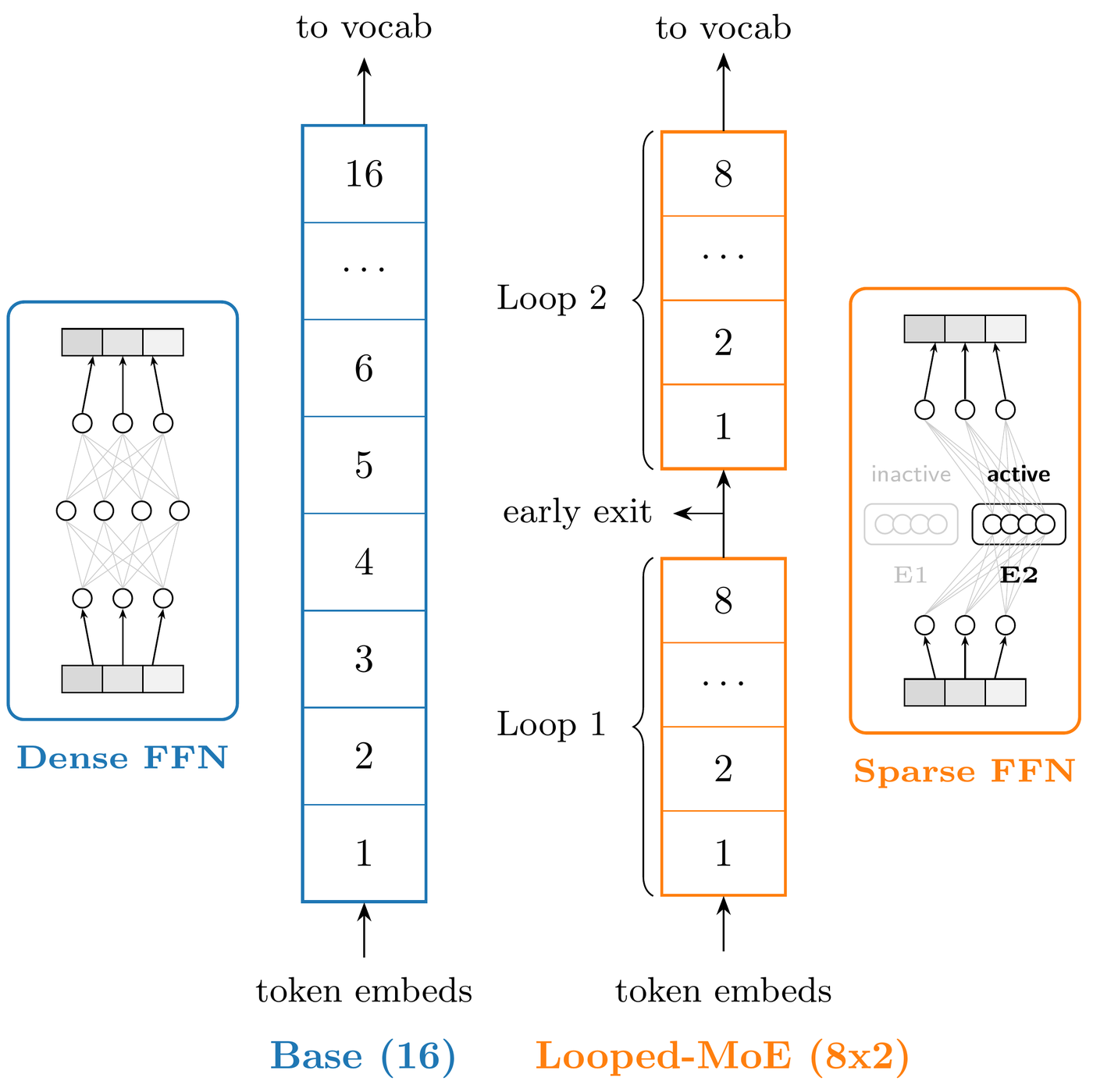 A generic Looped-MoE design. One set of layers, two trips through it, and a router free to choose another expert each time. That is the published research concept, not a GLM-5.4 diagram from Zhipu.
A close private score, a longer invoice
AICodeKing's private evaluation gives GLM-5.4 a composite score of 33.2. GPT-6.2 Astra sits at 33.6, Opus 5.5 at 34.7. The gap to Opus is under 5%; the gap to Astra is 0.4 points. On KingBench 4 the model ranks first among open models, with 1.56% of tool calls failing and 66% recovery after a retry.
Good agent numbers. The invoice is a separate question. Zhipu itself warns that difficult tasks can send GLM-5.4 into long reasoning runs. Final answers may be shorter while total usage grows, because the model burns extra tokens ahead of the first word. Cost shifts from storing parameters to serving them.
Whether that trade works depends on the job. One 40-step run that works immediately may cost less than a 30-step run with three retries. Record usage and wall-clock time for each finished task, and count how often a run has to restart. Output length alone will miss the reasoning bill. Test the workflow itself, not a single prompt.

What the demos can and cannot show
The model adds visual understanding. Code also serves as the output layer outside software: robot-arm modeling, 3D scenes, video rendering. The published demos include three examples: a music video generated entirely from frontend code, a six-axis robot arm modeled in FreeCAD and animated there, and a 3D birdwatching scene whose geometry and shading come from math and GLSL, with no imported models or textures.
Each demo leans on a long causal chain. A frame, a scene and a motion path each depend on one world state staying coherent over many steps. If extra serial depth helps anywhere, it should help here.
Demos are not measurements, though. A 3D scene can look right and fail a geometry check. A rendered clip can hold together visually and say nothing about planning. A public benchmark of multi-step jobs, priced per finished task and paired with a failure taxonomy, would make generalized coding testable. Until then it is a direction, not a capability.
Three checks before you trust a composite score
- Long tool traces. Pick a pipeline that already breaks on you. One-shot output can look great and still fall apart by call 30.
- Token cost per success. A short answer is not a cheap answer if most of the spend happens before the first visible token.
- Time and retries. Record wall-clock time to completion and how often the run has to start over.
Where GLM-5.4 stands
Access runs through Zhipu's Coding Plan. The coding clients Qoder, WorkBuddy, Trae and ZCode also connect to the model. API access is waiting on a safety review, and Zhipu says the weights will follow at a later date.
For an evaluation, use your own hard cases: long tool traces, recovery after failed calls, jobs that hold state for dozens of steps. Record reasoning and output token counts, completion time, and how often a run restarts. That record tells you more than any leaderboard number.
Zhipu has made a serious bet on recurrence. Its 30B data backs the choice. Whether the flagship belongs in 2T-3T territory is still open. A public benchmark on the 750B model would settle it.
Leaderboard scores start the conversation. Your own trace ends it: the tools the agent calls, how often it retries, and what each finished task consumes.
If you want to compare endpoints, the current model catalog is the place to check availability.