 dssub
By Cameron Voss · Reviewed November 26, 2026
Six builds came out of one model release, and not one of them is a screenshot of a chat window. There is a playable descent of Mont Blanc, a memorial axis in Nanjing placed on map coordinates, an Earth rendered with no 3D library, a paper-cut platformer, a tangram puzzle with a solver underneath, and a dashboard running on a Waveshare board. Every one of them was produced on GLM-5.4, which entered GLM Coding Plan the day it shipped, roughly three months behind GLM-5.3.
What ties the set together is not the subject matter. It is the clock. Each artifact took hours to finish, and the reason lies in where the model puts its compute, not in how much of the world it memorized.
One block, run T times
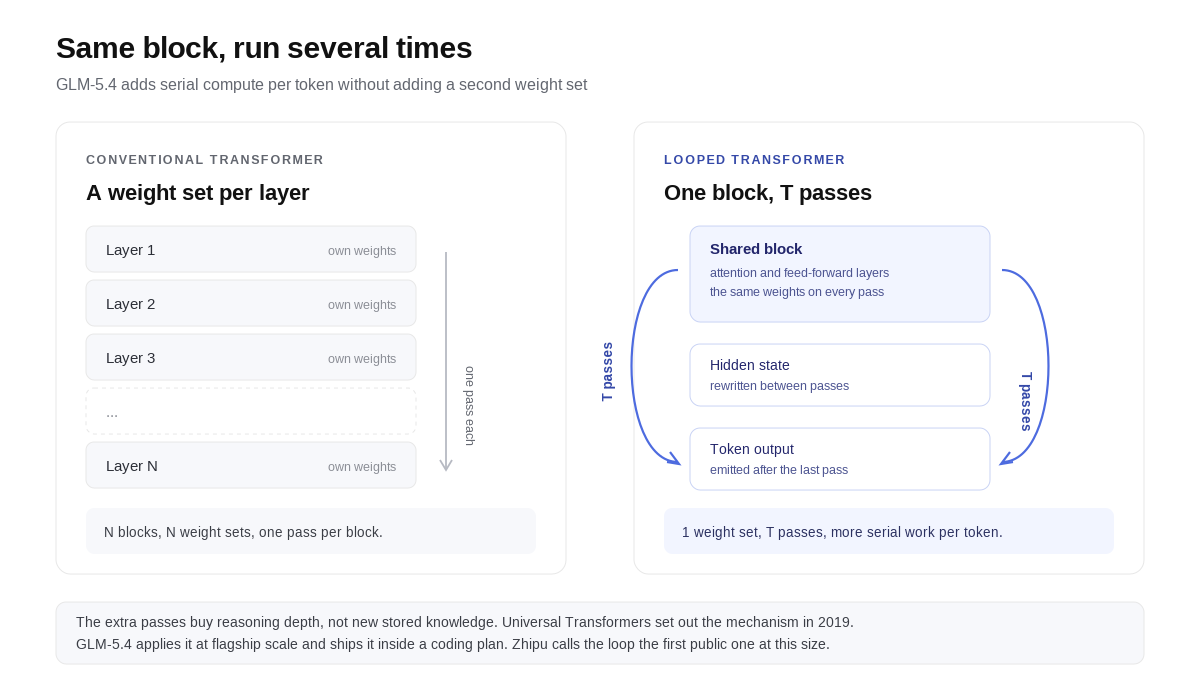
A conventional transformer keeps a separate weight matrix for every layer and pushes the hidden state through each one a single time. GLM-5.4 takes another route. A single block of layers is applied repeatedly, T passes for each token, with the hidden state rewritten between them. No new storage is added. What increases is the number of sequential steps taken on the same input.
Zhipu calls the arrangement a Loop Transformer and presents it as the first publicly documented loop at this parameter scale. The mechanism itself is older. In 2019, Universal Transformers made the case for reusing the same weights across repeated steps, and later work mapped where that helps. Extra passes can lift certain reasoning tasks. They cannot supply facts the weights never saw. Each added pass returns less as the count grows, and the depth used in training puts a ceiling on what an inference-time pass can buy.
That ceiling is the honest way to read the launch material. Nothing here shows the model reaching deeper into a knowledge base. It shows what several passes per token are worth on a task that can be checked, and the same design is why a build stretches into the afternoon.
Vision appears in the release notes as a newly added capability. These six builds do not exercise it, because each one begins with a text prompt.
Two builds that answer to the real world
Both geographic builds can be checked against something outside the screen, which makes them harder to fake and easier to judge.
Mont Blanc, with the mountain as the reference
The prompt specified a ski game built on surveyed elevation, snow that holds a track, avalanches on steep ground, and audio generated by code instead of loaded from files. The output pulls map data and elevation covering Mont Blanc together with the Chamonix valley, fixes nine drop-in points at their true altitudes, and layers in slope physics, deforming snow, avalanche rules, a sound layer and automated checks. One captured run keeps 60 fps at 1080p and tops out at 131 km/h in first person, all of it on the mountain.
The route to that capture was not straight. An earlier pass had terrain that looked right beneath a sky that rendered black. It read its own screenshots, traced the fault, patched it and inspected the frame again. Hours of runtime, a written plan and that self-review step are what separate a demo from a first draft.
Yuhuatai, 1.2 km of memorial axis
In Nanjing, the second geographic build reconstructs the Yuhuatai memorial axis using published coordinates: the north gate, the monument, the reflecting basin and the memorial hall, the south gate, plus every tree between them. Terrain and vegetation consumed most of the build. Two animations came out of it, one closing on the reflecting pool and one flying the length of the axis.
Four builds with nothing to check against
The rest of the set has no survey data to fail against, so the test becomes internal consistency: does the look hold, does the geometry close, does the scene survive a camera move.
A paper garden that keeps its look for 2:39
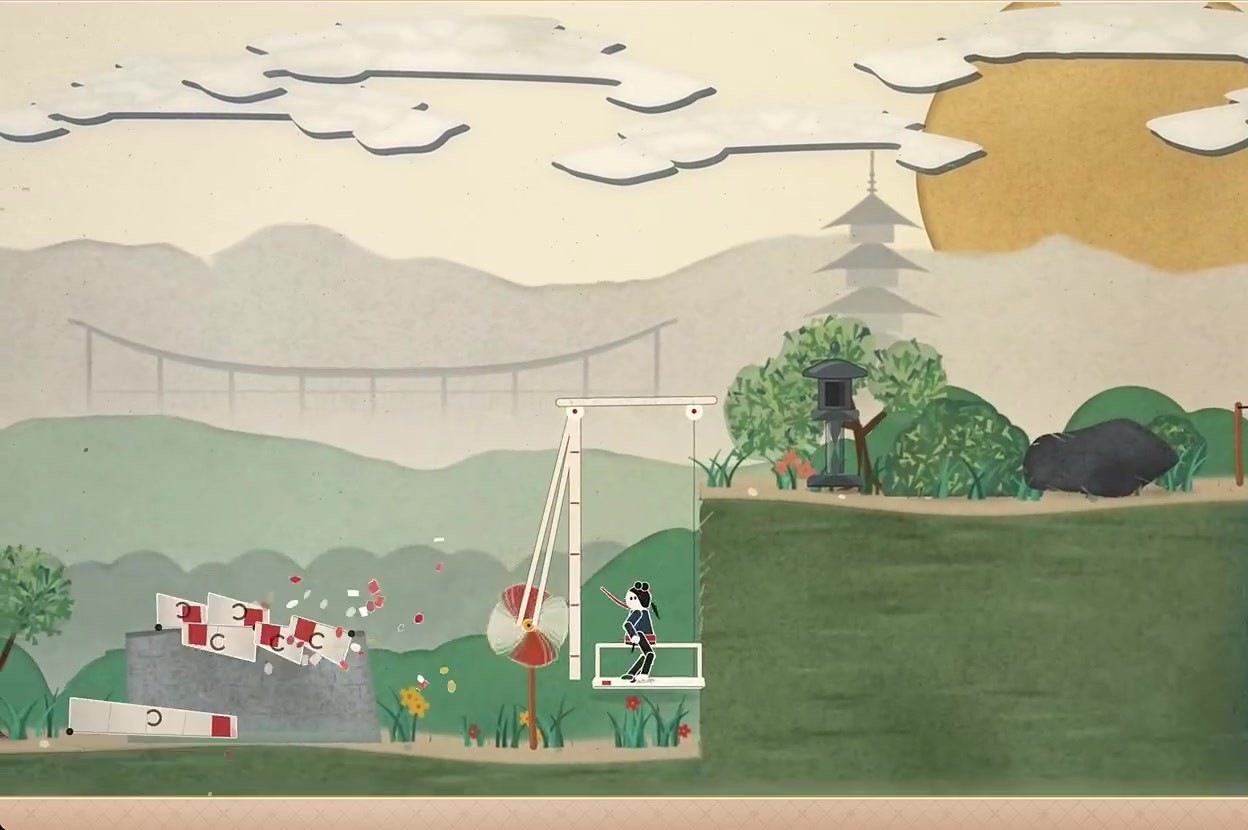
The paper garden borrows the language of a hand-cut side-scroller: torn edges, a flat sun disc, a narrow palette, a figure crossing stacked scenery. It runs 2:39, and watching it feels like play, not like a technology sample. The renderer is not the achievement. Holding the art direction together across a build that long is.
Seven pieces that have to close exactly
The tangram game is the most exacting of the four. Pieces drag, rotate and flip, and a finished silhouette turns into a moving animal. Beneath the interface sits an exact-cover solver that verifies every shape as a real union of all seven pieces, with no overlap and no gap. The interface is English throughout. What the build shows is a visual task handled as geometry rather than as decoration.
An Earth written from nothing
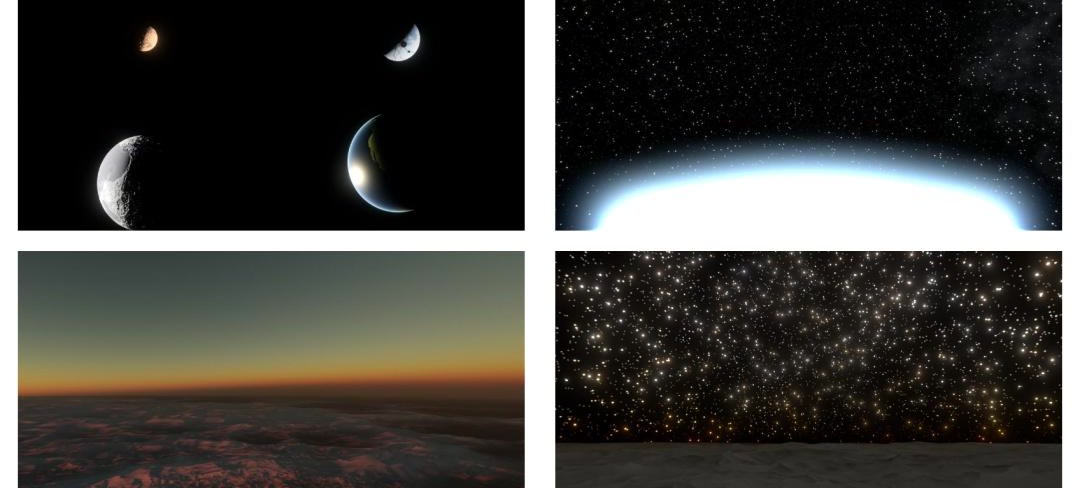
The Earth engine was written without a 3D library off the shelf. Ground, atmosphere, the positions of sun and moon, and a trio of satellites, each with its own craters, are authored directly. The camera opens in lunar orbit, falls through the air and arrives at the surface without pausing to load. Four moments cover the range: moons in open space, the bright edge of the atmosphere, daybreak over dim ground, and a starfield over the night side.
A dashboard on a desk
The last build leaves the browser. A ready-made dashboard sits on a Waveshare board, turns on a level sensor and takes spoken questions. It started from a vendor manual and went out in one pass. Its interface is Chinese, so no screenshot appears here.
The method repeats
Six artifacts, one working pattern. Plan the build first, fan the work out across parallel branches, produce assets with code instead of sourcing them, verify with screenshots, and stay with the job for hours on end. The pattern explains both why the output looks composed and why the clock runs long.
The bill arrives in hours
Speed is what gets traded away. The build notes talk about long planning stretches, repeated reviews of backend detail, and sessions timed with a clock rather than a token counter. One build ran for 3 hours 32 minutes. The next build gave whole hours to terrain and trees alone. Staying coherent across that span is the hard part, and it is also the part that makes the model unpleasant to wait on.
Billing decides how much that matters. On a coding plan the charge follows the subscription, so a four-hour build does not turn into a surprise invoice. On a metered API the useful metric is price per completed artifact rather than throughput in tokens per second. Either way, this is not the model for autocomplete or a quick back-and-forth in a chat box.
Where it earns its keep
Reach for GLM-5.4 when the work is visual, long and checkable: 3D scenes, front-end pages, games whose difficulty is geometric, refactors that run for hours and end at a test or a screenshot. It is strongest when nothing off the shelf covers the problem and the model has to build from first pieces.
Skip it for interfaces where latency is visible, for answers that depend on recent facts and cannot call a tool, and for single-shot questions. Treat the demos as a ceiling too. Each was made with hours of runtime and a person watching. Grade the first delivery the way you would grade a contractor's opening draft, not a signed-off build.
Before you queue a long run
A run that eats an afternoon deserves five minutes of homework first. Model coverage, provider prices and published benchmarks sit in one catalog; check them before you queue, not after an afternoon goes into the wrong model.
Every listing carries a price and an availability note, with plan coverage where it is confirmed.
Bottom line
The loop is a genuine change, and the trade-off is plain: more serial depth per token in exchange for latency. These demos carry more signal than a score table, since they show what kind of work suits the model, which is long, visual and verifiable. If that describes your queue, it deserves a trial run. If your queue is a chat window with nothing but a blinking cursor, it does not.