 dssub
By Cameron Voss · Reviewed November 26, 2026
SimplexAI publishes the project. It appeared on GitHub on November 10, 2026 and reached about 4,700 stars two weeks later. The pitch is simple: a capable agent, your own machine, your own files, and no per-token bill once the model is installed.
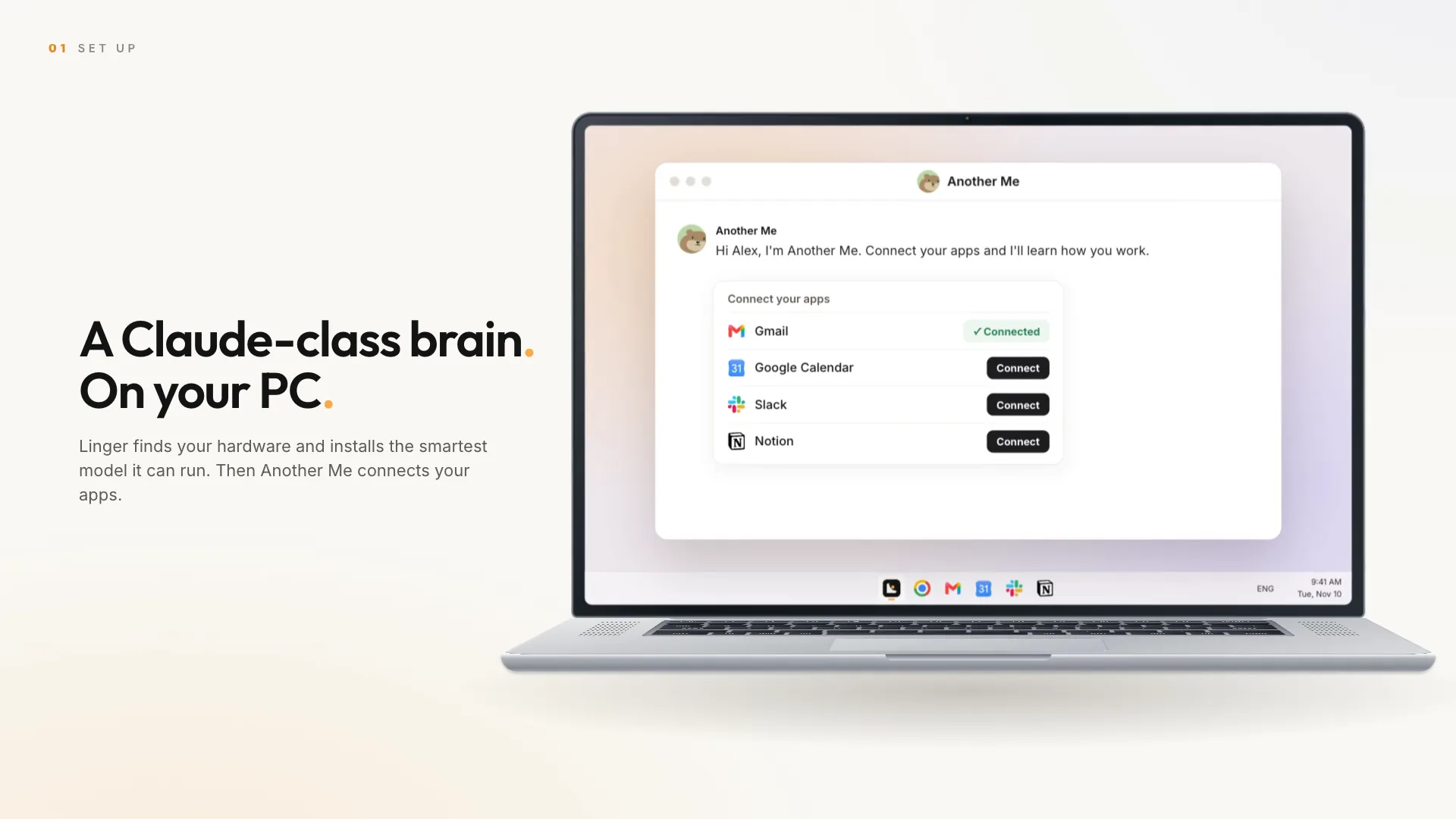
What Linger is, and who built it
Linger is a desktop app plus a local server that host a group of AI agents. Another Me is the one in the chat window. It watches inbox, calendar and Slack, files what it learns into a searchable wiki, and takes on work in the apps you already use. It is proactive: it follows up and messages you only when something needs you. A nightly process called Dreaming reads how you reacted and rewrites the rules it uses to decide when to speak. No retraining, just a short rule list.
The license names SIMPLEX AI TECHNOLOGIES PTE. LTD. as the producer, and the GitHub organization links to lev8.com, a go-to-market platform that lists the same legal entity. The Chinese AI tool directory ai-bot.cn reports that the founder is Zhang Bo, former head of DeepSeek-VL. The official site and repository do not name a founder, so treat that as a report, not a confirmed fact.
What separates it from a chat app
Local by default
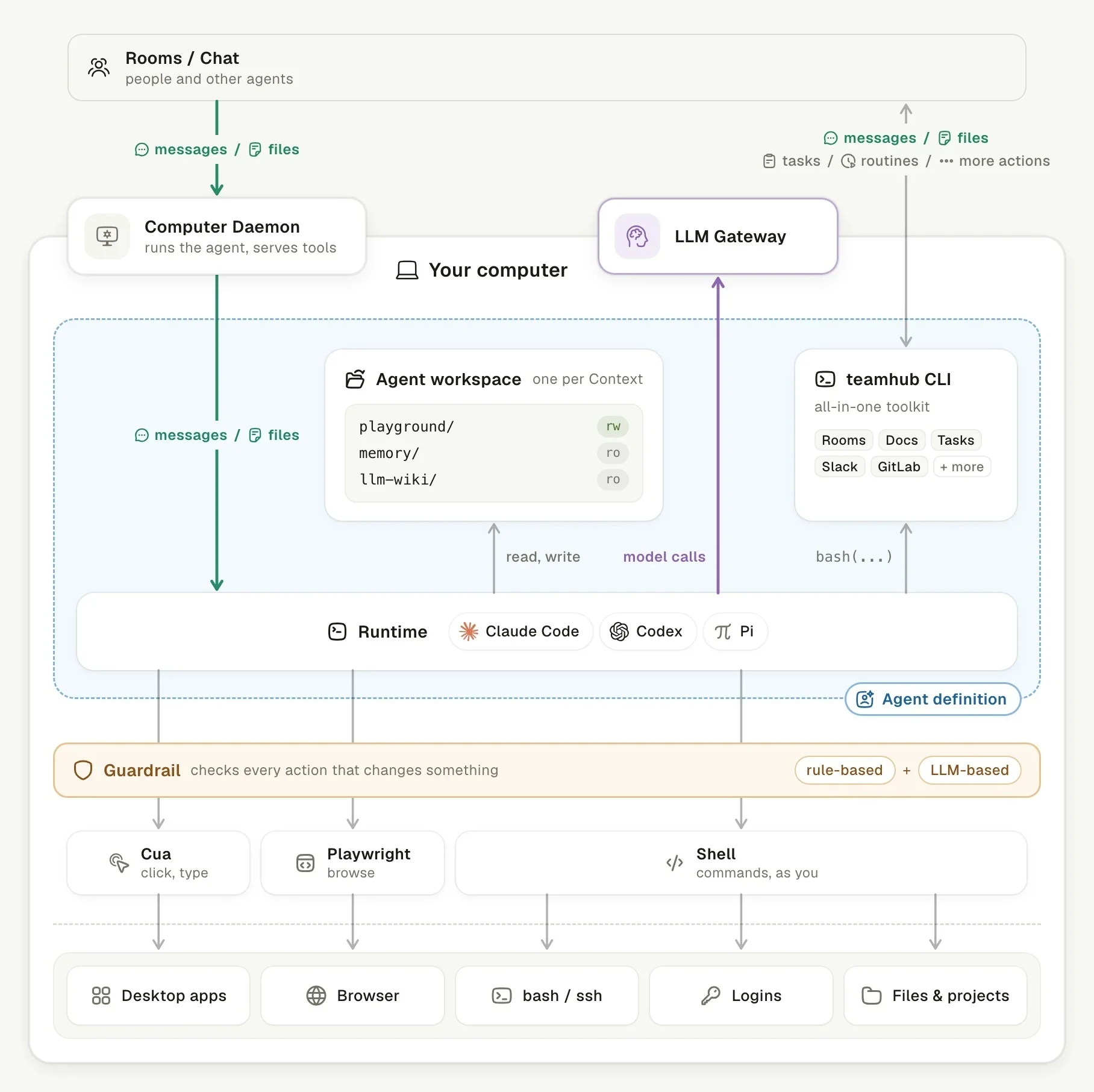
Rooms, documents and files live on the server you run. Agents execute on your computer, and model calls go straight to the model source, so a local model needs no API key or vendor account. Cloud models and connected apps are opt-in. The privacy page lists each exit: a remote model provider, Composio for apps such as Gmail and Slack, Soniox for speech, and xAI for live voice.
Open source, with conditions
The code is on GitHub under the Linger Open Source License, a modified Apache 2.0. Commercial use is allowed. You cannot resell it as a hosted service without permission, or remove the logo from the frontend.
Desktop control, with an approval step
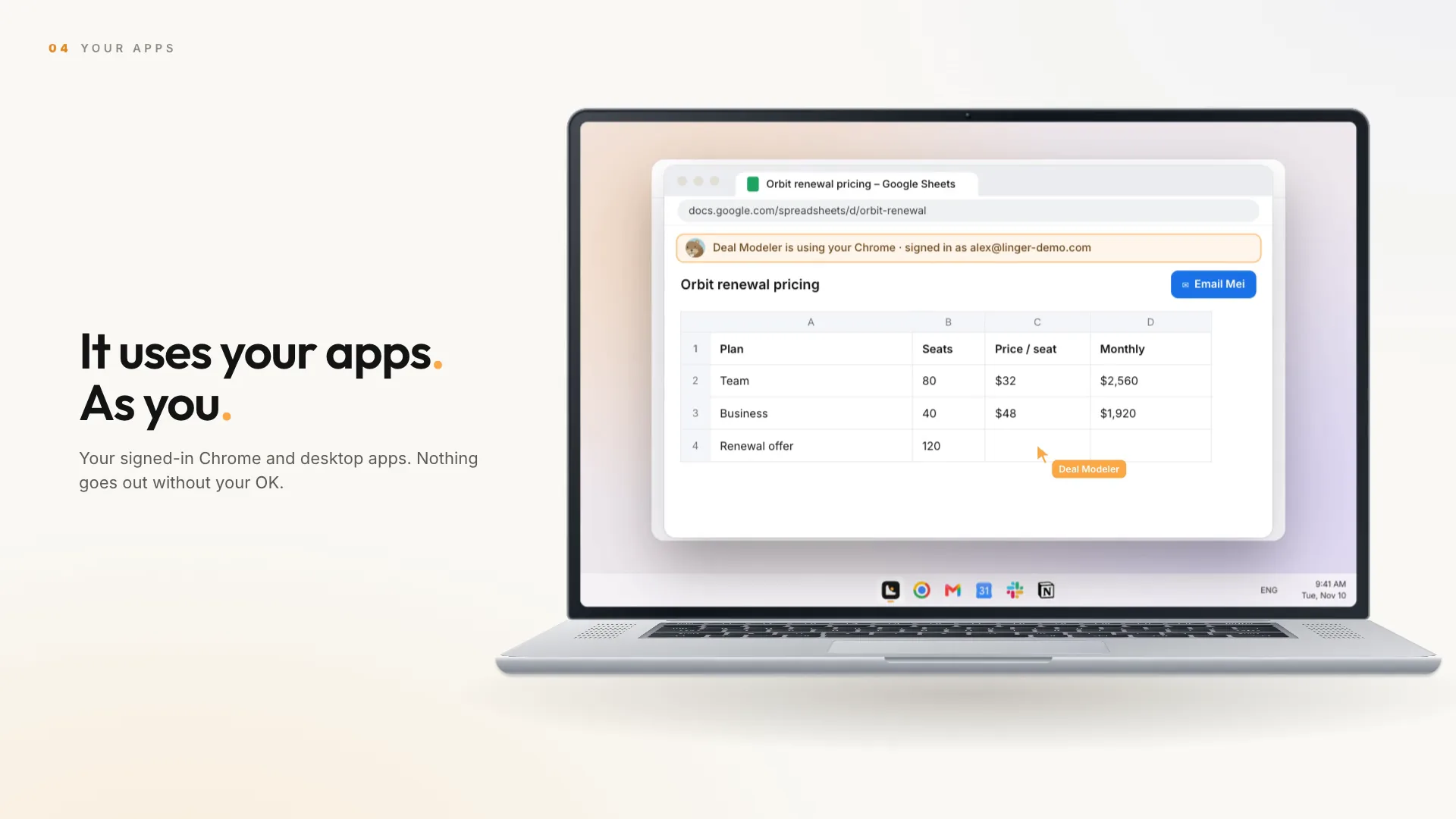
Agents click and type in desktop apps and your signed-in Chrome. Writes to external apps wait for approval. The docs call this a guardrail, not a sandbox: agents inherit your files, apps and shell, so only connect a machine you trust.
No token fees on local models
A local model carries no per-token charge. The cost is hardware and electricity. If you connect Claude, Codex or a remote API, that provider bills you as usual.
Hardware: what the demo does not show
The floor is an Apple silicon Mac with 16GB of unified memory, or an NVIDIA GPU with 8GB of VRAM and 32GB of system RAM. Linux needs glibc 2.35 or newer. There is no Intel Mac build, so those machines use Docker Compose.
The headline setup is Qwen3.8-Flash-Next, a 125B mixture-of-experts model, on a 12GB GPU with 64GB of RAM. PolyStrata keeps hot experts on the GPU and the rest in RAM or on SSD. The vendor measured 45.5 tokens per second on an RTX 3060 and 179 on an RTX 5090.
| Machine | Recommended model | Speed |
|---|---|---|
| Mac 16GB | Spark-X2.6-4B | ~41 tok/s |
| Mac 24GB | Inkling 2 Mini | 29.1 tok/s |
| Mac 32GB | Inkling 2 Mini | ~30 tok/s |
| Linux, 8GB NVIDIA + 32GB RAM | Inkling 2 Mini | ~50 tok/s |
| Linux, 12GB NVIDIA + 32GB RAM | Inkling 2 Mini | ~68 tok/s |
| Linux, 24GB NVIDIA + 64GB RAM | Qwen3.8-Flash-Next | 126.7 tok/s |
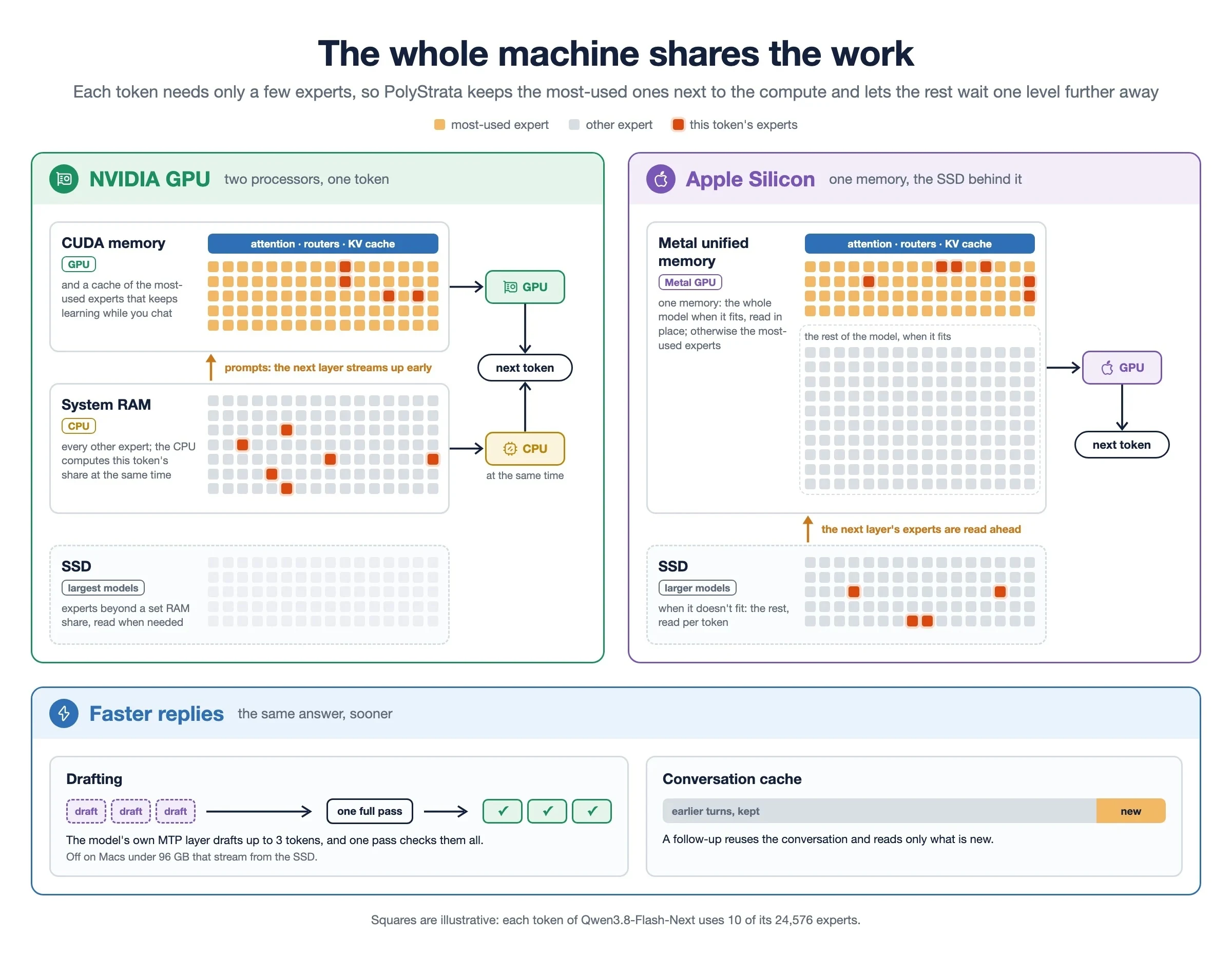
Local models are quantized, often 2-bit or 3-bit, and sit below frontier cloud models. Speed drops when experts come from RAM or SSD. Voice needs Soniox, live voice needs xAI, connected apps go through Composio. The desktop app is at 0.1.9; GitHub Releases has installers while the website has not posted them yet.
Three jobs it can take off your desk
Personal automation
Another Me sends a morning brief at 8:30 on weekdays, nudges you before meetings, drafts follow-ups and keeps a list of open items. It decides when a message is worth interrupting you, and learns from the times you say not now.
Local files and memory
It reads local files and turns mail, chats and meetings into wiki pages for clients, contacts, projects and preferences. The vendor reports 95% on the LoCoMo memory benchmark, ahead of Zep and Mem0. That is a vendor number, not an independent test.
Web and desktop operations
It can open a spreadsheet in your signed-in Chrome, fill cells, draft an email and stop for approval. It can drive desktop apps through Cua and run shell commands with your authority. When a job needs more agents, Another Me writes a shared team.md and hands long work to background tasks.
Linger vs GPTs and cloud agents
| Linger | GPTs | Cloud agents | |
|---|---|---|---|
| Where it runs | Your PC plus a local server | OpenAI cloud | Vendor cloud |
| Data path | Local by default; remote only when you choose | Prompts and files go to OpenAI | Prompts, files and browser sessions go to the vendor |
| Model cost | $0 per token on local models; hardware upfront | Subscription or usage fees | Credits or subscription |
| Desktop control | Signed-in Chrome and desktop apps, with approvals | Connected apps and browser tools | Varies; often a hosted browser |
| Memory | Local wiki and rule list | Per-GPT knowledge and chat memory | Vendor-managed |
| Setup | GPU or Apple silicon, installer, runtime | Account and a browser | Account and a browser |
| Openness | Code available and self-hostable | Closed | Closed |
A GPT is easier to start: no GPU, a browser, OpenAI's models. A cloud agent such as Manus can use stronger models and take long jobs off your hardware. Linger trades that convenience for control: the model, memory and files can stay on your machine, and local inference has no token meter.
It is not a frontier-model replacement. The company's own comparison puts a 24GB RTX machine at about Claude Opus 4.6 on its internal score, a vendor-defined number. If you need the best answer on a thin laptop, use the cloud. If you have private files and a capable GPU, the local agent has a clear advantage.
Why it took off
The repository was created on November 10, 2026. By November 26 it had about 4,700 stars, 442 forks, 1,065 commits and 24 open issues. Open-weight models have become good enough for everyday work, and MoE engines can now fit a 125B model into consumer memory. Linger packages that into an installer, a desktop app and a chat interface a non-researcher can use.
The 28-second product film makes the loop easy to follow: a laptop opens, a local model installs, Another Me connects the apps, an agent team finishes the job. The other reason is price. A proactive agent that checks your inbox all day is a bad fit for usage-based pricing; on a local GPU, another check costs almost nothing.
The hype has limits: the license adds conditions, the hardware floor is real, and 0.1.x software will have rough edges. The star count measures interest, not production readiness.
The verdict
Linger is worth a try if you have the hardware and care where your data goes. It is the most complete attempt so far to make a local agent feel like a desktop product. If you need frontier quality on an 8GB laptop, a cloud agent is still simpler. If you have a 12GB or 24GB GPU and private files, Linger offers something the cloud cannot: a local model that reads them without uploading them, and a token bill that stays at zero.