 dssub
By Cameron Voss · Reviewed November 25, 2026
DSSUB does not resell MAGI-2. If you are building a video pipeline that consumes reference images, the GPT Image 2.5 models on DSSUB cover the reference-frame side — details at the end of this article.
The leaderboard moved this week. MAGI-2, the new video generation model from Chinese startup Sand.ai, now sits first on Artificial Analysis' image-to-video ranking — above Seedance 2.5, the ByteDance model that has been everyone's measuring stick for most of the year. For a name that wasn't on anyone's bingo card in January, that's a loud way to arrive.
Treat the crown as a strong signal rather than a final verdict; leaderboards reward specific tastes, and image-to-video boards above all reward prompt fidelity and motion coherence. What makes MAGI-2 genuinely interesting isn't the ranking alone. It's the combination behind it: a price that undercuts the incumbent by roughly ten times, native 30-second generation, and a stated plan to open-source the weights. Any one of those would be a story. All three together is a different market.
The timing matters too. Video generation has spent 2026 consolidating around a handful of expensive flagships — Sora 2 and Veo 3.1 up top, with Kling and Seedance 2.5 close behind — and every one of them assumes video stays a premium output. MAGI-2 is the first serious contender built as if it won't.
What MAGI-2 actually costs
Sand.ai prices MAGI-2 at ¥0.5 per second of 1080p output. The company puts that at about a tenth of Seedance 2.5's rate, and the arithmetic holds up directionally even after you discount the marketing. At that price, a 30-second clip — the model's full native length — runs roughly ¥15, about two US dollars.
This is the part that changes behavior rather than headlines. Anyone who has budgeted video generation like a cloud-compute line item knows the drill: one careful prompt, one render, one wince at the bill. When a test render costs pocket change, you stop writing one prompt and start writing thirty. Iteration volume is where video quality actually comes from, and MAGI-2's pricing is built for volume.
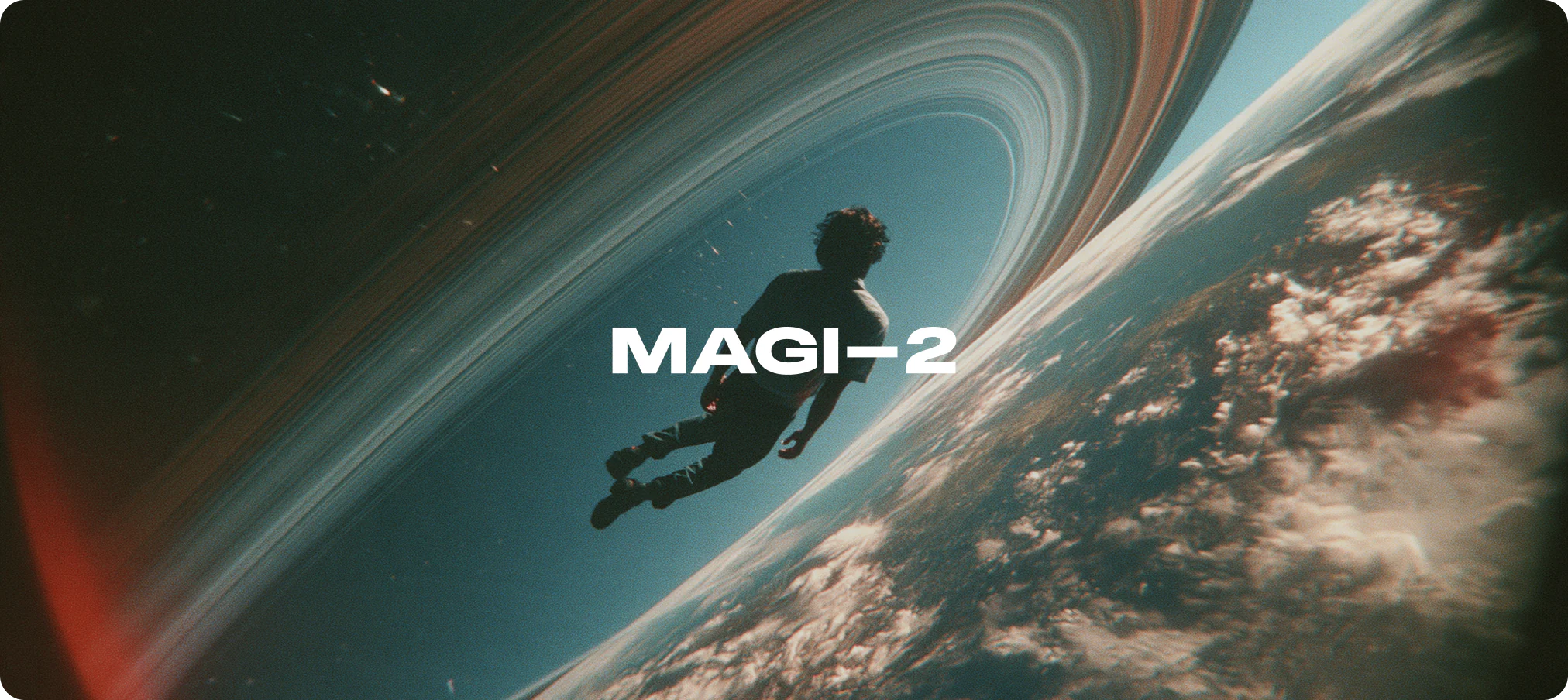
Thirty seconds, and twenty thousand characters to fill them
Two numbers define how much a MAGI-2 generation can hold. The first is 30 seconds of native video — not five-second clips stitched together after the fact, but one continuous render where camera, characters and pacing stay under the model's control the whole way. Continuity is where stitched pipelines fall apart, and it's the problem the longer window exists to solve.
The second is a 20,000-character prompt context. Sand.ai's framing is that you can hand MAGI-2 a complete script — scene order, dialogue, shot notes — instead of compressing an idea into a paragraph and hoping for the best. Whether the model uses all of that context well is something only sustained testing will show. But the input budget at least matches the output ambition, and that's rarer than it sounds.
What the footage looks like
Sand.ai's launch page leads with three clips, and they're worth watching before reading another benchmark number. All three are company-published demos, so judge them accordingly — but the craft on display is the pitch, and none of it is obvious from a leaderboard row.
Omni reference: 20 slots in one generation
The most distinctive MAGI-2 feature is what Sand.ai calls Omni reference. A single generation can take up to 10 images, 5 videos and 5 audio clips — 20 reference assets in total. The point of the pile is consistency: characters, wardrobes, logos, on-screen text. Anything you can supply as an asset is something MAGI-2 doesn't have to reinvent from scratch on every shot.
The company's demo reel leans on this hard. A single reference image drives a full stylization pass — one demo re-renders a scene in a Matisse-like palette, another borrows Magritte's deadpan surrealism — while the underlying motion stays intact. Impressive in the reel, sure. As always with company-cut demos, the honest test is what MAGI-2 does with your assets, not theirs.
Feeding a reference-driven pipeline?
MAGI-2 gives a generation 10 image slots, and whatever goes into them sets the ceiling on the render. DSSUB's gateway carries GPT Image 2.5 — draft fast with Flare, refine precisely with Sunburst — for producing exactly that kind of reference frame. Compare coverage account by account before you commit a workflow to any one platform.
Editing that keeps the camera roll
Generation is half the pitch. The other half is what MAGI-2 does to footage that already exists, and two editing demos deserve the attention they're getting.
Switch the language, keep the performance
Swap the language a character speaks and MAGI-2 re-voices the line with lip movement matched to the new audio, while the camera move and the acting stay untouched. Dubbing teams currently get paid real money to fake exactly this by hand.
A model that owns a stopwatch
The smaller demo is the more telling one: a countdown timer that blinks yellow at the three-second mark, green at five, blue at seven. One instruction, three timed events, all inside a single clip. That requires keeping a clock, not a vibe.
That second one sounds trivial and isn't. Most video models spread a prompt evenly across a clip like butter; temporal instruction following means MAGI-2 tracks events on a timeline and fires them on schedule. It's the difference between a video generator and a very expensive screen-saver.
Under the hood: one stream, 480 billion parameters, most of them asleep
Sand.ai puts MAGI-2 at 480 billion total parameters with roughly 28 billion active per generation, using a Multi-Head Latent Mixture-of-Experts design — a compression trick the LLM world (DeepSeek in particular) made fashionable, now pointed at video. The company reports the latent formulation adds about 22% training throughput over a standard MoE setup, and that the pretraining corpus tripled to 4 trillion tokens.
The deeper architectural bet is a single stream. Text, video and audio move through one shared pathway instead of parallel towers that exchange information late in the stack. The argument is that late fusion caps exactly the things video models get wrong: lip sync, sound-effect timing, the coupling between what you see and what you hear. A single stream is the straightforward fix, and MAGI-2's synchronized audio output is the early evidence it may be working.
One more claim carries weight beyond benchmarks: Sand.ai says MAGI-2 was adapted to train and run on domestic silicon, Hygon and Moore Threads included. Take the performance caveats as read. As a supply-chain statement, though, it says the model is built to survive export-control math — which is a different kind of durability than a leaderboard slot.
The open-weights promise
Then there's the sentence that traveled further than any benchmark: Sand.ai says it plans to release MAGI-2's weights. No date, no license terms, no word on which parameter tier ships. "Plans" is doing real work in that sentence.
Still, direction matters. If the release lands anywhere near the quality the leaderboard suggests, self-hosting a frontier-tier video model stops being a hypothetical. For studios and platforms currently renting generation by the second, that's the scenario worth planning for — and for the incumbents, the one worth dreading. Every open video model of the past two years moved prices; none so far arrived with MAGI-2's ranking attached.
From the community gallery
Sand.ai's showcase is already filling with community work, credited to the creators who prompted it. Six favorites, reproduced from the company's English launch site:





Demo clips and gallery images remain © Sand.ai; they are company-published showcase material reproduced here for commentary, with creator credits as published on Sand.ai's English launch site.
Watching the video-model market?
MAGI-2's leaderboard spot may reshuffle next month; the economics don't need the crown to matter. If your pipeline leans on reference images, the model page below lists what DSSUB carries today — model facts, point rates and coverage, confirmed account by account.
Availability is listed on the model page; verify both model IDs and rates in your account before you migrate.